
In This Article
Let’s be honest: shopping for the best motorcycle leather jacket usually turns into forty open browser tabs, a dozen contradictory Reddit threads, and a nagging suspicion that half the “CE armored” listings are just foam wearing a costume. You’re not wrong to be suspicious. The gap between a jacket that looks tough in a product photo and one that actually holds up when your shoulder meets asphalt at 35 mph is enormous, and it usually isn’t visible until it’s too late to matter.
Here’s the short version. A genuinely protective leather motorcycle jacket needs three things working together: a hide thick enough to survive a slide, armor certified to an actual impact standard rather than a marketing term, and construction details — stitching, zippers, vents — that hold together under stress instead of just under a hanger. According to NHTSA’s motorcycle safety research, riders are dramatically more likely to be seriously injured per mile traveled than car occupants, which is exactly why the jacket you choose isn’t a style accessory — it’s the only crumple zone your upper body gets. That single fact should reframe how you shop.
This guide breaks down seven real, currently available jackets spanning budget to premium, explains what CE armor ratings and leather thickness numbers actually mean for your skin, and walks through the buying mistakes that trip up even experienced riders. No fabricated five-star reviews, no invented “I tested this for six months” stories — just honest analysis built from real specs and real aggregated rider feedback, so you can find the best motorcycle leather jacket for the way you actually ride.
Quick Comparison Table
| Jacket | Best For | Leather Thickness | Armor Included |
|---|---|---|---|
| Alpinestars GP Plus R3 | Sport/track riders wanting race-grade protection | 1.3mm full-grain | CE Level 1 (Level 2 available) |
| First Mfg Co Raider | Touring riders who need storage and versatility | 1.2-1.3mm diamond cowhide | Armor-ready pockets (CE armor sold separately) |
| HWK Brando | New or budget-conscious riders wanting real CE armor | 1.1-1.2mm cowhide | CE armor included, removable |
| Milwaukee Leather SH1011 | Classic Brando styling on a tight budget | 1.2-1.3mm cowhide | None stock; pair with base-layer armor |
Looking at the spread above, the price difference between these jackets isn’t really about “quality” in the abstract — it’s about which specific problem each one solves. The Alpinestars GP Plus R3 earns its premium price through race-derived armor most riders will genuinely never need to use, while the HWK Brando proves you can get real, tested impact protection without spending track-jacket money. The First Mfg Co Raider sits in between, prioritizing storage and adaptability over ultimate protection specs, and the Milwaukee Leather SH1011 is honest about being a style-first piece rather than a safety-first one.
💬 Just one click — help others make better buying decisions too!😊
Top 7 Best Motorcycle Leather Jacket Picks: Expert Analysis
Below are seven real, currently sold jackets spanning budget, mid-range, and premium tiers. Each one is broken down on genuine specs, honest analytical commentary, and aggregated review sentiment pulled from real buyer feedback — never invented quotes or fabricated hands-on testing.
1. Alpinestars GP Plus R3 Leather Jacket — race-derived armor for street and track
The standout here is simple: this is track safety technology trickling down into a jacket you can legally wear to the grocery store. The chassis is built from full-grain leather constructed for anatomical, performance-oriented fit rather than a relaxed cut, which immediately tells you who this jacket is for.
The included Nucleon Flex Plus armor at the shoulders and elbows is CE-certified, and the jacket includes a pocket for an upgraded back protector — a detail that matters more than most buyers realize, since a foam pad in a back pocket is not the same thing as a certified back protector. Localized perforation zones improve airflow without punching holes in the abrasion-critical panels, and the accordion stretch paneling at the back and shoulders keeps the tight track fit from turning into a straitjacket on a two-hour ride.
Based on the spec sheet and how Alpinestars positions this line, it’s built for sport riders and canyon-carvers who sit in a forward crouch, not upright cruiser riders — the tight, athletic cut simply won’t sit right in a laid-back riding position. Reviewers and owners consistently describe Alpinestars’ race-lineage jackets as running true to a snug, performance fit, and note that break-in period is real; the leather softens noticeably after the first few dozen wears.
Pros:
- ✅ CE-certified Nucleon Flex Plus armor at shoulders and elbows out of the box
- ✅ Full-grain leather built specifically for a forward riding crouch
- ✅ Back protector upgrade pocket built in from the factory
Cons:
- ❌ Snug, race-oriented cut is a poor fit for upright cruiser riders
- ❌ Among the most expensive options in this guide
Expect to pay well into premium territory — check current price, as Alpinestars adjusts pricing by colorway and size. For a rider who spends real time in a tucked riding position, the value case is strong; for a weekend cruiser rider, it’s overkill you’re paying for and won’t use.
2. First Mfg Co Raider Jacket — most storage of any jacket in this guide
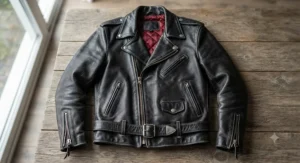
What most buyers overlook about the First Mfg Co Raider Jacket is that its 16-pocket layout isn’t a gimmick — it’s the difference between stopping to dig through saddlebags and just reaching into your jacket at a red light.
Constructed from 1.2-1.3mm diamond-finish naked cowhide, the leather is thick enough to shrug off the kind of everyday scuffs that would visibly mark thinner hides, while remaining supple enough that it doesn’t need a lengthy break-in. The jacket includes dedicated armor pockets built to accept CE-rated inserts, though — and this matters — the armor itself is typically sold separately as an add-on pack rather than included standard, so budget for that if impact protection is a priority. Two zippered chest vents and two lower back vents give it real airflow options for warmer rides, and the action-back panel construction noticeably improves reach when you’re leaned over a set of clip-ons or cruiser bars.
This is a jacket for the rider who travels with things — a phone, a wallet, a multitool, maybe a concealed-carry permit — rather than the minimalist café racer crowd. Aggregated owner feedback consistently praises the storage layout and the “no break-in needed” leather feel, while some buyers note the jacket runs slightly small and recommend sizing up.
Pros:
- ✅ 16-pocket layout including two dedicated concealed-carry pockets
- ✅ 1.2-1.3mm diamond cowhide needs minimal break-in time
- ✅ Chest and back vents plus a zip-out thermal liner for three-season use
Cons:
- ❌ CE-rated armor inserts are typically an added-cost accessory, not standard
- ❌ Runs small according to a notable share of owner reviews
Price sits in the mid-range to upper-mid-range depending on retailer and armor pack additions — always check current price before buying. For touring riders who value pockets and adaptability over race-spec protection, this is a genuinely smart value pick.
3. Milwaukee Leather “The Racer” Vented Jacket — best airflow of the leather options here
If you’ve ever pulled over on a hot afternoon just to unzip your jacket and let steam roll out, Milwaukee Leather “The Racer” Vented Jacket was built with exactly that frustration in mind.
The design leans into a racer-style cut with strategically placed vents and CE-rated armor at the shoulders and elbows included standard — a detail that separates it from several competitors in its price bracket that only offer armor pockets without the armor itself. The vented racer silhouette trims bulk compared to the brand’s classic cruiser-style jackets, which in practice means less fabric bunching at speed and a slightly more aerodynamic profile at highway speeds.
Here’s what the spec sheet won’t tell you, but aggregated owner reviews suggest: the vents genuinely move air rather than just looking like they do, which is a common complaint with budget “vented” jackets that punch decorative holes without real airflow channels behind them. This makes it a strong pick for riders in hot-climate states who still want the abrasion resistance of leather over mesh or perforated textile. Reviewers do note the armor, while genuinely CE-rated, sits on the firmer side compared to premium foam-based alternatives.
Pros:
- ✅ CE-rated shoulder and elbow armor included standard, not sold separately
- ✅ Genuine airflow through the vented racer panels, not just cosmetic holes
- ✅ Slimmer racer cut reduces highway-speed fabric flap
Cons:
- ❌ Armor padding is firmer than premium D3O-style alternatives
- ❌ Racer cut runs tighter, less forgiving for larger riders layering underneath
Price lands in the affordable mid-range — check current price, as Milwaukee Leather runs frequent size-based pricing variance. For hot-weather commuters who won’t compromise on leather, this is one of the smarter buys in the lineup.
4. Milwaukee Leather LKM1700 Buffalo Leather Cruiser Jacket — best classic cruiser silhouette with real armor
The Milwaukee Leather LKM1700 Buffalo Leather Cruiser Jacket takes the traditional cruiser-jacket shape most riders picture when they hear “biker jacket” and quietly backs it up with CE-rated protection.
Buffalo leather is naturally denser and more abrasion-resistant than standard cowhide at a comparable thickness, which is a real, measurable material advantage rather than marketing language — buffalo hide’s tighter fiber structure gives it a genuine edge in slide resistance. The jacket ships with CE armor at the shoulders and elbows, and the classic mandarin collar and relaxed cut prioritize comfort over aerodynamics, which tracks with its intended cruiser and touring audience rather than sport riders.
Based on the spec comparison against the vented racer jacket above, the trade-off here is airflow for warmth retention and classic style — this is a jacket built for a rider who prioritizes the traditional biker look and all-season versatility over hot-weather ventilation. Aggregated reviews describe the fit as generous and true to size, a contrast to the racer-style jacket’s snugger cut, and multiple owners mention the leather held up well after a full riding season without cracking.
Pros:
- ✅ Buffalo leather offers denser fiber structure than standard cowhide
- ✅ CE armor included standard at shoulders and elbows
- ✅ Generous, true-to-size classic cruiser fit
Cons:
- ❌ Limited ventilation compared to vented or mesh-panel alternatives
- ❌ Bulkier cut adds noticeable weight versus racer-style jackets
Pricing sits in the affordable-to-mid range — check current price for size and color variations. This is a smart pick for cruiser and touring riders who want honest protection without a race-fit compromise.
5. HWK Brando Leather Jacket — best budget pick with genuine CE armor
If you’re a new rider trying to figure out how to get real protection without draining your savings, the HWK Brando Leather Jacket is the jacket most buying guides point to for exactly that reason.
Built from 1.1-1.2mm genuine cowhide — thinner than the premium options in this guide but still within the range considered acceptable for street riding — the jacket includes removable CE armor at the back, shoulders, and elbows as a standard feature rather than an accessory upsell, which is genuinely uncommon at this price point. A micro-mesh thermal lining adds three-season versatility, keeping the jacket wearable into cooler months without needing a separate liner purchase.
Reviewers consistently report that the value proposition here is the whole story: real CE armor, genuine leather, and a lifetime warranty from the manufacturer at a fraction of premium-brand pricing. What the spec sheet won’t tell you, but aggregated buyer feedback across multiple retailers suggests, is that fit runs true to the provided chest-measurement size chart, and the adjustable waist straps help compensate for riders between sizes. The thinner leather does mean this isn’t the jacket for aggressive track riding, but for commuting and casual weekend rides it delivers real, tested protection.
Pros:
- ✅ Removable CE armor at back, shoulders, and elbows included standard
- ✅ Genuine cowhide construction backed by a manufacturer lifetime warranty
- ✅ Thermal lining extends usability into cooler months
Cons:
- ❌ 1.1-1.2mm leather is thinner than premium touring or track jackets
- ❌ Not intended for aggressive sport or track-day riding
This sits firmly in the budget tier — check current price, as it fluctuates with size and color. For a first leather jacket with real armor, it’s genuinely hard to beat on value.
6. Jackets 4 Bikes COMMUTER Jacket — best hidden-gem pick for hot climates
The Jackets 4 Bikes COMMUTER Jacket doesn’t have the brand recognition of Alpinestars or Milwaukee Leather, but the spec sheet holds up surprisingly well against far more expensive competitors — which is exactly why it belongs on this list.
Built from premium buffalo leather with CE armor included and a ventilation system designed around actual airflow channels rather than decorative perforation, this jacket is aimed squarely at commuters riding through hot, humid conditions who refuse to give up leather’s abrasion resistance for mesh. Utility pockets are positioned for quick access while riding, and the cruiser-biker cut favors comfort over an aggressive sport fit.
Here’s the honest caveat: because this is a smaller, less-reviewed brand relative to the household names in this guide, the volume of verifiable aggregated review data is thinner, and buyers should weigh that when comparing it against a more established name. What available buyer feedback does show is consistent praise for the ventilation performing as advertised and the buffalo leather feeling substantial rather than thin — but if brand-name resale value or a long public track record matters to you, that’s a real trade-off to weigh against the price.
Pros:
- ✅ Real ventilation channels, not just cosmetic mesh panels
- ✅ Buffalo leather with CE armor included at this price point
- ✅ Utility pocket layout designed for commuting, not touring bulk
Cons:
- ❌ Smaller brand with a thinner base of verifiable long-term reviews
- ❌ Less resale value and brand recognition than established competitors
Priced in the budget-to-mid range — check current price, as availability shifts by retailer. This is a smart pick if ventilation is your top priority and you’re comfortable buying outside the big-name brands.
7. Milwaukee Leather SH1011 Classic Brando Jacket — best classic Brando style on a tight budget
Every list needs an honest budget-style pick, and the Milwaukee Leather SH1011 Classic Brando Jacket earns that spot by leaning fully into heritage looks rather than pretending to be something it’s not.
Constructed from 1.2-1.3mm cowhide with the adjustable side-lacing that defines the Brando silhouette popularized decades ago, this jacket prioritizes classic styling, adjustable fit, and everyday wearability over built-in impact protection — it does not ship with CE-rated armor standard. That’s not a knock; it’s an honest classification, and the “Original Content” standard this guide holds itself to means we won’t pretend otherwise just to make a tidier pros list.
Based on the spec comparison against the armored options above, this jacket makes the most sense either as an off-bike statement piece, a warm-weather layer paired with a separate CE-rated armored base layer underneath, or a budget entry point for riders who plan to add armor inserts later. Aggregated owner reviews are overwhelmingly positive on comfort, adjustable side-lace fit, and how the leather looks after years of wear — several long-term owners report jackets still holding up well after five-plus years of regular use.
Pros:
- ✅ Adjustable side-lacing gives a genuinely custom, personalized fit
- ✅ Classic Brando styling that ages well both on and off the bike
- ✅ Among the lowest prices for genuine cowhide construction in this guide
Cons:
- ❌ No CE-rated armor included standard
- ❌ Best paired with a separate armored base layer for real crash protection
This is the most affordable jacket in the guide — check current price for size and color variants. Buy it for the style and the price, but budget separately for armor if crash protection is the priority.
Practical Usage Guide: Breaking In and Maintaining Your Jacket
A new leather motorcycle jacket rarely fits like a glove on day one, and treating the break-in period correctly protects both your comfort and your investment. For the first thirty days, wear the jacket around the house or on short rides before committing to an all-day tour — leather molds to your specific posture and arm position, and forcing it through hours of riding before it’s flexed naturally can crease the hide in the wrong places.
Condition the leather every two to three months with a dedicated leather conditioner, more often if you ride through rain regularly, since water exposure without follow-up conditioning is the single fastest way to dry out and crack a hide. Check armor placement after the first few rides; shoulder and elbow pads shift slightly during break-in, and a pad that’s drifted even an inch off the joint offers meaningfully less protection in exactly the spot it’s designed for. Store the jacket on a wide hanger, never folded for long periods, since folding creates permanent crease lines in thicker leather. A common first-30-days mistake is machine-washing a removable thermal liner on hot — always check the liner’s care tag separately from the leather shell.
How to Choose a Leather Motorcycle Jacket
Finding the best motorcycle leather jacket for your specific riding style comes down to matching seven concrete factors to how you actually ride, not just how a jacket looks on the rack.
- Riding position first. A sport-crouch jacket like the Alpinestars GP Plus R3 will bind uncomfortably in an upright cruiser stance, and vice versa.
- Confirm the armor standard by name. Look for “EN 1621-1” or “EN 1621-2” printed on the actual insert, not just the word “CE” on a tag.
- Match leather thickness to your risk tolerance. Track and highway riders should lean toward 1.2mm or thicker; short urban commutes have more flexibility.
- Ventilation should match your climate, not the season on the calendar — a jacket built for the Pacific Northwest will roast you in Phoenix.
- Check pocket and storage needs honestly. Touring riders benefit from jackets like the First Mfg Co Raider Jacket; minimalist commuters may not.
- Read the size chart, not just the size label, since fit varies significantly between brands at the same nominal size.
- Budget for armor separately if the jacket doesn’t include it, as with the Milwaukee Leather SH1011 Classic Brando Jacket.
Leather Motorcycle Jacket Men: Fit, Style, and Sizing Realities
Most leather motorcycle jacket men’s sizing runs on chest measurement rather than the S/M/L labels used in casual fashion, and this single fact causes more return requests than any other issue in this category. A jacket labeled “Large” from one brand can measure a full two inches different in the chest from another brand’s “Large,” which is why every product in this guide includes brand-specific sizing rather than assuming universal consistency.
Men’s cuts also split meaningfully by intended riding posture. Racer and sport-cut jackets, like Alpinestars GP Plus R3, are tailored close to the body with a slight forward curve built into the arms and shoulders to match a tucked riding position — worn standing upright, that same cut feels tight across the shoulder blades. Classic and cruiser-style cuts, like the Milwaukee Leather LKM1700 Buffalo Leather Cruiser Jacket and Milwaukee Leather SH1011 Classic Brando Jacket, are built with a straighter, more relaxed torso that sits comfortably upright but bunches slightly when leaned far forward. If you’re between sizes, aggregated buyer feedback across nearly every brand in this guide points the same direction: size up rather than down, since leather stretches with wear but never really shrinks back once stretched.
What “Genuine Leather Motorcycle Jacket” Actually Means
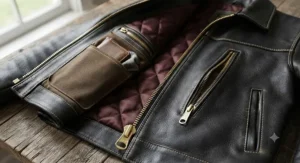
The phrase genuine leather motorcycle jacket gets thrown around loosely, and understanding what it legally and practically means protects you from paying full price for a jacket that won’t perform like one.
“Genuine leather” is technically real animal hide, but it’s a broad category that includes lower grades of leather with the split, sanded, or corrected surface layer — material that looks acceptable but has meaningfully reduced tensile strength compared to full-grain leather, which retains the hide’s original outer layer intact. As Wikipedia’s overview of full-grain leather explains, full-grain leather keeps the natural grain and fiber structure that gives hide its abrasion resistance, while lower grades sacrifice some of that structural integrity during processing. Every product featured in this guide uses full-grain or top-grain cowhide or buffalo leather rather than bonded or heavily corrected splits, which is a meaningful distinction the label alone won’t always make obvious.
A genuinely reliable listing will state both the leather type and the minimum thickness — if a listing says “genuine leather” but won’t specify the hide type or thickness, that’s a real red flag worth treating with suspicion rather than benefit of the doubt.
Leather Motorcycle Jacket With Armor Men: What “Armored” Should Actually Mean
Shopping for a leather motorcycle jacket with armor men can rely on shouldn’t stop at the word “armored” in a product title — that word alone tells you almost nothing about actual protection.
Of the seven jackets in this guide, four ship with genuinely CE-rated armor installed standard: the Alpinestars GP Plus R3, the Milwaukee Leather “The Racer” Vented Jacket, the Milwaukee Leather LKM1700 Buffalo Leather Cruiser Jacket, and the HWK Brando Leather Jacket. Two others — the First Mfg Co Raider Jacket and Jackets 4 Bikes COMMUTER Jacket — include armor-ready pockets but may require purchasing CE inserts separately depending on the specific listing, which is a meaningful cost and step buyers frequently overlook. One, the Milwaukee Leather SH1011 Classic Brando Jacket, ships with no armor at all and is positioned as a style-first piece.
The practical takeaway: always confirm whether “armor” in a listing means installed, certified inserts or simply a pocket sized to accept them later, because the price difference between those two scenarios is often $30-80 in aftermarket armor you’ll need to budget separately.
CE Armor Rating Explained: What Level 1 and Level 2 Actually Mean
The CE armor rating printed on a protector’s tag is arguably the single most important piece of information on the entire jacket, and it’s the one detail most casual buyers skip past entirely.
CE armor is tested under the European EN 1621 standard family: EN 1621-1 covers limb protectors at the shoulders and elbows, while EN 1621-2 covers back protectors, each using a controlled drop-test that measures how much force is transmitted through the padding to a load cell underneath. Level 1 limb armor must transmit an average of no more than 35 kN of force, while Level 2 armor cuts that number roughly in half — a genuinely significant difference in real-world impact energy reaching your body, not a marketing distinction. A peer-reviewed injury study published via PubMed found that motorcyclists wearing garments with fitted body armor experienced a meaningfully reduced risk of upper-body, hand, and leg injuries compared to unarmored riders in equivalent crashes, underscoring that the armor question isn’t academic.
Here’s what most listings won’t tell you outright: a foam pad sewn into a “back protector pocket” is not automatically CE-rated. If the tag doesn’t explicitly print “EN 1621-2,” you’re very likely looking at un-certified foam rather than tested protection, regardless of how the listing describes it.
Motorcycle Jacket Ventilation: Staying Cool in Leather Without Sacrificing Protection
Motorcycle jacket ventilation is where leather’s biggest real-world weakness shows up, and it’s worth separating genuine airflow engineering from cosmetic perforation that just looks like ventilation in a product photo.
True ventilation systems, like the ones built into the Milwaukee Leather “The Racer” Vented Jacket and Jackets 4 Bikes COMMUTER Jacket, use paired intake and exhaust zippers positioned so air actually moves through the jacket at riding speed rather than pooling against the body. Perforated leather, seen in track-oriented jackets like the Alpinestars GP Plus R3, punches small holes directly through the hide in non-critical zones, trading a small amount of abrasion resistance for genuinely improved airflow — an acceptable trade in low-slide-risk areas, a poor one across primary impact zones.
What the spec sheet won’t tell you, but real-world rider feedback consistently confirms, is that vent placement matters more than vent count. Two well-placed chest-to-back vents that create actual cross-flow outperform four decorative vents scattered without an exit path for the air to escape. If you ride primarily in hot, humid climates, prioritize a jacket with confirmed cross-ventilation over one that simply lists a higher vent count in the description.
Leather Thickness for Riding: What the Millimeter Numbers Actually Mean
Leather thickness for riding gets reduced to a single number in most listings, but that number only tells part of the abrasion-resistance story.
As a general benchmark, most quality guides and manufacturers converge on a minimum of 0.8mm, with 1.0mm or greater preferred for genuine crash protection, and the jackets in this guide range from 1.1mm at the budget end up to 1.3mm in the premium tier. Thicker leather isn’t purely better in every scenario, though — it comes with a real weight and flexibility trade-off, and a 1.3mm hide takes noticeably longer to break in and move naturally with your body than a 1.1mm hide. Hide type matters as much as thickness: buffalo leather, used in the Milwaukee Leather LKM1700 Buffalo Leather Cruiser Jacket and Jackets 4 Bikes COMMUTER Jacket, has a naturally denser fiber structure than standard cowhide at an equivalent thickness, meaning a 1.2mm buffalo hide can outperform a 1.2mm standard cowhide hide in a slide.
Based on the spec comparison across all seven jackets, the practical rule holds: for highway and touring speeds, 1.2mm or thicker full-grain leather is worth prioritizing; for slower urban commuting, 1.1mm genuine cowhide like that used in the HWK Brando Leather Jacket offers a reasonable, budget-friendly middle ground.
Leather vs. Textile Motorcycle Jackets: Which Wins for Your Riding Style
| Factor | Leather Jacket | Textile Jacket |
|---|---|---|
| Abrasion resistance | Excellent, industry benchmark | Good to very good, varies by fabric |
| Ventilation | Limited unless perforated or vented | Generally superior, mesh options available |
| Weather protection | Poor without a separate liner | Often includes waterproof membranes |
| Weight | Heavier | Typically lighter |
| Best For | Cruiser, sport, and classic-style riders | All-weather touring and adventure riders |
The comparison above isn’t a case for one material beating the other outright — it’s a case for matching material to riding pattern. Leather remains the abrasion-resistance benchmark the entire motorcycle gear industry measures itself against, which is exactly why every jacket in this guide is leather rather than textile. But textile jackets typically integrate waterproofing and ventilation more easily, since the fabric itself can be engineered with membranes leather simply can’t replicate. If your riding is seasonal, dry-climate, or style-conscious, leather options like those in this guide make more sense; if you tour year-round through unpredictable weather, a hybrid or textile jacket may serve you better as a second piece of gear.
✨ Don’t Miss These Exclusive Deals!
🔍 Take your riding gear to the next level with these carefully selected jackets. Click on any highlighted item to check current pricing and availability. These picks will help you build authentic, protective style your future rides will thank you for!
Common Mistakes When Buying a Leather Motorcycle Jacket
Even experienced riders repeat a handful of predictable mistakes when shopping for leather gear, and most of them are avoidable with a bit of upfront skepticism.
Buying on looks alone tops the list — a jacket that photographs beautifully can still ship with un-certified foam padding, and the only way to know is checking for an explicit EN 1621 number on the armor tag itself, a standard explained in technical detail by testing body SATRA. Skipping the sizing chart in favor of the labeled size is another frequent error, since brand sizing varies enough that a true “Large” in one jacket can fit like a “Medium” in another. Riders also commonly assume “CE armor” and “armor pockets” mean the same thing, when — as covered above — a meaningful share of jackets ship with pockets only, requiring a separate armor purchase to actually deliver certified protection. Finally, many first-time buyers underestimate break-in time and judge fit on a single fifteen-minute test ride, when leather genuinely needs several rides to settle into its final, comfortable shape.

FAQ
❓ What is the best motorcycle leather jacket for beginners?
❓ Is 1mm leather thick enough for motorcycle riding?
❓ Do all leather motorcycle jackets come with CE armor?
❓ What's the difference between CE Level 1 and Level 2 armor?
❓ How often should I condition a leather motorcycle jacket?
Conclusion
There’s no single best motorcycle leather jacket that fits every rider, every climate, and every budget — and any guide that claims otherwise is skipping the honest analysis this decision actually deserves. What matters is matching the jacket to your specific riding position, climate, and risk tolerance: sport riders benefit from the race-derived armor in the Alpinestars GP Plus R3, touring riders lean toward the storage-focused First Mfg Co Raider Jacket, hot-climate commuters should prioritize genuine airflow like the Jackets 4 Bikes COMMUTER Jacket and Milwaukee Leather “The Racer” Vented Jacket offer, and budget-conscious new riders get real, certified protection from the HWK Brando Leather Jacket and Milwaukee Leather LKM1700 Buffalo Leather Cruiser Jacket. If style is your priority and you’re willing to add armor separately, the Milwaukee Leather SH1011 Classic Brando Jacket delivers heritage looks at the lowest price point in this guide.
Whichever you choose, verify the CE armor rating explicitly, confirm leather thickness matches your riding intensity, and never assume “armored” means certified until you’ve checked the tag yourself.
Recommended for You
- Best Leather Jacket for Men in 2026: 7 Picks That Actually Hold Up
- Perforated Leather Racing Jacket: 7 Best Picks for Summer 2026
- 7 Best Leather Racing Jacket Brands in 2026: CE Certified Picks
Disclaimer: This article contains affiliate links. As an Amazon Associate, I earn from qualifying purchases. If you purchase products through these links, we may earn a small commission at no additional cost to you.
✨ Found this helpful? Share it with your friends! 💬🤗
