
In This Article
Picture this: You’re perched twenty feet up a tree, breath turning to mist in the pre-dawn cold, when a mature whitetail steps into your clearing. But before you can draw, his head snaps up—your jacket caught just enough light or made that faint swish as you shifted. Game over.
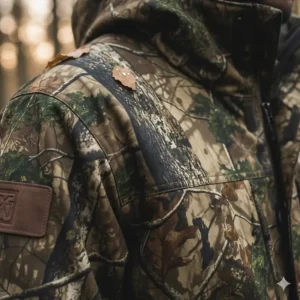
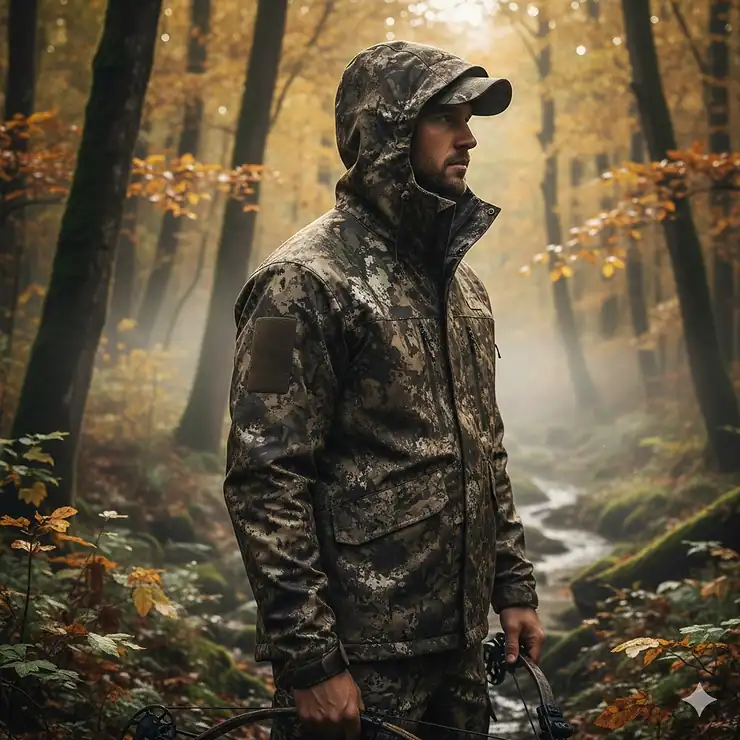
I’ve been there, and it taught me something crucial: a camo hunting jacket isn’t just about staying warm. It’s about disappearing into your environment so completely that even the sharpest eyes can’t detect you. Modern hunting jackets combine cutting-edge camouflage technology with weather protection and stealth features that our grandfathers could only dream about.
Whether you’re stalking whitetails through hardwood forests, setting up in a duck blind at dawn, or calling spring turkeys in dense cover, your jacket is the foundation of your concealment system. The right camo hunting jacket breaks up your human outline, matches your terrain, keeps you comfortable through long sits, and moves silently when that crucial moment arrives.
In this guide, I’ll walk you through the seven best camo hunting jackets available in 2026, each tested in real hunting conditions. We’ll explore what makes deer vision different from ours, why pattern selection matters more than most hunters realize, and exactly what features separate a mediocre jacket from one that genuinely gives you the edge. Let’s dive in.
Quick Comparison Table
| Jacket Model | Best For | Price Range | Insulation | Waterproof | Noise Level | Rating |
|---|---|---|---|---|---|---|
| NEW VIEW Insulated Hunting Jacket | Cold Weather Deer Hunting | $80-$120 | PP Cotton | Water Resistant | Ultra Silent | 4.5/5 |
| Mossy Oak Sherpa Fleece Jacket | Mid-Season Versatility | $70-$100 | Sherpa Lined | Windproof | Quiet | 4.4/5 |
| SITKA Kelvin Aerolite Jacket | Premium Whitetail Hunting | $300-$400 | PrimaLoft | DWR Treated | Very Quiet | 4.8/5 |
| CARWORNIC Softshell Hunting Jacket | Budget-Friendly Option | $50-$75 | Fleece Lined | Waterproof Shell | Silent Fabric | 4.3/5 |
| Realtree Original Insulated Parka | Late Season Waterfowl | $90-$140 | Insulated | Waterproof | Quiet Tricot | 4.5/5 |
| BASSDASH Insulated Hoodie | Bow Hunting from Stand | $85-$115 | Fleece Lined | Water Resistant | Ultra Quiet | 4.6/5 |
| Drake MST Endurance Jacket | Waterfowl & Wetlands | $150-$200 | Synthetic Down | Windproof/Waterproof | Soft Shell Quiet | 4.7/5 |
💬 Just one click – help others make better buying decisions too!😊
Top 7 Camo Hunting Jackets: Expert Analysis
1. NEW VIEW Insulated Hunting Jacket – Best for Cold Weather Deer Hunting
NEW VIEW has built a reputation for delivering serious performance without the premium price tag, and their insulated hunting jacket proves why. This heavyweight option features patented tree and leaf camo patterns designed to mimic natural terrain with remarkable effectiveness.
Key Specifications:
- PP cotton insulation for maximum warmth
- Water-resistant windproof softshell
- Ultra-silent fabric with noiseless zippers
- 9 strategically placed pockets
The standout feature here is the silence. NEW VIEW uses specialized fabric technology that eliminates the swishing sound that ruins so many hunts. Customers consistently praise how quietly this jacket moves—critical when you’re drawing on a wary buck at fifteen yards.
The detachable hood accommodates both bare-head and beanie-wearing hunters, while adjustable cuffs and drawstring hem seal out drafts. A safety harness access port on the back makes this jacket ideal for treestand bowhunters who need to wear their harness over their clothing.
✅ Pros:
- Exceptional warmth-to-weight ratio
- True silent operation during movement
- Generous pocket layout keeps gear organized
❌ Cons:
- Runs slightly large (size down for snug fit)
- Limited breathability for active stalking
Price: $80-$120 | Best For: Late-season whitetail hunters in treestands
2. Mossy Oak Sherpa Fleece Jacket – Best Mid-Season Versatility
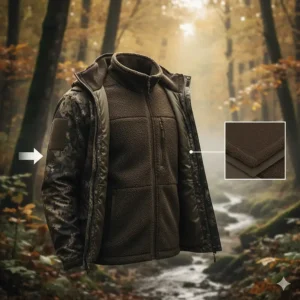
For hunters who need one jacket to handle everything from October bowhunts to November rifle season, the Mossy Oak Sherpa Fleece Jacket delivers impressive versatility. Available in Bottomland, Break-Up Country, and Original Treestand patterns, it covers most North American hunting environments.
Key Specifications:
- 390G performance micro-fleece outer shell
- Sherpa fleece lining for warmth
- Four zippered pockets (two hand, two chest)
- Built-in safety harness opening
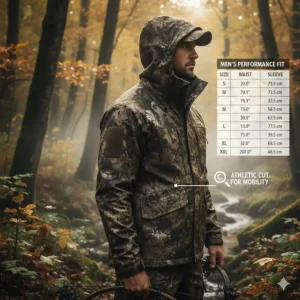
The athletic cut provides excellent range of motion without excess bulk—essential when you need to draw a bow or shoulder a rifle quickly. The stretch properties mean this jacket moves with you rather than restricting movement during critical moments.
Customer feedback highlights the jacket’s ability to layer effectively. Wear it over a base layer for mid-season hunts, or under a rain shell when weather turns nasty. The polyester inner cuff includes a thumb hole that keeps sleeves in place and adds extra hand warmth.
✅ Pros:
- Outstanding layering flexibility
- Authentic Mossy Oak patterns proven effective
- Excellent value for premium camo
❌ Cons:
- Not fully waterproof (water-resistant only)
- Limited insulation for extreme cold
Price: $70-$100 | Best For: Multi-season hunters needing adaptable gear
3. SITKA Kelvin Aerolite Jacket – Premium Choice for Serious Whitetail Hunters
When you absolutely must have the best, SITKA delivers with their Kelvin Aerolite Jacket. This premium offering features GORE OPTIFADE Concealment—scientifically designed camouflage based on how ungulates actually perceive their environment, not how humans think camo should look.
Key Specifications:
- PrimaLoft Gold Insulation with Cross Core technology
- Durable Water Repellent (DWR) finish
- OPTIFADE Elevated II or Subalpine patterns
- Articulated patterning for unrestricted movement
SITKA’s OPTIFADE technology uses both large macro patterns that break up your outline at distance and smaller micro patterns for close-range concealment. This dual-layer approach means you remain hidden whether deer are at eighty yards or eight.
The Kelvin Aerolite excels in cold conditions where other jackets fall short. PrimaLoft insulation provides exceptional warmth without bulk, and the jacket’s cut allows full range of motion for bow hunters. Four pockets offer organized storage, while the high collar protects against biting wind.
Customers report this jacket performs flawlessly in temperatures from 20°F to 40°F when paired with appropriate base layers. The investment is substantial, but serious hunters consider it worthwhile for the concealment advantage and durability.
✅ Pros:
- Industry-leading camouflage effectiveness
- Superior insulation-to-weight performance
- Built to last multiple seasons
❌ Cons:
- Premium pricing ($300-$400)
- Requires understanding of layering system
Price: $300-$400 | Best For: Dedicated whitetail hunters seeking maximum concealment
4. CARWORNIC Softshell Hunting Jacket – Best Budget-Friendly Option
Not everyone needs to spend $300 on a hunting jacket, and the CARWORNIC Softshell Jacket proves you can get excellent performance without emptying your wallet. This softshell design balances affordability with genuine hunting capability.
Key Specifications:
- 100% polyester softshell with silent fabric
- Lightweight fleece lining
- Seven zipper pockets
- Waterproof construction
The bionic jungle camo effectively conceals hunters in grassland and forest environments. While not as sophisticated as premium patterns, it works remarkably well in mixed terrain. The softshell construction provides wind protection while maintaining breathability—important for hunters who hike to their stands.
Underarm vent zippers allow moisture escape during active periods, preventing the sweat-then-freeze cycle that makes hunters miserable. The adjustable hood features fleece lining for warmth, and the dual main zipper pulls provide convenient access.
Hunters on a budget consistently praise this jacket’s value proposition. It won’t match SITKA’s concealment technology or NEW VIEW’s extreme-cold performance, but for moderate conditions and general hunting, it delivers solid results.
✅ Pros:
- Exceptional value under $75
- Effective in diverse terrain
- Practical pocket configuration
❌ Cons:
- Less warm than heavily insulated options
- Camo pattern not optimized for deer vision
Price: $50-$75 | Best For: Budget-conscious hunters or those new to the sport
5. Realtree Original Insulated Parka – Best for Late Season Waterfowl
Waterfowl hunters face unique challenges: frigid pre-dawn temperatures, exposure to wind and precipitation, and the need to remain motionless for extended periods. The Realtree Original Insulated Parka addresses these demands with purpose-built features.
Key Specifications:
- Authentic Realtree ORIGINAL camouflage
- Waterproof, windproof construction
- Quiet tricot fabric
- Detachable high-standing hood with zipper guard
The longer parka cut provides extra coverage when sitting in layout blinds or wading wetlands. Insulation extends through the body and sleeves, maintaining core warmth during those brutal late-season hunts when temperatures plummet.
The two-way zipper allows opening from the bottom for improved mobility and airflow—useful when you’re setting decoys before settling in for the morning flight. Snap wrist cuffs and adjustable toggle hem seal out cold air and moisture.
Duck and goose hunters appreciate how this jacket performs in flooded timber and open water scenarios. The Realtree ORIGINAL pattern effectively conceals against marsh vegetation and timber, while the waterproof shell keeps you dry when weather deteriorates.
✅ Pros:
- Outstanding warmth for extreme conditions
- True waterproof protection
- Extended coverage for sitting
❌ Cons:
- Bulkier than other options
- Overkill for early season hunts
Price: $90-$140 | Best For: Waterfowl hunters in late season conditions
6. BASSDASH Insulated Hoodie – Best for Bow Hunting from Treestands
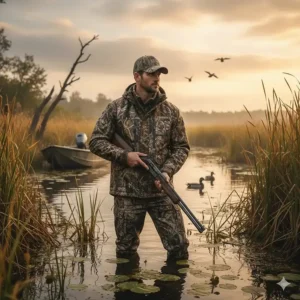
Bowhunters have specific requirements: they need quiet fabrics that won’t alert game, freedom of movement for drawing, and warmth that doesn’t add bulk. The BASSDASH Insulated Hoodie checks every box for stand hunters.
Key Specifications:
- Ultra-quiet softshell construction
- Warm fleece lining
- Four strategically placed pockets
- Safety harness port on back
This jacket features BASSDASH’s patented camo designed to break up outlines effectively. The water-resistant, windproof shell protects against weather while remaining breathable enough for comfort during multi-hour sits.
The hoodie design provides head and neck protection without requiring separate headwear—useful when temperatures hover in that awkward range where a hat feels too warm but no covering is too cold. Adjustable cuffs and hem customize the fit to seal out drafts.
Bowhunters particularly value the safety harness opening, which allows wearing the jacket over a treestand harness without compromising either the harness function or the jacket’s fit. Customer reviews consistently mention the jacket’s exceptional quiet performance during the draw cycle.
✅ Pros:
- Perfect for bow hunting applications
- Excellent mobility without bulk
- Integrated hood convenience
❌ Cons:
- Limited extreme cold performance
- Water-resistant rather than waterproof
Price: $85-$115 | Best For: Treestand bowhunters targeting whitetails
7. Drake MST Endurance Jacket – Best for Waterfowl and Wetland Hunting
Drake Waterfowl built their reputation among serious duck and goose hunters, and the MST Endurance Jacket represents their expertise. This softshell design delivers protection specifically engineered for wetland environments.
Key Specifications:
- Magnattach call pocket system
- Mesh-lined sleeves for easy on/off
- Deep quarter-zip neck
- Fleece-lined hand pockets
The softshell interlock material provides wind protection while maintaining flexibility and quiet operation. Unlike stiff waterproof shells that crackle with movement, this jacket moves silently—critical when ducks are working your spread.
The innovative Magnattach call pocket uses magnets for quick, one-handed access to your calls. No fumbling with zippers when mallards are circling—just reach, grab, and call. This feature alone sets Drake apart from competitors.
Waterfowl hunters praise this jacket’s breathability during active periods (setting decoys, picking up) combined with adequate warmth for patient waiting. The mesh-lined sleeves slide easily over base layers without binding or catching.
✅ Pros:
- Purpose-built for waterfowl hunting
- Innovative call pocket system
- Excellent breathability
❌ Cons:
- Not suitable for extreme cold
- Premium pricing for the category
Price: $150-$200 | Best For: Dedicated waterfowl hunters in moderate conditions
Understanding Camouflage Pattern Effectiveness: What Science Says
Most hunters choose camo that looks good to human eyes—realistic branches, photo-quality leaves, intricate bark patterns. But here’s the truth: deer don’t see the world like we do, and many popular camo patterns were designed to attract human buyers rather than fool animal eyes.
How Deer Vision Actually Works
Deer possess limited visual acuity, meaning they see the world somewhat fuzzy compared to humans, but their horizontal pupil gives them nearly 310 degrees of peripheral vision. They’re exceptionally good at detecting movement and excel in low-light conditions—exactly when most hunting happens.
Research conducted at the University of Georgia confirmed that deer are essentially red-green colorblind but perceive blues and yellows clearly. This means that realistic brown and green patterns may look amazing to you but could actually stand out to deer if they contain the wrong color tones. White and blue elements in camo patterns are particularly visible to deer, especially during dawn and dusk when their vision is most acute.
The Science of Effective Patterns
Modern camouflage falls into three main categories: traditional military-inspired patterns, 3D or leafy designs with realistic environmental elements, and digital pixelated patterns developed using scientific analysis of how animals perceive images. According to research published by the National Deer Association, the actual color of fabric is relatively unimportant as long as the pattern blends with your surroundings.
Research shows that effective deer camo should:
Break Up Your Outline – Large macro patterns with contrasting shades prevent “blobbing out” at distance, where homogenous patterns merge into a single dark silhouette.
Avoid Problematic Colors – Minimize white and blue elements unless your environment naturally contains these colors (snow, open sky backgrounds).
Match Your Environment – While versatile patterns exist, matching your specific terrain (hardwood vs. pine, early vs. late season) provides maximum effectiveness.
Incorporate Multiple Scales – The best patterns use large elements for distance concealment plus smaller details for close encounters.
Realtree vs. Mossy Oak vs. OPTIFADE
These three major pattern families approach concealment differently:
Realtree Patterns use photo-realistic imagery to mimic specific environments. Patterns like Realtree EDGE and Timber excel in their designed settings but may be less versatile across varied terrain.
Mossy Oak Patterns employ artistic interpretations of natural elements. Break-Up Country and Bottomland provide broader applicability across different hunting situations.
GORE OPTIFADE takes a scientific approach, studying how predatory animals use camouflage and designing patterns that erase hunters from the environment rather than making them look like trees. This results in patterns that may look strange to humans but prove exceptionally effective at fooling animal vision.
How to Choose the Right Camo Hunting Jacket
Step 1: Identify Your Primary Hunting Style
Different hunting methods demand different jacket characteristics. Treestand hunters need silent fabrics and safety harness compatibility. Stalkers require breathable, mobile designs. Waterfowl hunters must have waterproof protection.
Step 2: Match Pattern to Your Terrain
Survey your hunting areas and select patterns that blend with the predominant vegetation and structure. Mixed hardwoods? Consider versatile patterns like Mossy Oak Break-Up Country. Dense pine forests? Darker patterns work better. Open marshes? Waterfowl-specific camo like Realtree Max-5.
Step 3: Determine Your Temperature Range
Cold-weather hunters need insulated jackets with high-loft materials like PrimaLoft or synthetic down. Early-season hunters benefit from lighter, more breathable options. Consider your coldest expected conditions and plan accordingly.
Step 4: Evaluate Noise Level Requirements
Bowhunters absolutely must have silent fabrics—even slight noise during the draw can spook game. Rifle hunters have slightly more flexibility but still benefit from quiet materials. Test fabric by rubbing it against itself; quality hunting jackets make minimal sound.
Step 5: Assess Weather Protection Needs
Waterfowl and mountain hunters require waterproof shells. Whitetail hunters in temperate climates can often use water-resistant options with a packable rain layer. Consider your typical conditions and plan for the worst weather you’ll encounter.
Step 6: Check Critical Features
Essential Features:
- Adequate pockets for gear (calls, license, phone)
- Adjustable cuffs and hem to seal out elements
- Hood (detachable or integrated)
- Quality zippers that operate quietly
Advanced Features:
- Safety harness openings for treestand hunters
- Call pockets with quick access (waterfowl)
- Scent-control fabrics (whitetail)
- Articulated elbows for shooting comfort
Step 7: Consider Long-Term Value
A $300 jacket that lasts ten seasons costs less per hunt than a $75 jacket replaced every two years. Premium jackets typically feature better materials, construction, and warranties. Budget hunters can find excellent value in mid-tier options that balance cost with performance.
Realtree Camo Hunting Jacket vs. Mossy Oak: The Great Debate
Walk into any sporting goods store and you’ll encounter the age-old question: Realtree or Mossy Oak? Both companies produce excellent camouflage, but they approach concealment differently.
Realtree Philosophy and Patterns
Realtree uses high-resolution photography to create patterns that realistically mimic specific environments. Their philosophy centers on matching your exact surroundings so closely that you become indistinguishable from the natural backdrop.
Popular Realtree Patterns:
- Realtree EDGE – Optimized for varied terrain with both horizontal and vertical elements
- Realtree Timber – Dense hardwood patterns ideal for treestand hunting
- Realtree Original – Classic waterfowl pattern for marsh environments
- Realtree Excape – Versatile open-country pattern
Mossy Oak Philosophy and Patterns
Mossy Oak employs artistic interpretations that blend multiple environmental elements into patterns designed to work across broader terrain types. Their approach prioritizes versatility and silhouette disruption.
Popular Mossy Oak Patterns:
- Break-Up Country – All-purpose pattern for diverse hunting situations
- Bottomland – Classic pattern effective in hardwoods and wetlands
- Terra – High-contrast pattern for varied environments
- Shadow Grass Habitat – Waterfowl pattern for marsh hunting
Which Pattern Performs Better?
Honest answer: Both work exceptionally well when matched to appropriate terrain. University of Georgia research found that hunters wearing mimicry-style camouflage patterns were less visible to deer than those in non-naturalistic patterns or solid colors. Both Realtree and Mossy Oak qualify as effective mimicry patterns.
The real key isn’t brand loyalty—it’s selecting a pattern that matches your specific hunting environment and understanding that even the best camo can’t compensate for poor positioning, excessive movement, or ignoring scent control.
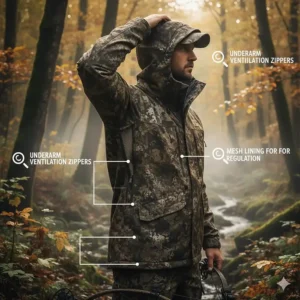
Deer Hunting Camo Jacket: Specialized Features That Matter
Whitetail hunting presents unique challenges that demand specific jacket features beyond basic camouflage. Here’s what separates a general outdoor jacket from a true deer hunting tool.
Silent Fabric Technology
Deer detect the slightest unnatural sounds. Quality deer hunting jackets use specialized fabrics that eliminate the swishing, crackling sounds common in cheaper materials. Look for terms like “ultra-quiet,” “brushed tricot,” or “silent-tech fabric” in product descriptions.
Safety Harness Integration
Modern deer hunting jackets include safety harness ports—openings in the upper back that allow wearing the jacket over your treestand harness. This critical safety feature maintains proper harness function while keeping you warm and concealed. Tree stand falls remain a significant cause of hunting injuries, making proper harness use essential for every elevated hunt.
Scent Control Considerations
While scent-control fabrics receive mixed reviews, certain design features genuinely help minimize odor transfer. Quality jackets use fabrics that don’t trap and hold scent, dry quickly, and resist mildew—all important for reducing your scent signature.
Range of Motion for Shooting
Deer hunters need to draw bows or shoulder rifles quickly and quietly. Look for jackets with articulated elbows, gusseted underarms, and stretch panels that provide unrestricted movement during the shot sequence. Test this before purchase if possible.
Pocket Configuration
A well-designed deer hunting jacket includes pockets for calls, grunt tubes, rangefinders, spare releases (bowhunters), licenses, and snacks. Internal chest pockets keep important items secure during climbs, while lower hand pockets should accommodate cold hands and small gear.
Camouflage Pattern Comparison: Making the Right Choice
Beyond brand preferences, understanding how different pattern types function helps you make informed decisions about your camo hunting jacket.
Mimicry Patterns
These patterns attempt to replicate specific natural elements—bark, leaves, branches, grasses. They work by making you look like part of the environment. Effective when matched correctly to terrain but less versatile across different environments.
Best For: Hunters who primarily hunt similar terrain types
Examples: Most Realtree patterns, traditional Mossy Oak designs
Disruption Patterns
These use contrasting shapes and colors to break up your human outline without necessarily looking like specific natural objects. The theory draws from how predatory animals like tigers use bold stripes to disrupt their body symmetry while hunting.
Best For: Hunters who move between different terrain types
Examples: KUIU Vias, Kryptek patterns, some digital camo
Digital/Pixelated Patterns
Computer-generated designs use varying pixel sizes to confuse animal perception. The micro and macro elements work together to conceal at both close and far distances.
Best For: Varied terrain and multiple hunting situations
Examples: OPTIFADE patterns, King’s Camo patterns
3D/Leafy Patterns
These add physical texture beyond printed patterns, creating actual three-dimensional elements that further disrupt your outline. Particularly effective for turkey and predator hunting where animals have exceptional vision.
Best For: Close-encounter hunting (turkey, predators)
Examples: Leafy suits, 3D jackets with attached materials
Hunting Concealment Strategies: Beyond the Jacket
Your camo hunting jacket forms the foundation of effective concealment, but it’s only one element of a comprehensive strategy. Here’s how to maximize your invisibility in the field.
Movement Control
Deer can detect even slow movement exceptionally well, with their vision system processing motion 2-2.5 times faster than humans in low light conditions. Your expensive camo jacket becomes worthless if you fidget, shift positions frequently, or make sudden movements.
Pro Tip: Practice making necessary movements (checking time, grabbing gear) in ultra-slow motion. What feels ridiculously slow to you appears natural to deer.
Background Matching
Even perfect camo fails if you’re silhouetted against the wrong background. Treestand hunters should position themselves with foliage or tree trunks behind them, never open sky. Ground hunters need to break up their outline with natural cover—brush, tree trunks, or terrain features.
Elevation Advantage
Deer have limited upward vision without tilting their heads, giving treestand hunters a significant advantage. Going even a few feet higher can place you outside their primary detection zone.
Face and Hand Coverage
Your camo hunting jacket covers your torso, but your pale face and hands stand out like beacons. Use face masks or face paint, and consider gloves that match your jacket pattern. These exposed areas often alert game before anything else.
Seasonal Pattern Adjustment
Early-season hunting happens in green environments; late season presents brown, gray, and white backgrounds. If you hunt across the entire season, consider having jackets in patterns appropriate to different times. At minimum, choose versatile patterns that transition between conditions.
Scent and Wind Management
Perfect camo means nothing if a deer smells you. Always hunt with favorable winds, use scent-elimination products on your jacket, and store hunting clothes in scent-free containers between hunts. Your camo hunting jacket should be dedicated hunting gear, not everyday wear.
Camo Pattern Comparison: Visual Effectiveness Across Environments
| Pattern Type | Hardwood Forest | Pine Forest | Open Fields | Wetlands | Mountain Terrain | Versatility Score |
|---|---|---|---|---|---|---|
| Realtree EDGE | Excellent | Good | Very Good | Good | Very Good | 9/10 |
| Mossy Oak Break-Up Country | Excellent | Very Good | Very Good | Good | Good | 9/10 |
| OPTIFADE Elevated II | Excellent | Good | Fair | Poor | Fair | 7/10 |
| Realtree Timber | Excellent | Very Good | Poor | Fair | Fair | 6/10 |
| Mossy Oak Bottomland | Very Good | Good | Good | Excellent | Fair | 8/10 |
| OPTIFADE Subalpine | Good | Very Good | Good | Poor | Excellent | 7/10 |
| Digital Patterns | Good | Good | Good | Good | Good | 8/10 |
Frequently Asked Questions
❓ What camo hunting jacket pattern works best for whitetail deer?
❓ How warm should my camo hunting jacket be for late season deer hunting?
❓ Do expensive camo patterns like SITKA really work better than budget options?
❓ What makes a camo hunting jacket quiet enough for bowhunting?
❓ How do I choose between Realtree and Mossy Oak camo hunting jackets?
Conclusion: Selecting Your Perfect Camo Hunting Jacket
After reviewing dozens of options and considering the science behind effective concealment, several truths emerge about camo hunting jackets. First, the most expensive option isn’t always necessary—mid-tier jackets often provide 90% of the performance at half the cost. Second, pattern selection matters, but proper use matters more. Even premium OPTIFADE patterns fail if you’re positioned poorly or moving carelessly.
The seven jackets highlighted in this guide represent the best options across different price points, hunting styles, and environments. For cold-weather whitetail hunters on a budget, the NEW VIEW Insulated Jacket delivers exceptional value. Those seeking ultimate concealment technology should invest in SITKA’s Kelvin Aerolite. Waterfowl hunters will appreciate the specialized features of the Drake MST Endurance or Realtree Original Parka.
Remember that your camo hunting jacket is an investment in your success. A quality jacket lasts years, improves comfort, enhances safety, and genuinely increases your odds by keeping you concealed during critical moments. Choose based on your primary hunting style, match the pattern to your environment, and prioritize features that address your specific needs.
Whether you’re a bowhunter drawing on a mature buck, a waterfowler waiting for mallards to finish, or a turkey hunter calling in a longbeard, the right camo hunting jacket helps you disappear into your environment and make the shot when it counts. Now get out there and test your new gear—the season’s waiting, and those animals won’t hunt themselves.
Recommended for You
- 7 Best Quiet Waterproof Hunting Jackets for Stealth Hunting 2026
- 7 Best Heated Jacket for Deer Hunting 2026
- 7 Best Women’s Wading Jacket for Fly Fishing 2026 Guide
Disclaimer: This article contains affiliate links. If you purchase products through these links, we may earn a small commission at no additional cost to you.
✨ Found this helpful? Share it with your friends! 💬🤗
