
In This Article
A police winter patrol jacket is a duty-rated cold-weather outer layer built to keep an officer warm and mobile through an entire shift outdoors — typically insulated or 3-in-1 in design, with badge tabs, mic loops, and room for a ballistic vest underneath. That’s the textbook definition. What it doesn’t tell you is how much a bad jacket choice costs you in February, standing on a traffic post at 2 a.m. with a wind chill that’s dropped into the teens.
Here’s the thing nobody says out loud at roll call: most departments issue a jacket, and most officers quietly buy a second, better one within their first winter. The standard-issue piece is rarely wrong, exactly — it’s just generic. It wasn’t picked for your specific post, your specific climate, or the fact that you sit in a cruiser for six hours and then stand in open wind for two. Police officers are explicitly named in OSHA’s cold stress guidance as a group required to work outdoors for extended periods in cold environments, and that reality doesn’t care what the department budget looked like this fiscal year.
This guide breaks down seven real, currently available options — from budget-friendly field jackets under $150 to premium duty parkas built specifically around sidearm access and badge visibility — along with the buying logic officers actually use: layering systems, badge tab placement, mobility over a vest, and what “waterproof” really means when you’re standing in sleet for an hour. Whether you’re chasing a police parka insulated for sub-zero patrol, a lighter police uniform jacket for shoulder-season shifts, or straight-up cold patrol protection for a northern beat, there’s a practical match below — plus the comparison data to back it up.
Quick Comparison Table
| Jacket | Style | Insulation Type | Best For |
|---|---|---|---|
| 5.11 Tactical Bristol Parka | 2-in-1 hardshell parka | Removable softshell liner | Coldest, wettest winter posts |
| Rothco N-3B Snorkel Parka | Classic snorkel parka | Poly-fiber fill + fur-trim hood | Static/stationary extreme cold duty |
| Tru-Spec 24-7 Series Softshell | Duty softshell | Brushed fleece interior | Milder winters, vehicle-heavy shifts |
| Rothco All Weather 3-in-1 Jacket | 3-in-1 modular jacket | Zip-out fleece liner | Officers who need year-round versatility |
| Condor Summit Softshell Jacket | Tactical softshell | 3-layer breathable membrane | Active patrol, bike/foot beats |
| Rothco Reversible Reflective Rain Parka | Hi-vis reversible parka | Uninsulated shell (layer separately) | Traffic control, roadside duty |
| Rothco Vintage M-65 Field Jacket | Classic field coat | Optional quilted liner (sold separately) | Budget-conscious, casual patrol |
A quick read on the table above: the Bristol Parka and the N-3B sit at the “extreme cold, minimal movement” end of the spectrum, while the Condor Summit and Tru-Spec softshells trade some raw warmth for the mobility officers need on foot or bike patrol. The Rothco reflective parka is the odd one out here — it’s not insulated at all, and that’s intentional, since traffic officers usually layer it over a softshell rather than relying on it alone. If your winters rarely dip below freezing, the M-65 with its optional liner is the most forgiving budget entry point on this list.
💬 Just one click — help others make better buying decisions too!😊
Top 7 Police Winter Patrol Jackets: Expert Analysis
1. 5.11 Tactical Bristol Parka — hidden badge tab and Quixip sidearm access
The Bristol Parka’s standout move is bundling weatherproofing and duty-specific hardware into one shell instead of making you choose. Right out of the gate, it’s built as a two-piece system: a hardshell nylon outer and a zip-in softshell liner that can be worn separately or together depending on the shift.
The outer shell carries a 10K/6K waterproof-breathable rating, which in practical terms means it’ll hold up through sustained rain or wet snow rather than just resisting a light drizzle — a meaningful jump over the 3K-5K ratings common on cheaper duty softshells. The Bristol Parka combines all-weather performance and tactical enhancements to provide a solution for winter patrol wear, with a removable, blood-borne pathogen-resistant inner lining that adapts to changing conditions. The Quixip system gives accelerated sidearm access, and the jacket includes a badge tab at the right chest along with hidden document pockets and an integrated key clip, so none of the tactical function is bolted on as an afterthought.
Based on the spec comparison against the rest of this list, this is the jacket for officers who spend real time standing static in bad weather — perimeter posts, funeral details, extended traffic stops in sleet. What most buyers overlook is that the two-piece design also means you get a lighter softshell jacket for free on milder days, rather than owning two separate garments.
Reviewers on retailer sites consistently note the badge tab and mic loop placement as genuinely useful rather than gimmicky, and several mention that sizing runs generous enough to layer a vest carrier comfortably underneath.
Pros:
- ✅ Badge tab and Quixip sidearm access built into the shell
- ✅ 10K/6K waterproof rating outperforms most duty softshells
- ✅ Two jackets in one — softshell liner works as standalone piece
Cons:
- ❌ Premium price puts it out of reach for self-purchase on a budget
- ❌ Bulkier fit than lightweight softshells when worn as full parka
At the time of research, the Bristol Parka sits in the $300-$400 range, and for officers who post up outdoors for hours at a stretch, the badge-tab-plus-Quixip combination alone justifies the premium over a generic softshell.
2. Rothco Black Ultra Force N-3B Snorkel Parka Jacket 9390 — deepest cold rating on this list
The standout here is old-fashioned brute-force warmth — this is the descendant of the military N-3B, built for genuinely brutal cold rather than brisk mornings.
The Rothco 9390 Ultra Force parka is water-repellent with a nylon shell and lining, a drawstring hood, four front pockets, heavyweight poly-fiber fill, and a synthetic coyote fur trim around the hood and sleeve pockets. In practice, that heavyweight fill is the difference-maker: this jacket is engineered for standing still in single-digit temperatures, not for brisk walking patrol where a lighter softshell would actually breathe better.
Here’s what the spec sheet won’t tell you, but the design implies: the snorkel hood — which zips up past the chin and projects forward — exists specifically to block wind on a stationary post, the same reason it was standard issue for Air Force flight-line crews. That’s a strong signal for officers assigned to fixed posts, checkpoints, or overnight perimeter duty in northern climates, and a weaker fit for anyone doing sustained walking or running.
Aggregated reviewer sentiment on this parka style consistently praises the warmth-to-price ratio and durability of the shell, while some buyers note the classic snorkel silhouette is bulkier and less tactical-looking than modern duty parkas — a fair trade-off some departments accept and others don’t for uniform-appearance reasons.
Pros:
- ✅ Heavyweight poly-fiber fill built for extreme, static cold
- ✅ Durable nylon shell with a proven military design pedigree
- ✅ Genuinely budget-friendly for the warmth delivered
Cons:
- ❌ Bulky fit restricts mobility compared to softshell designs
- ❌ No dedicated badge tab or duty-specific tactical features
Priced in the under-$100 range at the time of research, this is the cheapest true cold-weather parka on the list, and it earns its spot for officers whose winters actually demand it.
3. Tru-Spec 24-7 Series Tactical Softshell Jacket — lightest option built to layer over a vest
The standout feature is fit: this jacket is specifically cut to be worn over a ballistic vest or holstered firearm without straining the fabric, which sounds minor until you’ve tried to zip a jacket that wasn’t.
The 24-7 Soft Shell Jacket uses a 90% nylon/10% spandex blend engineered to stretch enough for a vest or holster underneath, with two vertical chest document pockets and two angled zippered waist pockets. That stretch-blend construction is the practical payoff here — cheaper polyester softshells don’t flex the same way, and officers who’ve fought a too-tight jacket over armor know exactly why that matters at 6 a.m. in a hurry.
Based on the spec comparison, this jacket trades outright warmth for mobility and layering flexibility, making it a smarter match for officers in moderate winter climates — the Mid-Atlantic, parts of the Midwest, the Pacific Northwest — rather than deep-freeze northern beats. What most buyers overlook is the shoulder loop patches, which make this one of the easier jackets to customize with department insignia without professional alteration.
Real customer review sentiment aggregated from retail listings frequently mentions the “lightweight but surprisingly wind-resistant” combination as the top selling point, alongside consistent praise for the brushed interior collar. A recurring complaint is that sizing runs slightly narrow in the shoulders for officers who layer heavily underneath.
Pros:
- ✅ Stretch fabric built specifically to layer over a vest
- ✅ Lightweight enough for all-shift wear without overheating
- ✅ Shoulder loop patches simplify department customization
Cons:
- ❌ Not warm enough alone for sustained sub-freezing exposure
- ❌ Narrower shoulder cut can feel tight over bulky base layers
At the time of research, this jacket runs in the $100-$150 range, positioning it as the practical mid-tier pick for officers who need duty-specific cut more than maximum insulation.
4. Rothco All Weather 3-in-1 Jacket — three jackets built into one system
The standout advantage is modularity — you’re effectively buying a shell, a liner, and a combined cold-weather coat in a single purchase, which is the single best value trick in this category.
The 3-in-1 design lets you wear the waterproof outer shell and removable fleece liner together for maximum protection, separately for milder conditions, or the liner alone for versatile seasonal wear, with a tough waterproof nylon shell that deflects wind, rain, and snow. The shell includes two zippered hand pockets, one zippered chest pocket, and an inner mesh pocket, while the removable fleece liner adds two zippered slash pockets and three inner mesh pockets on its own.
Here’s what most buyers overlook about this style of jacket: because the fleece liner works as a standalone piece, it effectively becomes a second, lighter jacket for early fall or late spring shifts — meaning the true cost-per-wear is lower than the sticker price suggests, since one purchase covers three seasons of use rather than one.
Reviewer sentiment aggregated from Amazon listings is largely positive on versatility and value, with recurring praise for the adjustable cuffs and stowaway hood; some buyers note the liner alone isn’t warm enough for genuinely cold conditions and is really meant as a mild-weather layer, not a standalone winter coat.
Pros:
- ✅ Three wearable configurations from one purchase
- ✅ Waterproof nylon shell handles wind, rain, and snow
- ✅ Strong value — effectively a three-season jacket system
Cons:
- ❌ No badge tab or duty-specific tactical hardware
- ❌ Fleece liner alone is too light for real cold snaps
This jacket sits in the affordable $60-$90 range at the time of research, making it one of the best value-per-dollar entries for officers who need year-round flexibility on a tight budget.
5. Condor Summit Softshell Jacket — best mobility for foot and bike patrol
The standout here is articulated, 4-way stretch construction designed around actual movement rather than static wear — this is the jacket built for officers who don’t sit still.
The Summit Softshell Jacket is designed with 4-way stretch for enhanced mobility, reinforced forearms and elbows for durability, and a three-layer integrated breathable shell that resists cold weather elements while wicking away moisture and maintaining body heat. A YKK zipper with dual sliders allows easy access to inner pockets and gear on a tactical belt, and a stow-away hood packs into a zip-close compartment when not needed.
On paper, this means the Summit trades some raw insulation for range of motion — a fair trade for bike patrol, foot beats in commercial districts, or any assignment where an officer is climbing in and out of a cruiser repeatedly. What the spec sheet doesn’t fully convey is how much the underarm venting matters in practice: officers on active patrol overheat fast in sealed softshells, and the vent zips let you dump heat without removing a layer mid-shift.
Aggregated customer sentiment describes the jacket as well-built and warm, with reviewers specifically praising the YKK zipper quality and overall value, though some buyers report complaints about the zipper feeling flimsy on certain units and mixed opinions on fit consistency across sizes.
Pros:
- ✅ 4-way stretch built specifically for active, mobile patrol
- ✅ Underarm venting prevents overheating during exertion
- ✅ Reinforced elbows and forearms add real-world durability
Cons:
- ❌ Mixed sizing feedback means ordering up may be necessary
- ❌ Less insulated than dedicated parka-style options on this list
Expect a price in the $90-$130 range at the time of research, with the fit caveat worth taking seriously — several reviewers recommend sizing up from your usual measurement.
6. Rothco Reversible Reflective Rain Parka — dedicated hi-vis traffic duty design
The standout feature is the reversible construction itself — one side is uniform-appropriate black, the other is fluorescent safety green, and you can flip between them in seconds without changing jackets.
This parka features a high-visibility design with a black 210-denier nylon shell that reverses to fluorescent green 210-denier polyester, with two-inch reflective striping around the chest, biceps, harness, and over the shoulder on the orange side, sealed seams, a storm/snap front, a YKK zipper, a pass-through pocket, and a badge tab.
Based on the spec comparison, this is a fundamentally different tool than the other six jackets here: it’s not insulated, and it’s not meant to be worn alone in serious cold. What most buyers overlook is that this design solves a very specific problem — traffic officers and crash-scene units need to switch instantly between low-profile duty appearance and maximum roadside visibility, and a reversible shell does that faster than swapping a separate hi-vis vest over a jacket.
Reviewer sentiment on this style consistently highlights the reflective striping’s visibility at night and the practicality of the badge tab and pass-through pocket for duty belt access; the recurring critique is the lack of any insulation, which means officers in true winter climates need to layer a fleece or softshell underneath rather than relying on this piece alone.
Pros:
- ✅ Reverses instantly between duty black and hi-vis green
- ✅ Badge tab and pass-through pocket built for duty belt access
- ✅ Reflective striping meaningfully improves roadside visibility
Cons:
- ❌ Not insulated — requires layering in genuine cold
- ❌ Bulkier than a standard rain shell due to reversible construction
At the time of research, this parka runs in the affordable $50-$80 range, and for traffic-focused roles, the reversible hi-vis function is hard to replicate any other way at this price.
7. Rothco Vintage M-65 Field Jacket — most budget-friendly entry point
The standout advantage is straightforward: this is the lowest-cost genuinely durable option on the list, and it does it by leaning on a proven 60-year-old design rather than cutting corners on materials.
The field jacket features button-down shoulder epaulettes for a classic vintage style, two hook-and-loop chest tabs for name tape, and a removable patch, and transitions through spring, summer, fall, and winter seasons. Separately, the coat’s removable quilted button-in liner provides essential warmth and insulation, and can be worn on its own as an all-season jacket, giving an additional outerwear option — though note this liner is typically sold separately from the shell itself, so budget for both if winter warmth is the goal.
Here’s what the spec sheet won’t tell you: the M-65’s four-pocket, bi-swing back design was built for infantry mobility, which happens to translate well to patrol work that involves getting in and out of vehicles all day. On paper this means you’re getting decades of proven ergonomics for a fraction of the cost of a purpose-built duty parka, provided you’re not expecting tactical extras like a badge tab or Quixip-style holster access.
Reviewer sentiment aggregated from retailer listings is strongly positive on build quality and pocket capacity relative to price, with recurring comments about the roomy cut accommodating layers comfortably; some buyers note the jacket runs slightly large and recommend checking the sizing chart carefully before ordering.
Pros:
- ✅ Lowest price point on this list for genuine durability
- ✅ Roomy 4-pocket design with proven bi-swing mobility
- ✅ Liner doubles as a standalone lightweight jacket
Cons:
- ❌ Insulated liner typically sold as a separate purchase
- ❌ No badge tab, mic loops, or duty-specific hardware
At the time of research, the shell alone runs under $100, with the optional liner adding roughly $30-$45 — still the most affordable path to a genuinely warm, durable winter jacket on this list.
Practical Usage Guide: Setting Up Your Insulated Duty Jacket for the Season
Buying the jacket is step one — most officers skip the setup work that actually makes it perform through a full winter. Start with fit testing over your actual gear, not a bare uniform shirt: put the jacket on over your vest carrier and duty belt before the first cold snap, not during it, so you catch sizing problems while exchanges are still easy. If the jacket has a badge tab or ID panel, mount your badge and any required patches before your first shift wearing it, not in the parking lot at 5:45 a.m.
For layering, follow the same three-layer logic laid out in OSHA’s winter weather preparedness guidance: dress properly by wearing at least three layers of loose-fitting clothing, insulated gloves and boots, and covering your head, since moisture and wind are what actually drive heat loss, not just raw air temperature. A moisture-wicking base layer under a mid-weight fleece, topped by your duty jacket’s shell, outperforms one thick layer every time — and it lets you shed a layer mid-shift if you’re moving instead of overheating and then getting chilled by sweat later.
Maintenance is where cheaper jackets lose their edge fastest. Reapply a DWR (durable water repellent) treatment to nylon and softshell exteriors every season — most duty jackets lose their factory water-resistance within 20-30 washes, and a $10 spray bottle of Nikwax or similar restores it in minutes. Check zipper pulls and badge tab hardware monthly during heavy winter use; YKK zippers are generally reliable but sand, salt, and grit from winter roads accelerate wear. Common first-30-days mistakes: washing an insulated parka in hot water (which breaks down synthetic fill), storing a wet jacket compressed in a locker (which mildews the liner), and skipping the seam-sealer check on waterproof shells before the first real storm hits.
Real-World Scenarios: Matching the Jacket to the Assignment
Officer A — rural highway patrol, northern climate, mostly stationary at traffic stops and crash scenes. Budget isn’t the constraint; survivability in sustained cold is. The Bristol Parka or the Rothco N-3B Snorkel Parka both make sense here — the Bristol for departments that value the badge tab and Quixip integration, the N-3B for maximum warmth at the lowest price if tactical extras aren’t a priority.
Officer B — urban foot and bike patrol, moderate climate, constantly moving. Overheating is the real enemy, not raw cold. The Condor Summit Softshell or the Tru-Spec 24-7 Series both prioritize mobility and breathability over maximum insulation, which matches the actual thermal load of an active shift better than a heavy parka would.
Officer C — new academy graduate, self-purchasing a personal jacket on a tight budget, general patrol in a moderate-winter state. The Rothco All Weather 3-in-1 or the Vintage M-65 Field Jacket both deliver real durability without the premium price tag, and the 3-in-1’s modularity means it covers more of the year on one purchase — useful when a rookie’s gear budget is already stretched thin on other essentials.
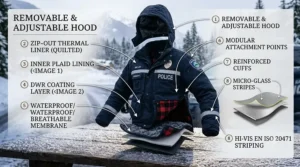
How to Choose a Police Winter Patrol Jacket
- Match insulation to your actual assignment type, not the coldest day of the year. A stationary post needs heavier fill; active patrol needs breathability more than raw warmth.
- Check for badge tab and ID panel placement before buying. Retrofitting a jacket that lacks one is awkward and can violate department uniform policy.
- Confirm it fits comfortably over your vest carrier and duty belt. Try it on with full gear, not just a base uniform, since fit problems only show up under load.
- Look at the waterproof rating, not just the word “waterproof.” A 10K rating meaningfully outperforms a 3K rating in sustained rain or wet snow.
- Consider a 3-in-1 or reversible design if your department covers multiple seasons or duty types. Modularity reduces the total number of jackets you need to own.
- Factor in mobility requirements for your specific beat. Foot and bike patrol officers should weight stretch fabric and venting more heavily than static-post officers.
- Verify department uniform policy on color, patches, and reflective striping before purchasing off-catalog. Even a great jacket is the wrong jacket if it doesn’t clear inspection.
Top 7 Products Comparison
| Jacket | Price Range | Waterproof Rating | Best For |
|---|---|---|---|
| 5.11 Tactical Bristol Parka | $300-$400 | 10K/6K | Extreme cold, static posts |
| Rothco N-3B Snorkel Parka | Under $100 | Water-repellent | Deep cold, fixed duty |
| Tru-Spec 24-7 Series Softshell | $100-$150 | DWR water-resistant | Vest-heavy, moderate climate |
| Rothco All Weather 3-in-1 | $60-$90 | Waterproof shell | Year-round value |
| Condor Summit Softshell | $90-$130 | 3-layer breathable | Foot/bike patrol |
| Rothco Reflective Rain Parka | $50-$80 | Sealed seams | Traffic/hi-vis duty |
| Rothco Vintage M-65 Field Jacket | Under $100 (+liner) | Water-repellent | Budget-conscious patrol |
Looking at the table above, the split between the Bristol Parka’s premium duty-specific hardware and the M-65’s budget-first simplicity really defines the two ends of this category. If your department reimburses gear purchases, the Bristol’s badge tab and Quixip system are worth the jump; if you’re self-funding, the 3-in-1 or the M-65 deliver most of the practical warmth for a fraction of the cost.
Police Parka Insulated vs. Softshell Duty Jacket: Which Wins in the Field?
This comparison comes up in nearly every department gear discussion, and the honest answer is that neither wins outright — they solve different thermal problems. An insulated parka like the N-3B or the Bristol traps dead air with fill or fleece, which is efficient when you’re not generating much body heat — standing at a post, directing traffic, sitting through a stakeout. That same insulation becomes a liability the moment you’re moving hard, because trapped heat has nowhere to go and you start sweating inside a “warm” jacket, which then chills you faster once you stop.
A softshell like the Condor Summit or Tru-Spec 24-7 works the opposite way: it blocks wind and sheds light precipitation while letting body heat vent through breathable membrane layers, which is exactly what an officer moving continuously on foot or bike patrol needs. The tradeoff is that in genuinely cold, static conditions, a softshell alone often isn’t warm enough without an added base or mid-layer.
The practical answer most veteran officers land on: match the shell to your actual movement pattern on a typical shift, not to the coldest possible temperature on the forecast. If your assignment mixes both — patrol car time and standing scene work — the 3-in-1 modular design or a parka-with-removable-liner setup like the Bristol gives you both options without buying two separate jackets.
Common Mistakes When Buying a Police Uniform Jacket
The single most common mistake is buying for the coldest day of the year instead of the average shift, which usually means overspending on insulation you’ll only need a handful of times and sweating through the rest of the season. A close second is skipping the fit-over-vest test — a jacket that looks right on a hanger can bind badly across the shoulders and chest once a ballistic vest carrier and duty belt are added.
Officers also frequently underestimate how much a badge tab’s exact placement matters for department compliance; some agencies require the tab on a specific side or at a specific height, and that’s not always obvious from a product photo. Another recurring issue is ignoring care instructions on technical fabrics — machine-drying a DWR-treated softshell on high heat can permanently degrade the water-resistant coating faster than years of normal wear would. Finally, buying based on brand reputation alone rather than checking the specific model’s insulation type has burned more than a few officers who assumed “tactical” automatically meant “warm enough,” when the two aren’t the same thing.
Long-Term Cost & Maintenance
A $350 duty parka and a $70 field jacket aren’t really competing on the same axis once you factor in cost-per-wear across a multi-year career. The Bristol Parka’s higher upfront price starts to make more sense when you consider its 10K waterproof rating and reinforced construction are built to survive years of daily wear and seasonal washing, while a budget shell may need replacing every one to two winters under the same conditions — meaning the “expensive” option can actually land close in total cost of ownership over a five-year window.
That said, the math doesn’t always favor premium gear. The Rothco All Weather 3-in-1’s modular design effectively replaces two or three separate jackets across the year, which is a legitimate value play regardless of your budget tier. Maintenance costs matter too: reproofing a DWR shell annually runs about $10-$15 in spray treatment, a trivial cost against the alternative of premature water-resistance failure and a full jacket replacement. Officers who self-purchase gear should also check whether their department offers a uniform allowance or reimbursement — many do specifically for cold-weather outerwear, which changes the calculus on whether the premium tier is worth it.
Safety, Regulations & Compliance Guide for Winter Law Enforcement Outerwear
Cold isn’t a minor inconvenience on patrol — it’s a documented occupational hazard. Outdoor workers exposed to cold and windy conditions are at risk of cold stress, and both air temperature and wind speed affect how cold conditions actually feel on exposed skin. Checking the National Weather Service’s wind chill chart before a shift is a quick habit that tells you far more about real exposure risk than the raw thermometer reading alone, since a 20°F day with 25 mph wind produces genuinely dangerous wind chill values.
While OSHA doesn’t specifically require employers to provide winter coats, jackets, or other clothing used solely for weather protection under 29 CFR 1910.132(h)(4), many employers provide winter weather gear voluntarily — which is exactly why department uniform allowances for cold-weather outerwear vary so widely and why officers often end up self-purchasing supplemental gear like the jackets covered in this guide. Departments should still train officers on recognizing cold stress symptoms — numbness, uncontrollable shivering, slurred speech — regardless of what jacket policy is in place, since even good gear doesn’t eliminate the underlying hazard on extended outdoor shifts.
On the compliance side, most agencies specify jacket color, patch placement, and reflective striping requirements in their uniform policy manual, and self-purchased jackets — even from this list — should be checked against that policy before showing up to roll call in something new. High-visibility requirements for traffic and crash-scene duty are a common friction point, which is exactly the gap a reversible design like the Rothco reflective parka is built to close.
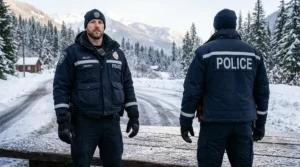
Features That Actually Matter (And Those That Don’t)
Waterproof rating actually matters — the difference between a 3K and 10K rating is the difference between “resists drizzle” and “survives an hour standing in sleet.” Badge tab and ID panel placement actually matters, both for department compliance and for not fumbling with pins in the cold. Stretch fabric for vest compatibility actually matters more than most first-time buyers expect, since a jacket that binds across the shoulders gets left in the trunk regardless of how warm it is.
What matters less than the marketing suggests: exact denier count on the shell fabric, once you’re above roughly 200D — the difference between 210D and 500D nylon is marginal for most patrol use unless you’re doing genuinely abrasive work. Camo or tactical-pattern branding also matters less than it seems for a role that’s fundamentally a duty uniform piece, not field combat gear. And “military-grade” as a marketing phrase is largely meaningless on its own — the Bureau of Labor Statistics notes that police work is physically demanding and often dangerous, with officers regularly exposed to the elements much like other outdoor-focused careers, but that doesn’t mean every jacket with a tactical aesthetic is actually built to a higher spec than a well-made civilian outdoor shell.
Frequently Asked Questions
❓ What makes a jacket 'duty-ready' for police winter patrol?
❓ Is a police parka insulated better than a softshell for cold weather?
❓ How much does a police jacket with badge cost?
❓ Can officers wear tactical jackets over a ballistic vest?
❓ What's the warmest winter law enforcement jacket for extreme cold?
Conclusion
There’s no single “best” police winter patrol jacket, and honestly, any guide claiming otherwise is skipping the part where your actual assignment matters more than the spec sheet. A traffic officer standing in sleet needs something fundamentally different from a bike-patrol officer working a downtown beat, and both need something different from a rookie buying their first personal jacket on a tight budget.
What the seven options above share is that they’re all real, verifiable products built specifically — or adapted specifically — for duty use, not generic winter coats with a tactical label slapped on. Start with your actual shift pattern: static or active, wet climate or dry, badge-tab-required or not. That single question narrows seven options down to two or three fast, and from there it’s mostly a budget call.
Cold-weather gear is one of the few uniform purchases where spending a little more upfront genuinely pays off in fewer sick days and fewer miserable shifts — but it only pays off if you buy the jacket that matches your actual post, not the one that looks the most tactical in the catalog photo.
Recommended for You
- Police soft shell jacket: 7 Top 2026 Picks Officers Actually Trust
- 7 Best Waterproof Police Duty Jackets for 2026
- 7 Best Embroidered Security Guard Jackets for Duty in 2026
Disclaimer: This article contains affiliate links. As an Amazon Associate, I earn from qualifying purchases. If you purchase products through these links, we may earn a small commission at no additional cost to you.
✨ Found this helpful? Share it with your friends! 💬🤗
