

In This Article
Here’s the uncomfortable truth nobody tells you before your first track day: the jacket that looked perfect on the hanger can turn into a straitjacket the second you drop into a race tuck. A racing jacket sizing guide exists precisely because racing leathers aren’t cut like your favorite hoodie — they’re built to fit an aggressive, forward-leaning riding position, not a standing human being browsing a rack. Get the size wrong and you’ll spend your first session fighting your own gear instead of the corner ahead of you.

So what is a racing jacket sizing guide, exactly? It’s a measurement-and-fit framework — chest, sleeve, torso length, and posture — used to match a rider’s body to a race-cut jacket so armor stays positioned correctly during a slide and the jacket doesn’t bunch, gap, or restrict the tuck. Unlike casual jacket sizing, it accounts for the fact that you’ll be leaned forward, elbows bent, for the majority of the time you’re wearing it. That single detail changes everything about how these garments should fit.
This guide walks through real measurement technique, seven genuinely good racing jackets spanning budget to flagship pricing, and the honest analysis you need to avoid buying twice. According to the National Highway Traffic Safety Administration, motorcyclists remain dramatically overrepresented in fatal crashes relative to car occupants — which is exactly why a jacket that actually fits, and keeps its armor where it belongs, isn’t a fashion decision. It’s the difference between a jacket doing its job and one that quietly fails you at the worst possible moment.
Quick Comparison Table
| Jacket | CE Class | Price Range | Best For |
|---|---|---|---|
| Cortech Latigo 2.0 | Level 1 armor | $250-$320 | First-time track day riders on a budget |
| Icon Overlord 3 | Level 1, D3O armor | $430-$520 | Street riders dabbling in occasional track days |
| Alpinestars GP Plus R V4 Airflow | Level 2-ready | $550-$700 | Mid-range riders wanting race-grade fit without race-suit pricing |
| Spidi Track Warrior | prEN 17092 Class A | $500-$650 | Riders who want race-style protection minus a full leather suit |
| REV’IT Quantum 2 Pro Air | AAA-certified | $650-$800 | Hot-climate track riders who refuse to compromise on ventilation |
| Dainese Racing 5 Perforated | EN 17092 Class AA | $700-$900 | All-around sport riders wanting airbag compatibility |
| Alpinestars Missile V2 Ignition | CE Category II, AAA | $1,150-$1,350 | Serious track riders running Tech-Air 5 |
Looking at the spread above, there’s a real jump in capability between the sub-$500 tier and anything wearing a genuine race cut — that’s where pre-curved sleeves, accordion stretch panels, and airbag compatibility start showing up. The Cortech Latigo 2.0 and Icon Overlord 3 are honest street-leaning jackets that can survive a track day, while the Alpinestars Missile V2 Ignition and Dainese Racing 5 Perforated are built from the ground up for repeated high-lean-angle abuse. Your riding frequency, not just your budget, should decide where you land on this table.
💬 Just one click — help others make better buying decisions too!😊
Top 7 Racing Jackets: Expert Analysis
1. Cortech Latigo 2.0 Leather Jacket — budget-friendly CE armor entry point
The Cortech Latigo 2.0 opens the field as the jacket most new track day riders actually buy first, and there’s a good reason for that. Constructed from 1.2-1.4mm cowhide with a mix of perforated and solid panels, it delivers CE-approved shoulder, elbow, and back armor at a price that doesn’t require a second mortgage.
What most buyers overlook about this model is that the Stretch-Tex side and shoulder panels do real work here — they’re what keeps the jacket from feeling like a barrel around your torso when you’re tucked in. Based on the spec comparison against pricier options, the Cortech Latigo 2.0‘s Level 1 armor and triple-density back protector cover the basics without the advanced impact-spreading tech found in flagship suits, which is a fair trade at this price point.
Reviewers consistently note that sizing runs true to a snug athletic cut rather than a relaxed street fit, so first-timers should size according to chest measurement rather than their usual jacket size. A common complaint in user reviews is that the collar closure feels basic compared to snap-and-zip systems on premium jackets, and that the armor, while functional, isn’t as contoured as race-specific inserts.
Pros:
- ✅ Genuinely affordable entry into CE-certified race-style protection
- ✅ Perforated front and back panels aid airflow in summer sessions
- ✅ Accordion stretch panels ease the transition into a tucked position
Cons:
- ❌ Collar and cuff hardware feel basic next to premium competitors
- ❌ Armor lacks the contouring of race-specific inserts
At around $250-$320 depending on colorway, the Cortech Latigo 2.0 earns its spot as the smartest low-risk way to try track days before committing serious money to gear.

2. Icon Overlord 3 Leather Jacket — aggressive street-to-track crossover fit
The Icon Overlord 3 takes Icon’s long-running Overlord silhouette and pushes it further toward track relevance with a Trackspec leather and 300D polyester chassis. The standout feature here is the D3O T5 Evo impact protection at the shoulders and elbows plus a D3O Viper back protector — D3O’s shear-thickening material stays soft until impact, then hardens, which in practice means the armor doesn’t feel like hockey pads while you’re riding.
What most buyers overlook is that this jacket’s laser-perforated venting covers genuinely large areas of the front, back, and arms, not just token vents, so it breathes better than its aggressive styling suggests. On paper, this means a rider who splits time between commuting and the occasional track day gets one jacket that does both jobs credibly, rather than owning a separate street jacket and race jacket.
Aggregated review sentiment on Icon’s Overlord line consistently praises the sport fit and stretch panels behind the elbows and shoulders, though some riders note the aggressive attack-fit cut runs unforgiving for anyone carrying extra weight around the midsection.
Pros:
- ✅ D3O armor stays flexible until impact, then firms up
- ✅ AirFly stowable mesh panel adds adjustable ventilation
- ✅ Sport fit with pre-curved arms suits an aggressive tuck
Cons:
- ❌ Attack fit runs tight through the midsection for larger riders
- ❌ Heavier overall than dedicated race-cut leathers
Priced in the $430-$520 range, the Icon Overlord 3 is the pick for riders who want one jacket that convincingly straddles street and occasional track use.
3. Alpinestars GP Plus R V4 Airflow — best mid-range airflow-to-protection ratio
Alpinestars built a genuine reputation on the track, and the Alpinestars GP Plus R V4 Airflow shows why: 1.3mm race-grade cowhide sits in the impact zones while buffalo leather covers the perforation areas, a combination chosen specifically so ventilation doesn’t come at the cost of abrasion resistance where it matters most. The tapered sport fit with pre-curved arms and stretch panels means this jacket assumes you’re going to be leaned forward — it’s genuinely uncomfortable standing upright at a gas station, which is exactly the trade-off race-cut buyers should expect.
Here’s what to weigh: the jacket is cut longer on the back specifically for the riding position, so a rider who measures true-to-chart on chest alone might still find the torso length surprising if they’re used to street-cut jackets.
Reviewers frequently highlight the mesh interior comfort liner and vented shoulders as standout comfort features for warm-weather riding, while a recurring theme in feedback is that the hook-and-loop waist adjustment, though functional, isn’t as refined as a full lacing system.
Pros:
- ✅ Race-grade cowhide in impact zones, lighter leather in vents
- ✅ Cut longer on the back for proper riding-position coverage
- ✅ Two zippered external pockets keep essentials secure
Cons:
- ❌ Uncomfortably long-cut for anyone riding upright most of the time
- ❌ Waist adjustment system feels basic for the price tier
Sitting in the $550-$700 range at the time of research, the Alpinestars GP Plus R V4 Airflow is a strong mid-tier pick for riders who spend real time in a tuck.
4. Spidi Track Warrior Leather Jacket — lightest race-spec cowhide construction
The Spidi Track Warrior is built from 1.1 to 1.2mm cowhide leather, noticeably lighter than several competitors on this list, paired with high-tenacity Flex Tenax Nylon 6.6 sections at the flex points. Spidi’s Warrior Tech armor system — external shields on the shoulders plus removable internal protectors — was developed through biomechanical study of where riders actually get hit during a slide, and reviewers note the external shoulder shields genuinely reduce the “digging in” sensation some jackets create mid-fall.
What the spec sheet won’t tell you, but user reports suggest, is that the lighter leather trades a small amount of raw abrasion margin for noticeably better all-day comfort, which matters if you’re doing multiple 20-minute track sessions back to back. This is a jacket built for riders who want serious protection options without stepping up to a full one-piece race suit — Spidi explicitly positions it that way, and the zip-and-clip pant attachment system backs that positioning up.
Based on the spec comparison, its prEN 17092-2:2017 Class A certification sits a notch below the AA and AAA jackets on this list, which honest buyers should factor into their decision if they’re doing frequent high-speed track days rather than occasional ones.
Pros:
- ✅ Noticeably lighter cowhide without feeling flimsy
- ✅ External Warrior shields reduce shoulder impact sensation
- ✅ Zip-and-clip system pairs cleanly with race pants
Cons:
- ❌ Class A certification trails the AA/AAA jackets here
- ❌ Back and chest protectors sold separately, adding to total cost
At roughly $500-$650, the Spidi Track Warrior rewards riders prioritizing comfort and mobility over the absolute highest abrasion class available.
5. REV’IT Quantum 2 Pro Air — most ventilated AAA-rated leather
Few jackets on the market manage to be both AAA-certified and genuinely cool to wear, but the REV’IT Quantum 2 Pro Air pulls it off through Monaco cowhide leather perforated extensively across the chest, bicep, and back, combined with PWR fuse airmesh panels in a speed hump design. The chrome-tanned leather is certified to prEN 17092 Class AA in this perforated configuration — one step down from the solid Quantum 2’s AAA rating, a completely honest trade-off for the extra airflow, and something buyers should know going in rather than discover later.
What most buyers overlook is that the elasticated ribbing at the back of the shoulders and above the elbows does more for comfort than the perforation itself; it’s the difference between a jacket that merely looks race-cut and one that actually moves with a tucked rider.
Reviewers consistently single out the venting performance as unmatched among premium leather jackets, with one detailed review calling it possibly the best-ventilated race leather currently available, while a fair number of owners note the PWR stretch panels under the arms run snug enough that riders between sizes should size up rather than down.
Pros:
- ✅ Genuinely class-leading ventilation for a leather jacket
- ✅ Elasticated ribbing adds real range of motion in the tuck
- ✅ Neoprene-lined collar and cuffs boost all-day comfort
Cons:
- ❌ Perforated Pro Air version drops to Class AA, not AAA
- ❌ Underarm stretch panels run snug for riders between sizes
Expect to pay in the $650-$800 range, making the REV’IT Quantum 2 Pro Air the clear pick for hot-climate riders unwilling to sacrifice ventilation for protection.
6. Dainese Racing 5 Perforated Leather Jacket — best all-round sport fit with airbag compatibility
Dainese’s reputation didn’t happen by accident, and the Dainese Racing 5 Perforated Leather Jacket demonstrates the engineering depth behind it. Built from 1.2mm Tutu cowhide with EN 17092 Class AA certification, the jacket integrates composite Level 2 protectors on the elbows and shoulders alongside replaceable aluminum shoulder inserts designed specifically to slide naturally during a fall rather than dig in and transmit rotational force. On paper, this means the jacket is engineered around what actually happens in a crash, not just what looks protective in a catalog photo.
Here’s what stands out from a fit-engineering standpoint: Dainese studied riding posture specifically to design the Veloce Racing Neck collar, reducing neck pressure in a tuck, and the jacket is cut to be worn comfortably over the Dainese Smart Air airbag without needing to size up — a detail that matters enormously if you’re planning to add airbag protection later rather than immediately.
Aggregated review sentiment praises the S1 bi-elastic fabric panels for genuine mobility gains, while some reviewers note the sporty cut runs notably slim through the shoulders for riders with a broader build.
Pros:
- ✅ Aluminum shoulder inserts engineered to slide, not dig in, on impact
- ✅ Fits comfortably over the Smart Air airbag without upsizing
- ✅ Veloce Racing Neck collar reduces pressure in a tucked position
Cons:
- ❌ Slim shoulder cut can feel restrictive for broader-shouldered riders
- ❌ Premium pricing reflects Dainese’s engineering, not just branding
At around $700-$900, the Dainese Racing 5 Perforated Leather Jacket is the safest all-around bet for riders who want one jacket to handle years of serious sport riding.
7. Alpinestars Missile V2 Ignition Leather Jacket — top-tier Tech-Air 5 integration
Topping this list is the Alpinestars Missile V2 Ignition, a jacket engineered from the outset around active airbag protection. Built with 1.3mm premium cowhide and MATRYX technical fabric panels on the back and abdomen, it’s fully CE-certified to Category II prEN 17092 Class AAA — the highest abrasion classification currently available under the standard.
What most buyers overlook is that the accordion stretch inserts at the shoulders and underarms aren’t just for mobility; they’re specifically engineered to accommodate the Tech-Air 5 airbag’s inflation without restricting the rider or bursting a seam, and the internal conduits plus LED status panel on the left sleeve exist purely to make the airbag system’s status visible at a glance. Based on the spec comparison against every other jacket on this list, this is the only one purpose-built around active airbag integration rather than treating it as an afterthought accessory pocket.
Reviewers consistently describe the DFS armor and Nucleon Flex Pro protectors as genuinely comfortable for a race-grade jacket, while some owners note that the Tech-Air 5 system itself is sold separately and represents a significant additional investment on top of the jacket’s own price.
Pros:
- ✅ Purpose-engineered accordion panels for Tech-Air 5 expansion
- ✅ AAA-class certification, the highest currently available
- ✅ LED sleeve panel shows airbag status at a glance
Cons:
- ❌ Tech-Air 5 airbag system sold separately at real added cost
- ❌ Among the priciest jackets a track rider can buy
Priced in the $1,150-$1,350 range, the Alpinestars Missile V2 Ignition is the jacket for riders who’ve decided active airbag protection isn’t optional.
How to Measure Yourself for a Racing Jacket
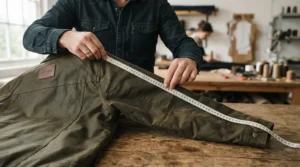
Getting a racing jacket sizing guide right starts with accepting that your regular jacket size means almost nothing here. Follow these steps:
- Measure your chest under the armpits, arms relaxed. Wrap a cloth tape around the fullest part of your chest, keeping it parallel to the floor — this is the single most important number for race-cut jackets.
- Measure sleeve length with arms slightly bent. Stand as if gripping handlebars, then measure from shoulder to wrist; a straight-arm measurement will run short once you’re actually leaned over a tank.
- Check your torso length in a forward lean. Race jackets are cut longer in the back specifically for this posture, so measure while bent forward, not standing upright.
- Cross-reference two brand charts before buying. Manufacturer sizing genuinely doesn’t correlate across brands, and even established fitting resources caution that manufacturer size charts don’t guarantee a perfect fit, so treat any single chart as a starting point, not gospel.
- Account for armor bulk in your chest number. CE Level 2 shoulder and elbow armor adds real bulk; if you’re between sizes, size up rather than compress the armor.
- Try the tuck test if a return policy allows it. Bend forward in a mirror with the jacket zipped; if the collar chokes you or the hem rides up past your waistband, the size is wrong regardless of what the chest measurement says.
- Re-measure every two to three years. Body composition shifts, and a jacket that fit perfectly at your last purchase may not fit the same way now.
| Chest (inches) | Chest (cm) | Typical Jacket Size |
|---|---|---|
| 33-34 | 84-86 | 42 (S) |
| 35-36 | 88-92 | 44-46 (M) |
| 37-39 | 94-100 | 48-50 (L) |
| 40-42 | 102-108 | 52-54 (XL) |
| 43-45 | 110-116 | 56-58 (XXL) |
This table is a starting reference, not a universal law — Dainese, Alpinestars, REV’IT, Spidi, and Icon all cut their patterns slightly differently, so a 50 in one brand can fit like a 48 in another. The safest move is measuring your actual chest, then matching that number to each specific brand’s own published chart rather than assuming size consistency across manufacturers.

Racing Jacket vs Regular Motorcycle Jacket
A racing jacket vs regular motorcycle jacket comparison comes down to one core difference: posture assumption. Regular motorcycle jackets are cut to look and feel normal standing upright, with straight sleeves and a torso built for comfort off the bike. Racing jackets assume you’ll spend the majority of your riding time leaned forward, which is why the sleeves are pre-curved forward at the elbow and the back panel runs longer than the front.
| Feature | Racing Jacket | Regular Motorcycle Jacket |
|---|---|---|
| Sleeve cut | Pre-curved, forward-rotated | Straight, neutral |
| Torso length | Longer in back for tuck coverage | Even front/back length |
| Armor class | Typically Level 2, race-positioned | Often Level 1 |
| Standing comfort | Compromised | Comfortable |
| Airbag compatibility | Common on premium models | Rare |
The practical upshot: a racing jacket will feel slightly awkward walking through a paddock but disappear once you’re tucked in at speed, while a regular jacket feels natural off the bike but can bunch uncomfortably around the shoulders and lower back once you’re leaned over a fuel tank at 100 mph. Riders who split time evenly between commuting and track days, like the Icon Overlord 3 buyer profile, benefit from a crossover cut; riders doing dedicated track time are better served by the deeper race cut found in the Alpinestars GP Plus R V4 Airflow or Dainese Racing 5 Perforated.
Track Day Jacket Features That Actually Matter
Track day jacket features fall into two buckets: the ones that genuinely affect your safety and comfort, and the ones that mostly exist for marketing photos. Accordion stretch panels behind the elbows and shoulders matter enormously — they’re what lets the jacket flex without pulling armor out of position during hard braking or aggressive lean angles. A zip-to-pants connection matters if you’re running two-piece leathers, since a gap at the waist during a slide is a genuine injury risk, not a comfort quibble.
What matters less than marketing suggests: aggressive graphics packages, since they add zero protective value and mostly affect resale appeal. Aerodynamic humps on jackets like the Alpinestars Missile V2 Ignition do have a real function at triple-digit speeds, but for most club-level track day riders under 130 mph, the difference is marginal at best. Reviewers of jackets like the Spidi Track Warrior consistently note that external shoulder shields feel more reassuring during a slide than internal-only armor, which lines up with Spidi’s own biomechanical research on impact zones.
✨ Don’t Miss These Exclusive Deals!
🔍 Take your racing jacket search to the next level with these carefully selected picks. Click on any highlighted item to check current pricing and availability. These jackets will help you build authentic track-day confidence your future lap times will thank you for!
Racing Jacket Ventilation: Staying Cool at Race Pace
Racing jacket ventilation is one of the most misunderstood specs on a spec sheet, because “perforated leather” sounds simple but performs very differently depending on placement and leather thickness. The REV’IT Quantum 2 Pro Air demonstrates this well — its extensive perforation across the chest, bicep, and back combined with PWR fuse airmesh panels delivers what multiple independent reviews call unmatched venting performance among premium leather jackets, but that airflow comes with a certification trade-off, dropping from AAA to AA compared to the solid Quantum 2.
The Alpinestars GP Plus R V4 Airflow takes a different approach, using buffalo leather specifically in perforation zones while keeping race-grade cowhide in the impact areas, so ventilation doesn’t compromise the parts of the jacket most likely to hit the ground. What most riders overlook is that a mesh interior liner, like the one in the GP Plus R V4, often does more for perceived coolness than perforated leather alone, because it manages moisture against your skin rather than just letting outside air pass through the shell. If you ride primarily in hot climates, prioritize jackets with both perforation and an internal airflow liner rather than perforation alone — the combination genuinely outperforms either feature in isolation.
Racing Jacket Armor Placement: Where Protection Actually Needs to Sit
Racing jacket armor placement is where a lot of otherwise decent jackets quietly fail riders. CE-certified armor only protects you if it stays exactly where your body needs it during a slide, and several jackets on this list solve that problem differently. The Dainese Racing 5 Perforated Leather Jacket uses replaceable aluminum shoulder inserts engineered to slide across pavement rather than dig in, reducing rotational force transmitted to the shoulder joint — a detail most competing jackets simply don’t address. The Alpinestars Missile V2 Ignition takes armor placement further by engineering its stretch panels specifically around where the Tech-Air 5 airbag needs to expand, meaning the armor and the airbag are designed as one system rather than bolted together as an afterthought.
Common armor placement problems and how these jackets solve them:
- Problem: Shoulder armor rides up during arm movement. Solution: pre-curved sleeves with accordion stretch, as used in the Icon Overlord 3 and Alpinestars GP Plus R V4 Airflow, keep armor anchored through the full range of tucked-position movement.
- Problem: Back protector gaps at the waist during a slide. Solution: full-circumference jacket-to-pants zip systems, standard on the Spidi Track Warrior and Alpinestars Missile V2 Ignition, close that gap entirely.
- Problem: Elbow armor sits too low or too high. Solution: brands offering multiple torso-length cuts, like Dainese’s chest-to-sleeve chart proportions, let taller or shorter riders match armor position to their actual joint location rather than a generic average.
Real-World Scenarios: Matching Riders to the Right Jacket
If you’re a college student who just discovered track days and rides maybe four sessions a year, the Cortech Latigo 2.0 makes the most financial sense — genuine CE protection without betting rent money on a hobby you’re still testing. If you’re a daily commuter in a hot-summer city who wants to add occasional track days without owning two jackets, the Icon Overlord 3 or Alpinestars GP Plus R V4 Airflow cover both roles credibly, with enough ventilation for stop-and-go traffic and enough race-cut structure for a track day tuck.
If you’re a weekend club racer doing 15-20 track days a season in a warm climate, the REV’IT Quantum 2 Pro Air solves the specific problem of overheating mid-session, which matters more than most riders admit until they’ve fought heat exhaustion in lap eight of a twenty-minute session. And if you’re a serious track rider who’s already decided an airbag system belongs in your future, buying the Alpinestars Missile V2 Ignition or Dainese Racing 5 Perforated now, both airbag-compatible from the factory, saves you from re-buying a jacket later once you commit to that upgrade.

Buyer’s Decision Framework: Choosing Fast Without Guessing
If you’re unsure where to start, work through this simple priority checklist in order:
- If budget is your primary constraint, choose the Cortech Latigo 2.0 because it delivers real CE armor without the race-suit price tag.
- If you split time between street and track, choose the Icon Overlord 3 because its crossover fit and venting handle both roles.
- If hot weather is your biggest complaint about leather gear, choose the REV’IT Quantum 2 Pro Air because its ventilation is genuinely class-leading.
- If you plan to add an airbag system eventually, choose the Dainese Racing 5 Perforated or Alpinestars Missile V2 Ignition because both are engineered around airbag compatibility from day one.
- If maximum abrasion protection is non-negotiable, choose whichever AAA-rated option fits your budget, since Class AAA represents the highest tier currently defined under the standard.
Practical Break-In & Maintenance Guide
New race leather doesn’t feel like race leather until it’s broken in, and rushing this step is a common first-30-days mistake. Wear the jacket around the house zipped up for short stretches before your first ride, letting the leather flex at the elbows and shoulders where the accordion panels live — this softens the material faster than riding alone will. Avoid conditioning oils in the first few weeks; premature conditioning can actually soften structural fibers before the leather has settled into its shape.
For ongoing maintenance, wipe down perforated panels after wet rides since trapped moisture inside perforation holes can promote mildew faster than solid leather sections. Check armor pocket Velcro and snap closures every few months — a loose pocket is how internal armor migrates out of position over a season of riding, quietly undermining the exact protection you paid for. Store the jacket on a wide hanger, never folded, to prevent crease lines from forming at stress points like the elbows, where repeated creasing can weaken the leather over years of use.
Common Sizing Mistakes When Buying a Racing Jacket
The single most common mistake is buying by street-jacket size instead of measuring fresh for a race cut — the two numbers frequently don’t match, even from the same brand. A close second is ignoring torso length in favor of chest fit alone; a jacket can measure perfectly across the chest and still ride up dramatically in the back once you’re tucked over a tank, exposing the lower spine exactly where a back protector needs coverage.
Riders also commonly underestimate armor bulk, buying a size that fits comfortably without armor installed, then discovering the jacket is uncomfortably tight once Level 2 protectors are actually in their pockets. Finally, skipping the tuck test — trying the jacket on standing upright only — is a mistake almost every first-time buyer makes, and it’s the single easiest one to avoid: bend forward in the fitting room mirror before you commit.
Long-Term Cost & Maintenance of a Racing Jacket
Thinking in cost-per-track-day rather than sticker price changes the calculus considerably. A $290 Cortech Latigo 2.0 used for ten track days a year works out to a fraction of the per-session cost of a $1,250 Alpinestars Missile V2 Ignition used the same amount — but that math flips for riders logging 30-plus track days annually, where the more durable AAA-rated leather and replaceable armor components on premium jackets pay for themselves in reduced replacement frequency. Independent crash research consistently supports the underlying premise here: a peer-reviewed study on motorcycle crash injuries and protective clothing found that riders wearing protective clothing had meaningfully lower rates of soft-tissue injuries than those without it, reinforcing that gear quality isn’t just about comfort — it’s measurably protective.
Maintenance costs matter too. Leather conditioning every six months, occasional armor pocket repairs, and eventual back protector upgrades add real dollars over a jacket’s lifespan regardless of which model you buy. Budget roughly $50-$100 annually for upkeep on any leather race jacket you plan to keep for several seasons.
Safety, Regulations & Compliance Guide
Every jacket on this list is rated under EN 17092, the standard governing motorcycle protective clothing sold as certified PPE. As the technical body SATRA explains in its EN 17092 breakdown, Class AAA and AA garments require elbow, shoulder, knee, and hip impact protectors as a mandatory feature, positioned according to the relevant impact protector standard — which is exactly why armor placement, covered earlier, isn’t a cosmetic detail but a certification requirement. Class A garments sit a tier below, with hip protectors optional rather than mandatory.
Buyers should always check for the internal EN 17092 label rather than trusting marketing language alone; “CE approved” without a specific class letter tells you very little. For U.S. riders, no federal law mandates protective jacket certification the way DOT mandates helmet standards, which makes voluntary adherence to EN 17092 classes the most reliable signal of genuine protective performance currently available in the consumer market.
Frequently Asked Questions
❓ What size racing jacket should I buy if I'm between sizes?
❓ Do racing jackets run smaller than regular motorcycle jackets?
❓ Can I wear a racing jacket for street riding?
❓ How tight should a racing jacket fit for track days?
❓ What's the difference between CE Level 1 and Level 2 armor in a racing jacket?
Conclusion
Getting your racing jacket sizing guide right isn’t about vanity sizing or brand loyalty — it’s about making sure CE-certified armor stays exactly where your body needs it during the split second that matters. Whether you land on the budget-friendly Cortech Latigo 2.0 or the flagship Alpinestars Missile V2 Ignition, the same measurement discipline applies: measure your chest under the armpits, account for a forward-leaning posture, cross-reference brand-specific charts, and always run the tuck test before you commit.
The seven jackets covered here span a genuinely wide range of budgets and use cases, from occasional track day dabblers to riders logging dozens of sessions a season in punishing heat. What they share is honest engineering behind the marketing — pre-curved sleeves, accordion stretch panels, and armor positioned according to real crash biomechanics rather than guesswork. Take the measurements seriously, try before you buy whenever possible, and the right jacket will disappear into the background the moment you tuck in for turn one.
Recommended for You
- Vintage Leather Jacket Men: 7 Best Picks Ranked for 2026
- Casual Leather Jacket Men: 7 Best Picks for 2026
- 7 Best Mens Leather Biker Jacket Picks for 2026
Disclaimer: This article contains affiliate links. As an Amazon Associate, I earn from qualifying purchases. If you purchase products through these links, we may earn a small commission at no additional cost to you.
✨ Found this helpful? Share it with your friends! 💬🤗
