
In This Article
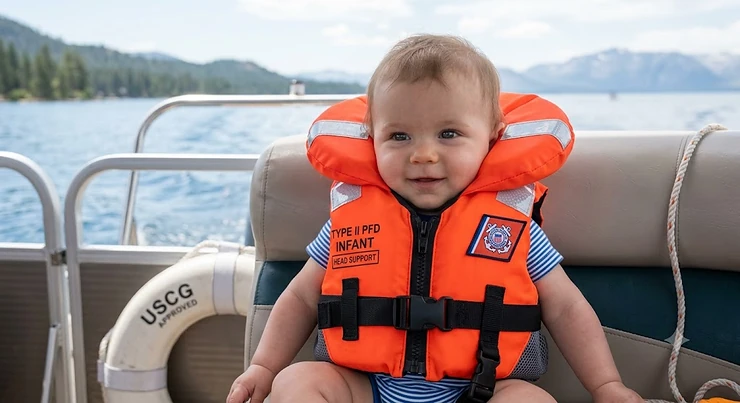
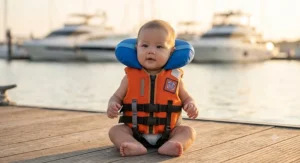
The first time you buckle a life jacket around a two-month-old, something clicks that no spec sheet prepares you for: babies are top-heavy. Their heads make up roughly a quarter of their total body weight, and their neck muscles are nowhere near strong enough to hold that weight up on their own, let alone against a wave or a wobbly kayak. That single fact is why infant PFD head support exists as its own category, separate from the foam vests made for toddlers and older kids. A proper infant PFD head support system uses a shaped collar or foam headrest to keep a baby’s face out of the water even if they tip backward or go limp, which is precisely the scenario that ordinary swim vests were never built to handle.
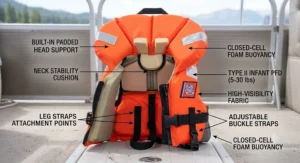
This guide walks through seven real, currently available infant life jackets, all chosen because they treat head support as a design priority rather than an afterthought. You’ll get honest, spec-grounded commentary on each one, a breakdown of how face-up flotation actually works, and practical guidance on fit, maintenance, and buying mistakes to dodge. The CDC’s drowning prevention resources point parents toward exactly this kind of prevention-first thinking, and that emphasis runs through every section here — a life jacket is a tool that buys time in an emergency, never a substitute for an adult within arm’s reach.
We’ll also be upfront about pricing: Amazon and retailer prices shift constantly, so every figure below is a range based on research at the time of writing, not a locked-in number. Check current pricing before you buy.
Quick Comparison Table
Before the deep dive, here’s a fast-scan snapshot of where each pick lands on price, weight range, and its core head-support approach.
| Product | Weight Range | Head Support Style | Price Range | Best For |
|---|---|---|---|---|
| Full Throttle Baby-Safe Infant Life Jacket | Under 30 lbs | Oversized collar headrest | Around $20-$30 | Tightest budget |
| Dark Lightning USCG Infant Life Jacket | 0-30 lbs | Foam headrest + leg strap | Under $25 | First-time buyers |
| Airhead Classic Infant Life Vest | Under 30 lbs | Closed-sided contrast headrest | $30-$40 range | High-visibility needs |
| Stearns Child Life Jacket (Heads-Up Flotation) | Wide infant/child range | Heads-Up asymmetric foam | $25-$35 range | All-around families |
| O’Neill Superlite USCG Infant Vest | Under 30 lbs | Shaped PVC foam, face-up cut | $35-$45 range | Beach and surf families |
| Stohlquist Infant Life Jacket | 20-30 lbs | Support collar with grab handle | $40-$55 range | Paddlers and boaters |
| Salus Bijoux Baby Vest | 9-25 lbs | Three-piece cradling collar | $60-$75 range | Smaller babies, premium comfort |
Reading across this table, the split isn’t really “cheap versus expensive” — it’s about which weight window and which activity each collar geometry was engineered for. The Salus Bijoux Baby Vest is the outlier worth flagging immediately: it fits babies as light as 9 lbs, a range none of the USCG-tested vests can legally claim, but that also means it isn’t Coast Guard approved. Everything else here clears the standard 20-30 lb USCG infant bracket, so the real decision usually comes down to how snug you need the collar and how much you’re willing to spend on it.
💬 Just one click — help others make better buying decisions too!😊
Top 7 Infant Life Jackets With Head Support: Expert Analysis
Coverage below spans budget, mid-range, and premium tiers, plus one niche pick built specifically for babies under the usual 20 lb minimum.
1. Full Throttle Baby-Safe Infant Life Jacket — lowest price with full USCG approval
The standout here is right in the name: this is a genuinely low-cost vest that still clears every U.S. Coast Guard box, which is rarer than it sounds in this category. The oversized collar creates the headrest, and a convenient buckle opening at the collar makes it noticeably easier to get a squirming, arching infant strapped in without a wrestling match. Add an elasticized leg strap for comfort and a grab strap for quick recovery, and you’ve got a vest built around the exact moments that matter — putting it on fast and pulling a baby out fast.
Based on the spec comparison, this is the vest to buy if your boating days are occasional — a few lake trips a summer rather than weekly outings — because the firmer foam and simpler collar shape trade some plushness for a lower price tag. One independent tester who ran it head-to-head against pricier competitors scored it 84 out of 100, landing it as their top budget pick precisely because it still meets every USCG Type II requirement without the extra cost. Reviewers consistently note that the collar buckle is the feature that saves the most frustration during a squirmy dockside changeover.
Pros:
- ✅ Full USCG Type II approval at the lowest price point tested
- ✅ Collar buckle opening speeds up dressing a wriggling infant
- ✅ Grab strap and elasticized leg strap add real rescue utility
Cons:
- ❌ Firmer foam feels less plush than premium collar designs
- ❌ Limited color options compared to higher-tier competitors
Priced in the around $20-$30 range, the Full Throttle Baby-Safe Infant Life Jacket is arguably the best value-per-dollar vest in this roundup for anyone who just needs a certified, functional infant PFD without extras.
2. Dark Lightning USCG Infant Life Jacket — best entry point for first-time buyers
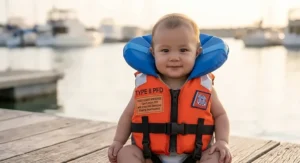
What stands out first is how deliberately this vest is positioned as an alternative to inflatable arm floaties — a supportive headrest plus a leg strap and top grab handle in one closed-cell foam package rather than several separate accessories. That matters in practice because arm floaties do nothing for head control if a baby tips backward, while this vest’s headrest is purpose-built for exactly that scenario.
The foam buoyancy is distributed to keep the collar riding high around the neck and skull, and the adjustable leg strap keeps the whole assembly from creeping up over the chin during active splashing. What most first-time buyers overlook is that “0-30 lbs” on a label doesn’t mean one universal fit — you still need to test the shoulder lift check every time weight changes. Aggregated feedback on this model frequently praises the price-to-feature ratio for families buying their very first infant PFD, though a smaller number of reviewers note the straps run slightly long on newborns at the bottom of the weight range.
Pros:
- ✅ Combines headrest, leg strap, and grab handle in one budget vest
- ✅ Marketed and priced as a real floaties alternative
- ✅ Simple foam construction is easy to rinse and dry
Cons:
- ❌ Straps can run long for babies at the low end of the range
- ❌ Fewer third-party durability reviews than legacy brands
At under $25 in most listings, the Dark Lightning USCG Infant Life Jacket earns its spot as the pick for parents who want certified head support without a big upfront commitment.
3. Airhead Classic Infant Life Vest — best for high-visibility supervision
The vivid yellow headrest is the detail that actually earns its place on this list — it’s not just cosmetic. Against blue water or a crowded dock, a contrasting yellow collar makes a baby’s head position easy to spot at a glance, which is genuinely useful for a parent scanning a busy swim area. The closed-sided nylon construction wraps snugly and resists riding up, and three strong buckles keep the whole vest cinched even through determined wriggling.
Based on the spec comparison, the closed-sided cut is the trade-off worth understanding: it’s more secure than open-sided designs but slightly slower to put on, since there’s no side-entry shortcut. This is Type II, U.S. Coast Guard approved, and geared explicitly for calm inland waters where rescue is expected within just a few minutes, rather than open-water conditions. Reviewers frequently cite the color visibility and buckle security as the two reasons they’d repurchase, with occasional notes that the nylon shell runs slightly warm on hot days.
Pros:
- ✅ High-visibility yellow headrest aids quick visual tracking
- ✅ Closed-sided design resists riding up during movement
- ✅ Three secure buckles hold fit through active splashing
Cons:
- ❌ Closed-sided cut takes longer to put on than side-entry vests
- ❌ Nylon shell can feel warm in direct sun
In the $30-$40 range, the Airhead Classic Infant Life Vest is the practical choice for busy beach days where keeping visual tabs on a baby matters as much as the flotation itself.
4. Stearns Child Life Jacket with Heads-Up Flotation — best all-around family pick
This is the model that shows up again and again in independent buying guides, and the “Heads-Up Flotation” name isn’t marketing fluff — it describes an asymmetric foam layout that intentionally weights the vest to tip a limp or startled infant onto their back, face skyward. One reviewer named it their overall top pick specifically because it performs well across a wide variety of baby weights, which is a meaningful claim given how quickly infants outgrow gear.
What the spec sheet won’t tell you, but aggregated reviews suggest, is that this vest’s popularity comes largely from how forgiving the sizing feels as a baby grows through their first year — parents report getting more usable months out of it than some narrower-range competitors. The trade-off is that a jack-of-all-trades foam layout is rarely the single best at any one thing; families prioritizing the plushest collar or the most technical paddling cut may still prefer a specialist option further down this list.
Pros:
- ✅ Asymmetric foam actively rights a baby onto their back
- ✅ Comfortable, forgiving fit across a wide weight range
- ✅ Frequently recommended as an overall best-pick by independent reviewers
Cons:
- ❌ Generalist design isn’t the most technical option for serious paddlers
- ❌ Standard colorways are less distinctive than boutique competitors
At roughly $25-$35, the Stearns Child Life Jacket with Heads-Up Flotation is the safe default recommendation for most families who want one reliable vest and don’t want to overthink the decision.
5. O’Neill Superlite USCG Infant Life Vest — best foam shaping for face-up recovery
O’Neill built its reputation on wetsuits, and that surf-industry foam expertise shows up here in the closed-cell PVC marine foam, which is specifically shaped to float a baby face-up rather than relying purely on a bolted-on headrest pad. That’s a meaningfully different engineering approach from a flat foam panel with a headrest sewn on top — the buoyancy itself is contoured to the task.
Durable Delrin quick-release buckles handle the fastening, and a grab loop is built directly into the head cushion, giving caregivers a dedicated lift point right where it matters most in a rescue. Based on the spec comparison, the nylon-over-PVC shell adds UV resistance that budget foam vests typically skip, which matters for families spending full beach days in direct sun rather than short pool dips. Aggregated review sentiment leans positive on comfort and shape retention, though stock availability on specific colorways has been inconsistent according to several retailer listings.
Pros:
- ✅ Foam contour is engineered for face-up flotation, not just a headrest add-on
- ✅ Grab loop built into the head cushion for direct rescue access
- ✅ UV-resistant nylon/PVC shell suits long beach days
Cons:
- ❌ Certain colorways see frequent stock shortages
- ❌ Premium foam shaping adds cost over basic competitors
In the $35-$45 range, the O’Neill Superlite USCG Infant Life Vest suits beach and boat families who want engineering-driven face-up support rather than a simple headrest pillow bolted onto a standard vest.
6. Stohlquist Infant Life Jacket — best support collar for active paddling families
Stohlquist built its name in whitewater and touring kayaks, and that paddling-first DNA shows up in the phrase right on the label: “Support Collar with Grab Handle.” Where some infant vests treat the collar as passive padding, this one is cut to actively cradle the head during the kind of quick, choppy movement you get from a canoe wobble or a kayak re-entry, not just calm-water floating.
The Type II, U.S. Coast Guard approved rating covers the standard 20-30 lb window, and the grab handle is sized and placed for a fast one-handed lift — a detail paddlers particularly value when hauling a baby back into a canoe from open water. Reviewers consistently note that the collar sits snugger against the neck than bulkier department-store vests, which reduces the chance of it sliding sideways during active paddling, though a snugger collar also means slightly less room to size up as a baby grows.
Pros:
- ✅ Purpose-built support collar suited to active paddling, not just calm water
- ✅ Grab handle sized for fast one-handed rescue lifts
- ✅ Snug collar fit resists sideways slipping during movement
Cons:
- ❌ Snugger cut leaves less room to grow into
- ❌ Priced above general-purpose big-box competitors
At around $40-$55, the Stohlquist Infant Life Jacket is the pick for kayaking and canoeing families who want a collar engineered for movement, not just stillwater floating.
7. Salus Bijoux Baby Vest — most cradling collar for the smallest babies
The Salus Bijoux Baby Vest exists because of a genuine gap in the market: it’s rated for babies as light as 9 lbs, well below the roughly 20 lb floor where most USCG-tested infant vests start. Its three-piece collar design adds flotation on both sides to cradle the baby’s head in the center, and a one-piece front panel is shaped specifically so a baby turns face-up from a face-forward position, rather than staying belly-down.
Here’s the honesty that matters most: this vest is not USCG or Transport Canada approved, because there is currently no official testing standard for personal flotation devices covering children under 9 kilograms, or about 20 pounds. Salus stepped outside the existing standard on purpose to serve that under-20-lb gap, and Transport Canada and the Canadian Coast Guard recognize it as an appropriate safety device for infants under 20 lbs — but “recognized” is not the same legal status as “approved,” and U.S. boating law generally requires a Coast Guard-approved PFD. Aggregated reviews consistently praise the Dry-Lex Aerospacer liner for staying cool and dry, and the mesh back for letting a baby lie comfortably in a carrier between water sessions.
Pros:
- ✅ Fits babies as light as 9 lbs, below most USCG vests’ floor
- ✅ Three-piece collar cradles the head from multiple angles
- ✅ Breathable Dry-Lex liner and mesh back add all-day comfort
Cons:
- ❌ Not USCG approved — doesn’t satisfy U.S. legal requirements on its own
- ❌ Premium price for a niche, narrow weight window
At roughly $60-$75, the Salus Bijoux Baby Vest is best understood as a comfort-and-fit specialist for tiny babies rather than a legal substitute for a Coast Guard-approved vest once your baby clears 20 lbs.
Top 7 Products: Specs, Price Range & Ratings Snapshot
| Product | USCG Approved | Collar Style | Notable Feature | Price Range | Best For |
|---|---|---|---|---|---|
| Full Throttle Baby-Safe Infant Life Jacket | Yes | Oversized collar | Buckle-opening collar | $20-$30 | Occasional boaters |
| Dark Lightning USCG Infant Life Jacket | Yes | Foam headrest | Floaties replacement | Under $25 | First-time buyers |
| Airhead Classic Infant Life Vest | Yes | Closed-sided | High-vis yellow headrest | $30-$40 | Busy beach days |
| Stearns Child Life Jacket | Yes | Heads-Up asymmetric | Wide weight-range fit | $25-$35 | All-around families |
| O’Neill Superlite USCG Infant Vest | Yes | Shaped PVC foam | Grab loop in head cushion | $35-$45 | Beach/surf families |
| Stohlquist Infant Life Jacket | Yes | Support collar | Active paddling cut | $40-$55 | Kayakers/canoeists |
| Salus Bijoux Baby Vest | No (TC-recognized) | Three-piece cradle | Fits down to 9 lbs | $60-$75 | Babies under 20 lbs |
The pattern that jumps out here is that six of the seven vests share the same core legal status — Coast Guard approved, Type II, built for the 20-30 lb bracket — so the real differentiator is collar geometry and intended activity rather than certification. The Salus Bijoux Baby Vest is the deliberate exception, trading legal certification for a weight range that simply doesn’t exist elsewhere, which makes it a companion purchase for very young babies rather than a universal replacement for the other six.
✨ Don’t Miss These Exclusive Deals!
🔍 Take your search for the safest infant PFD head support to the next level with these carefully vetted picks. Click on any highlighted vest to check current pricing and availability. The right one now means safer, calmer days on the water all season long!
Practical Usage Guide: Getting the Fit and Fasten Right
Buying the right infant PFD head support is only half the job — fit and first-use habits do the rest. Start every outing with the shoulder-lift test: gently lift your baby by the shoulder straps and confirm the collar doesn’t rise above the chin or ears. If it does, the vest is too loose, no matter how snug the buckles feel around the belly. Recheck this every time your baby’s weight shifts noticeably, not just once at purchase.
For the first 30 days of ownership, the most common mistake is skipping a dry-land practice run. Buckle the vest at home, let your baby wear it for a few supervised minutes on a blanket, and watch how they react to the collar against their neck — better to work out fussiness on dry land than at the dock. Rinse foam vests in fresh water after every ocean or chlorinated-pool use, and let them air dry fully before storage; trapped moisture inside foam panels can lead to mildew that degrades both smell and buoyancy over time. Inspect buckles, stitching, and foam integrity before every single outing, since a cracked buckle or compressed foam panel is a safety issue, not just cosmetic wear.
Real-World Scenarios: Which Infant PFD Fits Your Family
Picture three different families to see how the “best” choice actually shifts with context. If you’re a lake-house family with a dock and a pontoon boat for occasional weekend outings, a vest like the Full Throttle Baby-Safe Infant Life Jacket or Dark Lightning USCG Infant Life Jacket covers you well — solid, certified, and not a big investment for a few outings a summer.
If you’re paddling weekly with a baby in a canoe or kayak, prioritize the Stohlquist Infant Life Jacket, whose collar is cut specifically for movement rather than stillwater floating, paired with practiced re-entry drills before you ever leave calm water. And if you have a newborn under 20 lbs who you want dressed comfortably for supervised pool time or a baby carrier between swims, the Salus Bijoux Baby Vest fills a genuine product gap — just remember it isn’t a substitute for a Coast Guard-approved vest once your baby clears that 20 lb line and you’re on a boat subject to federal requirements.
What Is Infant PFD Head Support?
Infant PFD head support refers to the shaped collar, foam headrest, or cradling structure built into an infant life jacket specifically to keep a baby’s face out of the water and oriented upward, even if the baby goes limp or tips backward — a function standard adult or child-sized life jackets are not engineered to provide.
This distinction exists because babies simply can’t hold their own heads up reliably. The American Academy of Pediatrics explains that infants don’t have much neck and muscle control, so even a small amount of water covering their nose and mouth can stop them from breathing. A head-support collar compensates for that missing muscle strength mechanically, using buoyant foam positioned around the skull and upper neck rather than asking the baby’s own body to do the work.
Head Flotation Design: How Face-Up Positioning Actually Works
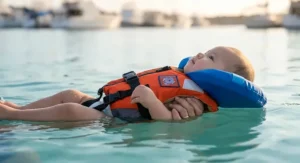
The engineering behind face-up positioning comes down to weight distribution, not magic. Vests like the Stearns Child Life Jacket with Heads-Up Flotation deliberately place more buoyant foam behind the shoulders and around the collar than across the chest, so that if a baby tips or goes still in the water, the heavier-floating rear panel rotates them onto their back automatically. The O’Neill Superlite USCG Infant Life Vest achieves something similar through a foam shape contoured specifically to float face-up rather than relying on a bolted-on pad, while the Salus Bijoux Baby Vest‘s one-piece front design pushes even a face-forward baby into a face-up rotation.
What most buyers overlook is that this rotation only works reliably if the vest fits snugly. A loose collar can shift out of position exactly when it’s needed most, which is why every fit check matters as much as the underlying design. Reviewers across brands consistently flag proper sizing, not brand loyalty, as the single biggest factor separating a vest that performs as designed from one that doesn’t.
How to Choose an Infant PFD With Head Support
- Confirm the weight range first. Sizing for infant PFDs runs by weight, not age — check your baby’s current weight against the label, not a projected future size.
- Look for U.S. Coast Guard approval. Unless your baby is under roughly 20 lbs, a Coast Guard-approved Type II vest is both the legal requirement and the tested-safety baseline.
- Prioritize the collar or headrest shape. A pronounced, structured headrest — not just a thin foam pad — does more of the heavy lifting when a baby tips backward.
- Check for a grab handle. A sturdy top handle turns a rescue from a scramble into a controlled lift.
- Test the buckle system before you buy. Quick-release buckles matter most in a genuine emergency, but for daily use, a collar-opening buckle saves real frustration.
- Factor in your activity type. Calm dock days favor comfort-first vests; active paddling favors a snug, movement-ready collar like Stohlquist’s.
- Plan to re-fit as your baby grows. Most infant vests only cover a roughly 10-lb window comfortably — budget for a resize sooner than you’d expect.
Common Mistakes When Buying Infant Life Jackets With Head Support
The single most common mistake is buying based on projected growth instead of current weight — a vest sized “to grow into” simply won’t perform its head-support function correctly until the baby actually reaches that weight. A close second is skipping the shoulder-lift fit test at the store or after unboxing; a vest that looks right on a hanger can still ride up dangerously once buckled on a squirming infant.
Parents also frequently confuse “USCG approved” language with blanket safety, forgetting that Type II vests like most on this list are designed for calm, near-shore water where rescue is expected quickly — not offshore or rough-water conditions. Finally, treating any PFD, however well-designed the head support, as a substitute for constant adult supervision is a mistake the AAP and Coast Guard both warn against explicitly; the vest buys time, it doesn’t replace watching.
Infant Life Jacket With Collar vs Standard Foam Vest
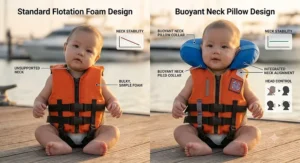
A standard child-sized foam vest and a true infant life jacket with collar solve genuinely different problems, even though they can look similar on a store shelf. Standard vests distribute foam relatively evenly across the torso and assume the wearer has enough neck strength to keep their own head above water. An infant-specific collar design, by contrast, assumes the opposite — that the baby may go limp — and compensates with asymmetric foam or a cradling collar structure that actively repositions the head.
| Feature | Infant PFD With Collar | Standard Foam Vest |
|---|---|---|
| Designed weight range | Typically 9-30 lbs | Usually 30 lbs and up |
| Head/neck support | Structured collar or headrest | Minimal to none |
| Face-up self-righting | Yes, by design | Not typically engineered |
| Best For | Infants and non-mobile babies | Toddlers and children who can self-right |
The takeaway from this table is straightforward: once a child can reliably hold their own head up and kick or paddle to reposition themselves, a standard vest becomes appropriate, but an infant who can’t yet do either genuinely needs the collar-style design. Using a standard vest too early isn’t just a comfort issue — it removes the exact mechanical support an infant’s body can’t yet provide on its own.
Baby Life Jacket Coast Guard Certified: What “Approved” Really Means
“Coast Guard approved” is a specific, testable status, not a marketing phrase. It means a vest has passed U.S. Coast Guard buoyancy and performance testing for its stated Type and weight range — which is why six of the seven vests in this guide, everything except the Salus Bijoux Baby Vest, carry that label. Federally, the Coast Guard requires all children under 13 years of age to wear a Coast Guard-approved life jacket while aboard recreational vessels underway, with narrow exceptions for enclosed cabins, and children are generally limited to foam life jackets rather than inflatable designs.
State rules can add further specifics on top of the federal floor — for example, California law requires every child under 13 on a moving recreational vessel to wear a Coast Guard-approved life jacket in serviceable condition, sized appropriately for the activity. It’s worth checking your own state’s specific boating requirements before you head out, since compliance details vary by location even though the underlying federal requirement is consistent nationwide.
Infant Neck Support and Muscle Development: What Parents Should Know
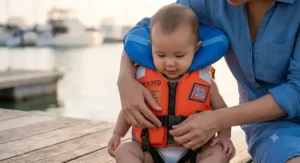
Newborns typically can’t fully support their own head until somewhere around 3 to 4 months, and even after that milestone, neck control under the stress and disorientation of falling into water is a different challenge entirely than holding steady on dry land. This is precisely the gap infant PFD head support is engineered to fill — a mechanical stand-in for muscle strength a baby simply hasn’t developed yet.
The American Academy of Pediatrics’ drowning prevention research identifies drowning as a leading cause of injury-related death in young children, and frames pediatrician education as a key prevention lever alongside physical safety gear. That’s part of why the AAP’s guidance goes beyond gear recommendations into broader supervision habits — a well-fitted collar reduces one specific risk, but it operates alongside constant, arm’s-reach supervision, never instead of it.
Safest Infant Life Jacket: What the Data and Reviews Actually Show
“Safest” isn’t a single number you can rank vests by — it’s a combination of certification status, fit accuracy, and real-world collar performance. Among Coast Guard-approved options here, the Stearns Child Life Jacket with Heads-Up Flotation and Stohlquist Infant Life Jacket stand out for engineering that actively repositions a baby rather than passively floating them, which matters most in the exact emergency scenario a head-support vest exists for.
Based on the spec comparison and aggregated review themes, the honest conclusion is that any of the six USCG-approved vests here perform their core safety function when properly fitted — the differences between them are mostly about activity fit and comfort, not a meaningful safety gap. The bigger safety lever, consistently, is correct sizing and the shoulder-lift fit check, not brand selection.
Long-Term Cost & Maintenance
Infant PFDs are a recurring cost, not a one-time purchase, because babies outgrow the roughly 10-lb comfortable window each vest covers within a matter of months. Budget vests like the Full Throttle Baby-Safe Infant Life Jacket, priced around $20-$30, keep total cost of ownership low if you expect to resize twice within a year or two. Premium options like the Stohlquist Infant Life Jacket or Salus Bijoux Baby Vest cost more upfront but often hold foam integrity and stitching quality longer, which matters if you plan to pass the vest down to a younger sibling.
Maintenance costs are minimal but not zero: replacement buckles and occasional foam-panel wear are the most common repairs cited in aggregated reviews. Air-drying fully after every use and avoiding direct high-heat drying — which can compress or crack foam — extends usable life across all price tiers.
Features That Actually Matter (And Those That Don’t)
Structured head support, a functioning grab handle, and genuine USCG Type II certification are the three features worth prioritizing every time — they directly affect whether the vest does its core job. A snug, correctly sized collar matters more than any other single spec on this list.
Character-themed prints, novelty colors, and marketing language like “ultra-premium foam” matter far less than actual fit and buoyancy distribution. A cute print doesn’t change how a collar rotates a baby face-up, and neither does a brand’s tagline — read the weight range and certification label before anything else on the packaging.
Problem → Solution Guide
Problem: The collar rides up above the chin during active splashing. Solution: check the leg strap tension first — a loose leg strap is the most common cause, since it lets the whole vest migrate upward; models like the Full Throttle Baby-Safe Infant Life Jacket with adjustable leg straps are specifically designed to counter this.
Problem: My baby fights getting the vest on every time. Solution: try a collar-buckle-opening design like the Full Throttle Baby-Safe Infant Life Jacket, and practice short dry-land wear sessions at home so the sensation becomes familiar before water time.
Problem: The vest feels too loose after a growth spurt. Solution: re-run the shoulder-lift test immediately and size up rather than waiting — most vests only comfortably span about 10 lbs of range.
Problem: I need something for a baby under 20 lbs. Solution: consider the Salus Bijoux Baby Vest, understanding clearly that it isn’t Coast Guard approved and doesn’t satisfy U.S. legal requirements on a boat.
Problem: The foam smells musty after storage. Solution: rinse thoroughly in fresh water after every salt or chlorine exposure and dry fully in open air before storing, since trapped moisture is the usual cause.
FAQ
❓ What is the best infant life jacket with head support?
❓ Is a Coast Guard-approved infant life jacket required by law?
❓ What weight is an infant life jacket for?
❓ How do I know if an infant life jacket fits correctly?
❓ Can a baby under 20 lbs wear a USCG-approved life jacket?
Conclusion
Choosing infant PFD head support ultimately comes down to matching a real, verified product to your baby’s current weight, your activity type, and your honest read on how much certification matters for your situation. Six of the seven vests covered here — from the budget-friendly Full Throttle Baby-Safe Infant Life Jacket up through the paddling-focused Stohlquist Infant Life Jacket — carry full U.S. Coast Guard approval and differ mainly in collar comfort and activity fit. The Salus Bijoux Baby Vest fills a real gap for babies under 20 lbs, with the important caveat that it isn’t a legal substitute for certification once your baby crosses that line.
Whatever you choose, the fit check matters more than the brand name: lift by the shoulders, confirm the collar stays below the chin, and recheck as your baby grows. Combined with constant, arm’s-reach supervision, a well-fitted head-support vest gives you exactly the margin it’s designed to provide.
✨ Ready to Gear Up for Safer Water Days?
🚼 Browse today’s current pricing on these Coast Guard-tested infant PFDs and find the collar fit that matches your baby’s next adventure on the water!
Recommended for You
- USCG Approved Infant PFD: 7 Best Picks for 2026
- Reflective Cat Life Vest: 7 Best Picks Tested for 2026 Safety
- 7 Best Cat Life Jackets With Handle for 2026: Safe Picks
Disclaimer: This article contains affiliate links. As an Amazon Associate, I earn from qualifying purchases. If you purchase products through these links, we may earn a small commission at no additional cost to you.
✨ Found this helpful? Share it with your friends! 💬🤗
