
In This Article
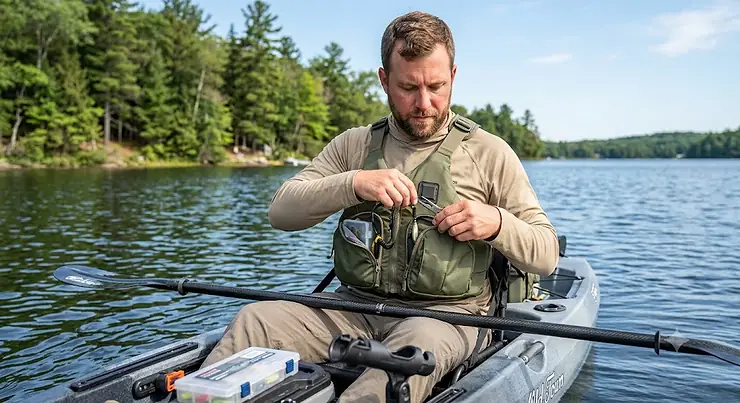
Here’s the thing nobody tells you before your first real day of kayak fishing: the vest is going to make or break your afternoon before the fish ever get a vote. You can have the perfect leader knot and a tackle box organized like a Swiss watch, but if your low profile kayak fishing PFD rides up around your ears every time you lean into a backcast, you’ll spend more time fighting your own gear than fighting fish.
A low profile kayak fishing PFD is a Coast Guard-approved life vest built with thinner foam panels, shorter torso coverage, and a high-cut back designed to clear tall kayak fishing seats — the goal being full safety with almost none of the bulk you’d get from a traditional Type III vest. It’s the difference between “wearing a life jacket” and forgetting you have one on.
That distinction matters more than it sounds, and it’s not just a comfort preference — the U.S. Coast Guard’s own guidance on life jacket wear makes clear that the best PFD is the one you’ll actually keep on, which is exactly the problem bulky vests create. Sit-on-top fishing kayaks now ship with seats that look more like recliners than boat benches, and a standard high-back PFD will bunch up against that seat back within the first ten minutes on the water. Anglers end up either loosening the straps to compromise fit (bad idea) or ditching the vest altogether (worse idea). A properly designed low profile model solves both problems at once.
In this guide, I’ve pulled together seven real, currently available options — foam and inflatable, built for men, built for women, budget and splurge — based on manufacturer specs and aggregated reviewer sentiment from paddling publications and long-term owners. I’ll walk through what each one actually does well, where it falls short, and which angler it’s really built for, so you’re not guessing between a product page and a review that reads suspiciously like the product page.
Quick Comparison: 5 Low Profile Kayak Fishing PFDs at a Glance
Before the deep dive, here’s the short version for anyone standing in an aisle (or a browser tab) trying to make a fast decision.
| PFD | Style | Best For |
|---|---|---|
| NRS Ninja | Foam, low-profile | All-around anglers who paddle and cast constantly |
| Astral V-Eight | Foam, ultralight | Hot-climate paddlers who overheat easily |
| Stohlquist Keeper | Foam, fishing-specific | Anglers with tall, stadium-style kayak seats |
| Onyx MoveVent Dynamic | Foam, budget | First-time buyers who don’t want to overspend |
| NRS Matik | Inflatable, low-profile | Anglers who want near-zero bulk on hot days |
A quick read of this table tells its own story: foam still dominates the “always-on, no-thinking-required” category, while the inflatable options only win once bulk becomes the deciding factor over convenience. The NRS Ninja and Stohlquist Keeper sit closest to the sweet spot most kayak anglers actually need — enough foam to forget it’s there, enough coverage to pass a safety check without a second glance. Budget shoppers shouldn’t feel like the Onyx MoveVent Dynamic is a consolation prize, either; low-profile design has trickled down to entry-level price points faster than most gear categories.
💬 Already have a favorite from this list? One click helps other anglers find the right fit too!😊
Top 7 Low Profile Kayak Fishing PFDs: Expert Analysis
1. NRS Ninja — always-ready, low-profile foam build
The NRS Ninja earns its name honestly — it’s built to disappear on your body the moment you buckle it, which is exactly what you want from something you’re supposed to wear for eight hours straight. NRS updated the Ninja recently with refined panel shaping that hugs the torso instead of boxing it in.
The foam is arranged in slim vertical panels rather than one solid block, which is what lets the vest flex when you rotate through a cast instead of resisting the motion like older-generation vests do. That panel layout also means less foam bunching against your lower back when you’re reclined in a kayak seat for long stretches. Based on the spec sheet, the side-entry zip and quick-release buckles are there to make on/off transitions fast, which matters more than it sounds like during a hot changeover between spots.
Reviewers who tested it on multi-day trips consistently note that it held up well under repeated wet-dry cycles without the foam degrading or the fabric losing shape — a common failure point on cheaper vests. The tradeoff mentioned across owner feedback is pocket space: this is a paddling-first design that happens to work for fishing, not the other way around, so anglers hauling a full tackle arsenal will want external storage.
Pros:
- ✅ Slim panel shaping moves naturally through a full cast
- ✅ Holds shape well after repeated wet use, per owner reports
- ✅ Quick-release side buckles speed up on/off transitions
Cons:
- ❌ Limited pocket space for anglers who carry heavy tackle
- ❌ Runs closer to a paddling fit than a dedicated fishing cut
Expect to pay in the $100-$130 range at the time of research; check current price before buying, since retailer pricing shifts often. For anglers who paddle as much as they fish, this is one of the more honest values in the low-profile category.
2. Astral V-Eight — lightest foam vest in its class
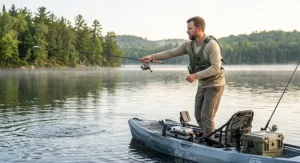
If you fish somewhere the air feels like a wet towel by 10 a.m., the Astral V-Eight was built with your specific misery in mind. At roughly 1.2 pounds, it’s the lightest foam PFD most reviewers have tested, and that weight savings comes from Astral’s Airescape system — a mix of mesh fabric, contoured foam channels, and actual vent ports cut into the panels themselves.
What that spec means in practice: heat and moisture have somewhere to go instead of sitting trapped against your back all day. The extra-high mesh back panel is also specifically shaped to clear the tall seat backs common on modern rec and fishing kayaks, so there’s no fighting the vest every time you lean back to relax between bites. Seven adjustment points let it dial in for a wide range of body shapes, which is why it’s become something of a “loan it to whoever needs one” vest among people who own it.
Aggregated reviewer sentiment consistently praises the breathability above almost anything else in this category — it’s frequently cited as the most ventilated foam vest testers have worn. The compromise is storage: the two zippered pockets are easy enough to reach but genuinely shallow, so this isn’t the vest for someone who wants to carry pliers, a multi-tool, and a spare spool all on the vest itself.
Pros:
- ✅ Airescape venting keeps you noticeably cooler in summer heat
- ✅ Lightest foam PFD most reviewers have handled at 1.2 lbs
- ✅ Seven adjustment points fit a wide range of body types
Cons:
- ❌ Pockets are accessible but shallow for serious tackle storage
- ❌ Minimal-frills design means fewer built-in fishing features
Prices tend to land in the $150-$170 range; always check current price, as breathable premium foam vests see periodic promotions. If overheating is your actual enemy on the water — more so than storage — this is the one worth the extra spend.
3. Stohlquist Keeper — built specifically around tall kayak seats
The Stohlquist Keeper was designed by people who clearly fish from a kayak themselves, because the entire vest is engineered around the one problem generic PFDs never solve: the tall, stadium-style seat backs on modern fishing kayaks. The soft, thin back panel pairs directly with those seats, adding a bit of cushion without ever fighting your paddle stroke or your cast.
Stohlquist’s Graded Sizing system is the other half of the story — instead of just scaling strap length across sizes, the company adjusts the actual foam panel size, thickness, and vest length proportionally. In practice, that means a large-size Keeper fits like it was built for a large-frame angler, not like a medium vest with longer straps bolted on. That’s a meaningfully different experience if you’ve ever worn a “one-size-fits-most” vest that clearly didn’t.
Reviewer sentiment across paddling publications singles this out as a favorite specifically for bigger and taller testers, who reported a noticeably better fit than several competing fishing PFDs tested in the same lineup. The honest downside is that this level of angler-specific engineering shows up in the price, and the fishing-first feature set (rod holders, tool tabs) adds a bit more visual bulk than the sleekest paddling-only vests.
Pros:
- ✅ Graded Sizing scales foam and length proportionally by size
- ✅ Soft back panel pairs cleanly with tall kayak fishing seats
- ✅ Reviewer-favorite fit among big and tall testers specifically
Cons:
- ❌ Costs more than general-purpose low-profile alternatives
- ❌ Fishing-specific features add slightly more visual bulk
Expect a price in the $110-$140 range at the time of research; confirm current pricing before ordering. For anglers whose kayak seat has ever “eaten” a vest’s back panel, this is the direct fix.
4. Stohlquist Ebb — women’s-specific slim-fit design
Most “unisex” PFDs are really men’s PFDs with a smaller size chart bolted on, which is exactly the gap the Stohlquist Ebb was built to close. This is a women’s-specific cut, not a resized men’s vest, and that distinction shows up in the shoulder width, torso taper, and chest panel placement — all shaped around female anatomy rather than adjusted after the fact.
The shell is a 240 denier ripstop nylon with a 200 denier nylon liner, filled with PE (polyethylene) foam for buoyancy between the layers — durable materials that hold their shape through repeated seasons rather than compressing flat after a summer of use. What most buyers overlook about the design is the high back paired with a mesh lower panel: the high back keeps flotation properly positioned around your head and shoulders in the water, while the mesh section underneath stays cool and doesn’t fight a kayak seat back.
Reviewer sentiment consistently frames this as one of the more comfortable “slim-fit” options specifically because the adjustment points let it cinch down without leaving excess fabric flapping at the sides — a common complaint with men’s vests worn by smaller-framed paddlers. The tradeoff is a narrower size range at the top end, so larger-framed anglers may find the Keeper or Ninja a better structural fit regardless of gender marketing.
Pros:
- ✅ True women’s cut, not a resized men’s pattern
- ✅ Durable 240D ripstop shell holds shape season after season
- ✅ Multiple adjustment points eliminate excess side fabric
Cons:
- ❌ Narrower size range than most unisex low-profile options
- ❌ Front pocket space is modest compared to fishing-first vests
Pricing typically sits in the $90-$120 range; prices may vary, so check current listings. If you’ve ever fought excess fabric bunching at your ribs in a men’s-cut vest, this is the direct answer.
5. Onyx MoveVent Dynamic — low-profile design at a budget price
Not every angler needs — or wants to pay for — Airescape venting and graded sizing. The Onyx MoveVent Dynamic exists for that buyer: a genuinely low-profile, USCG-approved Type III vest that doesn’t ask you to spend three figures deep into the hundreds to get there.
The MoveVent name refers to Onyx’s mesh ventilation channels built into the foam layout, which is a real feature rather than marketing dressing — it’s a legitimate way to cut down on the trapped-heat problem that plagues cheap PFDs, even if it doesn’t match the airflow of Astral’s Airescape system. Based on the spec comparison with pricier options on this list, the foam here is a bit denser and less contoured, which is the honest tradeoff for the lower price point — you’re getting real low-profile shaping, just without the last 10% of refinement.
Aggregated reviews frame this specifically as the “best low-profile” pick in its price tier rather than the category overall, which is an important distinction: it competes on value, not on outright comfort ceiling. First-time buyers testing the waters of kayak fishing — literally and figuratively — consistently point to this as a smart place to start before committing to a premium vest.
Pros:
- ✅ Genuine low-profile fit at a noticeably lower price point
- ✅ Mesh ventilation channels meaningfully cut trapped heat
- ✅ USCG Type III approval with no corners cut on safety
Cons:
- ❌ Denser foam than premium options, less contoured feel
- ❌ Fewer adjustment points than fishing-specific competitors
Expect around $60-$85 at the time of research; check current price for seasonal shifts. For anyone unsure they’ll stick with kayak fishing long-term, this removes the financial risk of finding out.

6. Onyx A/M-24 — automatic/manual inflatable with minimal bulk
The Onyx A/M-24 takes a completely different approach to “low profile” — instead of thinning out foam, it removes the foam almost entirely and inflates on demand. That single design choice is why inflatable PFDs divide anglers so sharply: skeptics assume less material means less confidence, while converts describe forgetting they’re wearing it within minutes.
The headline feature is right in the name — you can switch between automatic inflation (triggered by water contact) and manual inflation (a pull-cord you control), which solves the classic inflatable-PFD problem of wet-wading or heavy spray accidentally triggering the CO2 cartridge. During testing referenced across review coverage, it never interfered with casting or fighting a fish, which is the entire selling point of going inflatable in the first place. The neoprene neckline is a small detail that matters more than it should, since standard-collar inflatables tend to chafe on long, hot days.
Here’s the honest math on long-term cost: rearming after a deployment (intentional or accidental) runs about $25 per cartridge, so anglers who practice deployments or fish rough conditions regularly should budget for that ongoing expense. There’s also essentially no pocket storage, meaning this only works paired with a kayak’s built-in storage or a separate tackle bag.
Pros:
- ✅ Switchable auto/manual inflation covers wet-wading safely
- ✅ Near-zero bulk — testers report forgetting it’s on
- ✅ Neoprene neckline prevents chafing on long fishing days
Cons:
- ❌ Rearming after deployment costs roughly $25 per cartridge
- ❌ Essentially no pockets — requires separate tackle storage
Typical pricing runs $150-$180 before rearming kits; prices may vary, so confirm current cost. This is the pick for anglers who’ve decided bulk is a bigger enemy than the idea of inflation.
7. NRS Matik — low-profile inflatable with unrestricted mobility
Where the A/M-24 wins on flexibility between inflation modes, the NRS Matik wins on pure, uninterrupted range of motion. It’s built as a hydrostatic inflatable, meaning it triggers based on water pressure at depth rather than simple moisture contact — a meaningfully more reliable trigger method that cuts down on false inflations from rain or heavy spray.
What that spec actually buys you: a vest that sits almost flat against your torso until the moment it’s genuinely needed, with none of the panel bulk that even the best foam vests still carry. Reviewer coverage consistently ranks it among the top inflatable picks specifically for kayak fishing, citing the completely unrestricted shoulder and torso movement as the standout trait — there’s simply less material between you and your cast.
The honest tradeoff is the one every inflatable shares: no foam means no passive flotation before activation, which matters if you’re unconscious or the mechanism fails, and hydrostatic units carry a higher price tag than basic water-activated designs. Anglers who fish alone in remote water should weigh that against the comfort gains carefully rather than defaulting to the lightest option automatically.
Pros:
- ✅ Hydrostatic trigger reduces false inflations from rain or spray
- ✅ Least restrictive range of motion of any option on this list
- ✅ Sits nearly flat against the torso until activated
Cons:
- ❌ No passive flotation before inflation, unlike foam vests
- ❌ Premium price tag compared to basic inflatable models
Expect to pay in the $200-$230 range at the time of research; check current pricing, as hydrostatic units see less frequent discounting. For serious anglers who’ve made peace with inflatable technology, this is close to the ceiling of what’s currently available.
How to Choose a Low Profile Kayak Fishing PFD
Here’s a direct answer before the deep dive: choosing the right low profile kayak fishing PFD comes down to matching seat height, climate, and storage needs against foam or inflatable construction — not just picking whichever vest looks thinnest on a store shelf.
- Measure your torso against your kayak seat height first. A vest that clears a low bucket seat may still bunch against a tall, stadium-style seat back — check seat clearance before checking reviews.
- Decide if you run hot or cold on the water. Anglers who overheat easily should prioritize mesh ventilation systems; anglers fishing cold, exposed water may want more foam coverage regardless of profile.
- Be honest about how much tackle you actually carry on your body. Low-profile foam vests trade pocket space for slimness; inflatables trade it away almost entirely.
- Weigh foam versus inflatable against your fishing style. Foam gives instant, no-thinking buoyancy; inflatables give near-zero bulk but need mode-checking and occasional rearming.
- Check the size chart against your actual chest measurement, not your shirt size. A snug-but-breathable fit is safer and more comfortable than an oversized “universal fit” vest.
- Confirm USCG Type III approval before anything else. No amount of comfort matters if the vest isn’t legally and functionally approved for the water you’re fishing.
- Budget for the vest’s full lifecycle, not just the sticker price. Inflatables carry ongoing rearm costs; foam vests need periodic replacement as foam compresses over years of use.
Kayak Fishing PFD for Men vs Kayak Fishing PFD for Women
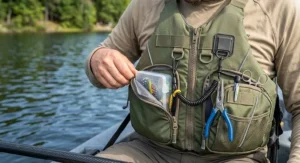
The gear industry spent years pretending “unisex” PFDs fit everyone equally, and anyone who’s actually worn one on a hot day knows that’s not quite true. A kayak fishing PFD for men is typically cut with a broader shoulder line, longer torso panels, and chest pocket placement built around a flatter chest profile. A kayak fishing PFD for women — like the Stohlquist Ebb — narrows the shoulder width, shortens the torso taper, and repositions the chest panels so the vest doesn’t ride up or gap under load.
That gap-and-ride-up problem is the real issue, not comfort in the abstract. A men’s-cut vest worn by a smaller-framed paddler tends to leave excess fabric bunched at the ribs even when fully cinched, which is exactly the kind of loose material that catches on a rod handle mid-cast. Meanwhile, a women’s-specific vest worn by a broader-framed angler can feel restrictive across the shoulders in a way that limits paddle stroke and casting range — the mismatch runs both directions.
What most buyers overlook here is that “men’s” and “women’s” PFDs are really just two different assumptions about torso geometry, not a statement about who’s allowed to wear which one. The smartest approach is trying on both cuts against your actual body, not your gender, and picking whichever one eliminates excess fabric and restriction simultaneously. Retailers with in-store fitting are worth the trip if you’re between sizes on either line.
Inflatable Kayak Fishing PFD vs Foam: What Minimal Bulk Design Actually Costs You
| Factor | Foam (e.g. NRS Ninja) | Inflatable (e.g. NRS Matik) |
|---|---|---|
| Bulk | Low-profile, but still visible on-body | Nearly flat until triggered |
| Passive flotation | Instant, no action required | None until inflation |
| Storage/pockets | Moderate to good | Minimal to none |
| Ongoing cost | None beyond initial purchase | Rearm cartridges after use |
| Best climate | Cold or mixed conditions | Hot climates, minimal movement restriction |
The table makes the tradeoff plain: an inflatable kayak fishing PFD like the NRS Matik genuinely delivers on minimal bulk design, offering close to zero restriction until the moment it’s needed. What that convenience costs is passive safety — a foam vest floats you the second you hit the water, while an inflatable needs its mechanism to work correctly, whether that’s a hydrostatic trigger or a manual pull. For anglers fishing alone in remote or cold water, that gap is worth weighing seriously against the comfort upgrade.
Foam still wins on total lifecycle cost, since there’s no cartridge to replace after every deployment or accidental soak. Inflatables win on hot-day comfort and unrestricted casting, provided the angler is disciplined about checking the cartridge and mechanism before every outing — a step foam vests simply don’t require.
💬 Foam or inflatable — which side are you on? Share this comparison with your fishing crew!😊
Common Mistakes When Buying a Low Profile Fishing PFD
Even careful buyers trip over the same handful of mistakes, and most of them show up after the return window has already closed.
Sizing by shirt size instead of chest measurement is the most common one — a vest sized off a “large t-shirt” assumption routinely ends up too loose to stay in place during an aggressive hookset. Buyers also frequently skip checking their kayak’s actual seat height against the vest’s back panel length, only discovering the mismatch on the water when the vest bunches against a tall seat back. A third mistake is choosing an inflatable purely for the bulk savings without accounting for the ongoing rearm cost or the discipline required to check the cartridge before every trip — a maintenance habit that’s easy to forget after the first few uneventful outings.
Buyers also underestimate how much pocket space they’ll actually miss once they’ve committed to an ultra-low-profile design, then end up bolting on an aftermarket tackle bag that partially defeats the low-profile purpose in the first place.
Features That Actually Matter (And Those That Don’t)
Marketing copy loves to list features, but not every feature moves the needle for kayak seat clearance or casting comfort. Mesh ventilation channels and graded sizing by torso length genuinely matter — they directly solve the two biggest complaints anglers report: overheating and seat interference. A high, contoured back panel that clears a stadium-style kayak seat is arguably the single most important spec on this entire list, since it’s the difference between wearing the vest comfortably for eight hours and quietly taking it off by hour two.
What matters less than the marketing suggests: an oversized number of pockets on a vest marketed as “low-profile” in the first place, since more pockets almost always means more foam bulk to hold them. Reflective trim and bright accent colors look good in product photos but add negligible real-world safety value versus simply wearing any properly fitted, brightly colored PFD in open water. Buyers should weigh seat clearance and ventilation heavily, and weigh pocket count and cosmetic extras much more lightly than the packaging implies.
Long-Term Cost & Maintenance
A PFD’s price tag is only half the financial picture, and it’s the half most buyers focus on entirely.
| Vest Type | Upfront Cost Range | Ongoing Cost |
|---|---|---|
| Budget foam (Onyx MoveVent Dynamic) | $60-$85 | None; replace foam every 5-7 years |
| Mid-range foam (Stohlquist Keeper, Stohlquist Ebb) | $90-$140 | None; replace foam every 5-7 years |
| Premium foam (Astral V-Eight) | $150-$170 | None; replace foam every 5-7 years |
| Inflatable (Onyx A/M-24, NRS Matik) | $150-$230 | ~$25 per rearm cartridge after each deployment |
Looking at the numbers, foam vests are effectively a one-time purchase that quietly ages out over several seasons as the foam compresses and loses buoyancy — a slow, easy-to-ignore decline that’s worth checking annually. Inflatables flip that math: a lower total ownership cost is possible if the vest is never deployed, but anglers who fish rough water or practice safety drills regularly should factor the rearm cost into their real annual spend rather than treating the sticker price as the full story.
Safety, Regulations & Compliance Guide
Every PFD on this list needs to clear one non-negotiable bar before comfort or style even enters the conversation: Coast Guard-approved wearable status is federally required equipment on board for every kayaker, regardless of how experienced you are. Approval status is confirmed by a label inside the vest — not by the marketing on the outside — so it’s worth checking that label directly rather than assuming a name-brand vest is automatically compliant.
Under the older Type classification system that’s still widely referenced, most kayak fishing PFDs fall under Type III flotation aid guidelines, which prioritize comfort and mobility for active water sports over the automatic face-up turning that bulkier Type I and Type II vests provide. That tradeoff is intentional — Type III vests assume calm, inland water with realistic rescue timelines, which describes the overwhelming majority of kayak fishing conditions.
State-level rules on when a PFD must be worn (versus simply carried on board) vary, so it’s worth a quick check of your specific state’s boating authority before assuming federal minimums are the whole picture.
How to Break In and Maintain Your New PFD
A brand-new low-profile PFD almost never fits perfectly out of the box, and treating the first few outings as a fitting process — not a final verdict — saves a lot of frustration.
Start by adjusting every strap on dry land while seated in your actual kayak seat, not standing in your living room; torso position changes meaningfully between standing and seated posture. On the first wet outing, deliberately test a full casting motion, a paddle stroke, and a seated recline to confirm nothing binds or rides up before you’re relying on it in real conditions. Rinse the vest in fresh water after every saltwater trip, since salt crystallizes in foam and stitching over time and accelerates wear.
Store it somewhere it can fully dry and away from direct sun, since UV exposure breaks down foam buoyancy and fabric strength faster than water use alone. A common first-30-days mistake is over-tightening the shoulder straps to compensate for a slightly-too-large size instead of exchanging for a proper fit — a tight-but-wrong-size vest rides differently than a properly sized one, and the difference shows up exactly when you need the vest to perform. If you’re new to kayak fishing specifically, a paddling-specific safety course through a group like the American Canoe Association covers fitting and on-water habits that go well beyond what any product manual will tell you.
Real Anglers, Real Picks: Matching PFDs to How You Fish
Consider a college student kayak fishing local ponds after class a few times a week on a tight budget — the Onyx MoveVent Dynamic covers the safety requirement and the low-profile comfort without the premium price tag, which matters when gear budget competes with rod and reel upgrades.
Consider a woman who fishes coastal flats most weekends and has struggled with excess fabric bunching in unisex vests — the Stohlquist Ebb solves the fit problem directly, and its durable shell holds up to the frequent saltwater exposure that flats fishing involves.
Consider an angler who fishes hot, humid summer mornings for four or five hours at a stretch and runs hot even in light clothing — the Astral V-Eight‘s ventilation system is built exactly for that discomfort, trading a bit of storage for meaningfully better heat management across a long session.
Consider a tournament angler who fishes aggressively, casts constantly, and can’t tolerate any restriction in shoulder movement — the NRS Matik removes nearly all the bulk a foam vest would add, provided they’re disciplined about checking the trigger mechanism before every launch.
Your Casting Freedom Decision Framework
If your kayak seat is tall and stadium-style, choose a vest with a high, contoured back panel — like the Stohlquist Keeper — because seat interference is the single biggest comfort killer on the water. If you overheat easily and fish mostly in warm climates, choose a heavily ventilated foam vest like the Astral V-Eight, because passive flotation still matters even when comfort is the priority. If unrestricted casting freedom matters more than storage or passive flotation, choose an inflatable like the NRS Matik or Onyx A/M-24, and build the rearm cost into your annual gear budget from day one. If you’re not yet sure kayak fishing is a long-term hobby, choose the Onyx MoveVent Dynamic and revisit the premium options once you know your actual habits and pain points.
✨ Ready to Upgrade Your Time on the Water?
🔍 Compare the full lineup above and check current pricing before your next trip. A properly fitted, low-profile PFD is the one piece of gear that quietly makes every single outing better — casting, paddling, and long, comfortable days chasing fish.
FAQ
❓ What is a low profile kayak fishing PFD?
❓ Are inflatable PFDs safe for kayak fishing?
❓ Do women need a different PFD than men for kayak fishing?
❓ How do I know if a PFD will clear my kayak seat?
❓ How often should I replace a kayak fishing PFD?
Conclusion
Choosing a low profile kayak fishing PFD really comes down to three honest questions: how tall is your seat, how much do you overheat, and how much gear do you actually need strapped to your chest. The NRS Ninja and Stohlquist Keeper cover the broadest range of anglers without forcing a compromise on either comfort or storage, while the Astral V-Eight solves overheating specifically and the Stohlquist Ebb solves fit for smaller-framed paddlers directly. If minimal bulk design is the deciding factor above everything else, the inflatable options — the Onyx A/M-24 and NRS Matik — deliver on that promise, provided you budget for rearm costs and stay disciplined about pre-trip checks.
None of these seven are the “wrong” choice in isolation; they’re built for genuinely different priorities, which is exactly why a side-by-side comparison matters more than a single “best overall” pick. Match the vest to your seat, your climate, and your fishing style, and the PFD becomes the piece of gear you stop thinking about — which, for safety equipment, is precisely the point.
Recommended for You
- 7 Best Kayak PFD with Pockets Picks for Anglers in 2026
- 7 Best PFD for Kayak Anglers Picks in 2026
- Bass Fishing Life Vest Guide 2026: 7 Picks Anglers Actually Love
Disclaimer: This article contains affiliate links. As an Amazon Associate, I earn from qualifying purchases. If you purchase products through these links, we may earn a small commission at no additional cost to you.
✨ Found this helpful? Share it with your friends! 💬🤗
