
In This Article
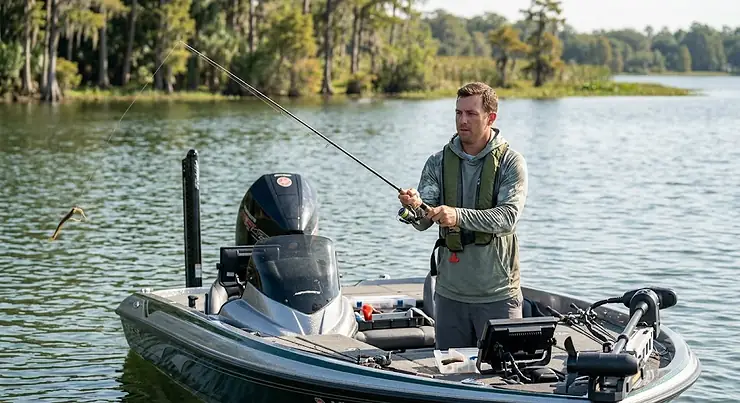
A bass fishing life vest is a personal flotation device built specifically for anglers, combining U.S. Coast Guard-approved buoyancy with tackle storage, high-back cuts for boat seats, and freedom of movement for casting. Unlike a generic boating life jacket, it’s designed to be worn all day without turning into dead weight strapped to your chest.
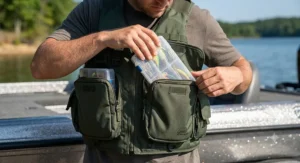
Here’s the uncomfortable truth nobody at the marina wants to say out loud: most anglers own a life vest, and most anglers don’t wear it. It sits under the console, sun-bleached and forgotten, until a game warden or a rough patch of chop reminds them why it exists. That gap between owning and wearing is almost always a comfort problem, not a safety-awareness problem. Give someone a stiff, boxy vest that rides up every time they cast, and they’ll leave it in the rod locker. Give them one built around how bass anglers actually move — twisting to flip a jig, reaching for pliers, standing on a rocking deck — and it becomes part of the uniform, not a punishment for boating responsibly.
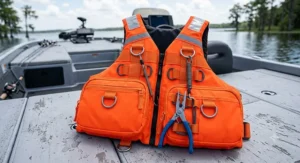
That’s really what separates a purpose-built bass fishing life vest from the orange horse-collar personal flotation device in your garage: fit, mobility, and fishing-specific features like rod holders, tool loops, and pockets sized for tackle instead of picnic supplies. Whether you’re running a bass boat at 60 mph, easing a kayak into a weed bed, or working an offshore point on choppy water, the right vest should disappear on your body until the moment you actually need it.
In this guide, we’ve researched seven real, currently available vests spanning budget foam options to premium hybrid inflatables, so you can match the one that fits your fishing style, your budget, and — most importantly — the vest you’ll actually keep zipped up.
Quick Comparison Table
| Vest | Style | Best For | Price Range |
|---|---|---|---|
| NRS Chinook Fishing PFD | Foam, high-back | All-around kayak & bass anglers | $130–$160 range |
| Onyx MoveVent Dynamic | Foam, mesh cutout | Budget-conscious, hot-weather anglers | $70–$90 range |
| Mustang Survival Accel 100 | Foam, Cordura | High-speed tournament bass boats | Around $100–$140 |
| Stohlquist Fisherman PFD | Foam, fold-down pockets | Fly and finesse anglers needing tackle access | $100–$150 range |
| BPS Tournament Fishing Life Jacket | Foam, high pocket count | Budget tournament weekends | Under $60 |
| Onyx A/M-24 Inflatable | Inflatable, auto/manual | Offshore and open-water anglers | $180–$200 range |
| Mustang Survival Khimera | Hybrid dual-flotation | All-day comfort, minimal bulk | Around $230–$250 |
Notice the spread here — this isn’t seven versions of the same vest with different logos slapped on. You’ve got traditional foam workhorses, a Cordura-reinforced speed vest built for tournament bass boats, and two inflatables at the premium end that trade pocket space for near-total mobility. If you fish mostly from a kayak or small bass boat and want maximum storage, lean foam. If you’re running offshore or just can’t stand the bulk of a traditional vest against your skin in July, the inflatable and hybrid options are worth the extra cost.
💬 Already have a favorite? Jump to the comparison table below and share which one you’re considering — your fellow anglers might thank you for it!
Top 7 Bass Fishing Life Vests: Expert Analysis
1. NRS Chinook Fishing PFD — best all-around pick for kayak and bass anglers
The Chinook earns its reputation as the default recommendation in kayak fishing forums for a reason: it was designed by watching how anglers actually fish, not how traditional boaters wear a vest. It delivers roughly 16 pounds of foam flotation in a Type III design, which is the sweet spot for anglers who spend hours seated rather than swimming laps.
What the spec sheet won’t tell you is how much the high-back cut matters once you’re actually in a boat seat — it clears tall kayak and bass boat backrests so the vest doesn’t push your head forward all afternoon, which is the single biggest comfort complaint about generic life jackets. The two clamshell tackle pockets are genuinely sized for lures and pliers, not just a phone and keys, and the zippered front entry means you’re not fighting buckles with wet hands.
Reviewers consistently note that the PlushFit foam holds up across multi-season use without breaking down, and several long-term owners specifically call out the high-back design as the reason they switched from a cheaper vest. The main complaint that surfaces repeatedly is price — it costs roughly three times what a basic recreational vest runs.
Pros:
- ✅ High-back design clears tall boat and kayak seats
- ✅ Large, organized tackle pockets sized for real gear
- ✅ Rod holder loop and dedicated tool attachment points
Cons:
- ❌ Noticeably pricier than generic recreational vests
- ❌ Bulkier than minimalist inflatable alternatives
At $130–$160 range, the NRS Chinook Fishing PFD isn’t the cheapest option here, but for anglers who fish more than a handful of days a year, the pocket layout alone tends to pay for itself in convenience.
2. Onyx MoveVent Dynamic — most breathable pick for hot-weather days
If your priority is arm mobility above everything else, this is the vest built around that single idea. The MoveVent Dynamic uses complete cut-out sides rather than traditional armholes, which sounds like a small detail until you’re mid-cast and realize nothing is catching under your shoulder.
The sculpted foam panels are lightweight and conform to your torso rather than sitting like a stiff plank, and mesh ventilation runs front and back to fight the sweat-through-your-shirt problem that plagues foam vests in July. Dual sizing (covering roughly a 28-inch to 56-inch chest range across two size options) means most body types can find a workable fit without ordering a specialty size.
Based on the spec comparison against pricier fishing-specific vests, this model trades tackle storage for mobility and price — there’s a single expandable zippered pocket rather than the multi-pocket tackle rigs found on dedicated fishing vests, so it suits anglers who keep gear in a boat box rather than on their body.
Pros:
- ✅ Cut-out sides maximize casting and paddling range of motion
- ✅ Dual-sided mesh ventilation for hot-weather comfort
- ✅ Budget-friendly compared to fishing-specific competitors
Cons:
- ❌ Minimal pocket storage compared to dedicated tackle vests
- ❌ Less structured foam support for larger body frames
At $70–$90 range, the Onyx MoveVent Dynamic is the easiest entry point on this list for anglers who mainly need a comfortable, breathable vest without paying for pockets they won’t use.
3. Mustang Survival Accel 100 — built for high-speed tournament bass boats
Tournament bass fishing has a specific problem generic vests don’t solve: boats that hit 60-plus mph on the way to a starting spot. The Accel 100 is engineered specifically around that scenario, using a 500-denier Cordura shell that’s strength-rated to handle speeds up to 50 mph — a spec that matters far more than it sounds once you’re strapped in at wide-open throttle across open water.
What most buyers overlook about this category is that speed rating isn’t marketing fluff; a vest that wasn’t built for high-velocity impact can shift, twist, or fail to stay secured exactly when a sudden stop or wake sends you forward. The Accel 100 is purpose-built for the exact use case tournament anglers live in every weekend: gunning it to the first stump, then fishing all day in the same vest.
Because it’s engineered around durability and speed rather than ventilation, it runs warmer than mesh-forward designs, which is the honest trade-off here — reviewers note it holds up to abuse well but isn’t the coolest option for a August weigh-in.
Pros:
- ✅ 500D Cordura shell built for high-speed boat runs
- ✅ Rated to withstand 50 mph impact conditions
- ✅ Purpose-engineered for tournament bass boat use
Cons:
- ❌ Less ventilated than mesh-heavy alternatives
- ❌ Premium fishing-specific pricing versus a generic Type III
In the $100–$140 range, the Mustang Survival Accel 100 is the vest to reach for if your tournament schedule involves more time at speed than any other product on this list accounts for.
4. Stohlquist Fisherman PFD — best fold-down tackle workstation
The defining feature here is the front pocket design: dual tool pouches with EVA-stiffened outer shells that fold down flat to act as a workstation when opened, essentially turning your chest into a fly-tying or rigging bench. For anglers who tie knots, swap leaders, or dig through small tackle constantly, that hands-free work surface is a genuinely different experience than reaching into a standard zippered pocket.
Owners consistently describe the build quality as excellent, with one longtime kayak angler noting they chose it specifically over a competing high-back model because the construction felt more durable. The fit allows ample range of motion for paddling and casting, which matters just as much for bass anglers working topwater as it does for kayak fishermen.
Here’s what the spec sheet won’t tell you: the front pockets, while clever in design, run smaller than some anglers expect — several reviewers specifically mention struggling to fit a medium-sized tackle or fly box inside, so pair this vest with a boat-mounted tackle box rather than expecting it to hold your whole arsenal.
Pros:
- ✅ Fold-down EVA-stiffened pockets double as work surfaces
- ✅ Well-regarded build quality among kayak and bass anglers
- ✅ Ample range of motion for casting and paddling
Cons:
- ❌ Front pockets run small for medium tackle boxes
- ❌ No dedicated mesh lower-back panel like some rivals
At $100–$150 range, the Stohlquist Fisherman PFD is the pick for anglers who want a genuine workstation strapped to their chest rather than just storage.
5. BPS Tournament Fishing Life Jacket — best budget option for tournament weekends
Bass Pro Shops built this one around sheer pocket volume, and it shows — testers reviewing it noted it has more pockets than most anglers know what to do with, along with rings and loops to hang nearly any tool or accessory you’d carry into a weigh-in line. For weekend tournament anglers who haul pliers, scales, multiple lure boxes, and a rain jacket, that storage capacity solves a real problem.
Based on the spec comparison against premium foam vests, this model doesn’t try to compete on ultra-premium materials or minimalist profile — it competes on utility per dollar, which is exactly what a lot of weekend tournament anglers actually need. It’s built to Type III Coast Guard standards, so the safety baseline is identical to pricier options even though the finishing touches are simpler.
Reviewers consistently point to the value proposition as the standout here: you’re getting fishing-specific organization without paying fishing-specific prices, though the trade-off is a bulkier build and fewer premium comfort touches like sculpted foam or moisture-wicking liners.
Pros:
- ✅ High pocket count for tackle, tools, and accessories
- ✅ Rings and loops for hanging gear within reach
- ✅ Budget-friendly Type III Coast Guard-approved design
Cons:
- ❌ Bulkier fit than sculpted premium foam vests
- ❌ Fewer comfort-focused materials than higher-end competitors
Priced under $60, the BPS Tournament Fishing Life Jacket is the practical choice for anglers outfitting an entire tournament team on a budget.
6. Onyx A/M-24 Auto/Manual Inflatable — best low-bulk option for offshore anglers
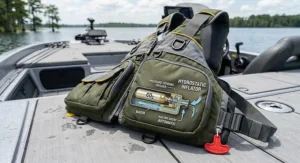
Inflatables solve a problem foam vests can’t: bulk. The A/M-24 provides roughly 22.5 pounds of buoyancy once inflated — noticeably more than most foam Type III vests — while sitting nearly flat against your body until the moment it’s needed. That’s a meaningful upgrade for offshore anglers running big water where higher buoyancy actually matters if conditions turn.
The standout engineering detail is the switchable inflation mode: automatic for open water where you might not have a chance to pull the cord yourself, or manual for situations like paddleboard fishing where you expect to get splashed and don’t want an accidental trigger. Reviewers specifically call out running it in automatic mode on fast bass boats and manual mode when wading or paddling, switching based on the day’s conditions rather than being locked into one setting.
What most first-time inflatable buyers overlook is the storage trade-off: with no foam bulk to hollow out for pockets, there’s essentially nowhere to stash tackle, so this vest works best paired with a tackle bag or boat storage rather than replacing your pocket-heavy foam vest entirely.
Pros:
- ✅ 22.5 lbs of buoyancy once inflated — high for the category
- ✅ Switchable automatic or manual inflation modes
- ✅ Minimal bulk and profile for hot offshore days
Cons:
- ❌ Very limited storage space compared to foam vests
- ❌ Requires CO2 cartridge maintenance and periodic re-arming
At $180–$200 range, the Onyx A/M-24 Auto/Manual Inflatable earns its premium price for offshore and open-water anglers who value buoyancy and low bulk over tackle storage.
7. Mustang Survival Khimera — best hybrid for all-day comfort
The Khimera splits the difference between foam and inflatable in a genuinely clever way: roughly 7.5 pounds of foam buoyancy keeps you afloat passively at all times, while a pull-cord inflatable cell adds another 13 pounds on demand, for 20.5 pounds total when fully deployed. That dual-flotation approach means you’re never fully “uninflated and unsafe” the way a pure inflatable can be if the cell fails to trigger.
On paper, this means you get some of the packability anglers love about inflatables without giving up all the passive safety margin of foam. In practice, owners describe it as barely noticeable while worn, with wide arm cutouts that keep paddling and casting motion unrestricted — several specifically mention using it across boating, kayaking, and fishing interchangeably because the slim profile doesn’t demand a dedicated “fishing vest” at all.
Reviewers consistently praise the adjustable fit and rearm process (simply deflate the cell and swap the CO2 cylinder, no repacking required), though a few note the single front pocket is really only large enough for a phone, not a meaningful amount of tackle.
Pros:
- ✅ Dual foam-plus-inflatable buoyancy system, 20.5 lbs total
- ✅ Slim, low-profile fit that barely restricts movement
- ✅ No-repack re-arming after inflation — just swap the cylinder
Cons:
- ❌ Highest price point on this list
- ❌ Minimal pocket space for tackle or accessories
Around $230–$250, the Mustang Survival Khimera is the splurge pick for anglers who fish long days across multiple activities and want one vest that disappears on their body regardless of what they’re doing.
Real-World Scenarios: Matching the Right Vest to Your Fishing Style
Picture three anglers heading out on the same Saturday morning. The first is a college student with a used 14-foot jon boat, fishing three or four evenings a week after class, budget stretched thin after buying a new reel. For that angler, the BPS Tournament Fishing Life Jacket or the Onyx MoveVent Dynamic makes the most sense — both deliver Coast Guard-approved safety without asking for a premium-brand price tag.
The second angler is a weekend tournament competitor running a 21-foot bass boat at 65 mph to reach a favorite hole before the field arrives. Speed-rated construction stops being optional at that point, which is exactly why the Mustang Survival Accel 100 exists — it’s rated to handle the exact conditions this angler faces every tournament morning.
The third is someone who fishes offshore structure from a center console a few times a month, values low bulk in summer heat, and wants maximum buoyancy if things go sideways in open water. That’s the profile the Onyx A/M-24 Auto/Manual Inflatable was built around, with its higher buoyancy rating and switchable inflation modes suited to open-water conditions.
Setting Up and Maintaining Your Fishing PFD
Getting a new vest out of the packaging isn’t quite grab-and-go. Start by adjusting all shoulder and side straps while standing, not sitting — a vest that feels snug in a chair often rides up once you’re standing to cast. Cinch it down until you can slide a flat hand under the shoulder strap but not a full fist; looser than that and the vest can ride up over your chin during a fall into water.
For foam vests like the NRS Chinook Fishing PFD or Stohlquist Fisherman PFD, rinse with fresh water after every saltwater trip and let them air dry fully before storage — packing away a damp vest is the fastest way to develop mildew in the foam panels. For inflatables like the Onyx A/M-24 Auto/Manual Inflatable or the Mustang Survival Khimera, check the CO2 cartridge and inflation indicator at the start of every season, and manually top off the oral inflation tube once a month to confirm the bladder still holds air. The U.S. Coast Guard’s boating safety division publishes wear-rate and maintenance guidance updated each season if you want to cross-check current recommendations.
The most common first-30-days mistake is over-tightening the vest so much that it restricts casting motion, then quietly leaving it unzipped “just for today” — which defeats the entire purpose. Dial in the fit once, properly, and you won’t be tempted to cut corners on day two.
✨ Don’t Miss These Exclusive Deals!
🔍 Ready to gear up for the season? Check current pricing and availability on any of the vests above before they sell out in your size. A comfortable, properly fitted bass fishing life vest is the one piece of gear that pays for itself the moment you actually need it.
Your Buyer’s Decision Framework for Choosing a Bass Fishing Life Vest
Use this simple framework if you’re stuck between two or three options:
- If your boat runs over 40 mph regularly, choose a speed-rated foam vest like the Mustang Survival Accel 100, because impact durability matters more than ventilation at that speed.
- If you fish mostly in hot, humid conditions and prioritize mobility over storage, choose a mesh cutout design like the Onyx MoveVent Dynamic, because breathability keeps you wearing it consistently.
- If you fish offshore or open water where buoyancy margin matters most, choose an inflatable like the Onyx A/M-24 Auto/Manual Inflatable, because its higher buoyancy rating outperforms most foam options.
- If you want one vest for boating, kayaking, and fishing without switching gear, choose a hybrid like the Mustang Survival Khimera, because dual flotation covers multiple use cases at once.
- If your budget is the deciding factor and you fish casually, choose the BPS Tournament Fishing Life Jacket, because it delivers Coast Guard-approved safety without the premium price tag.
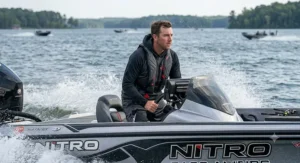
How to Choose a Bass Fishing Life Vest
- Confirm Coast Guard approval first. Every option on this list is a certified Type III or Type V device — never compromise on this regardless of style or price.
- Match buoyancy to your body weight and water conditions. Heavier anglers or rougher open water call for higher buoyancy ratings, like the 20+ pound options covered above.
- Prioritize fit over features. A vest with every pocket imaginable is worthless if it rides up when you actually fall in — try it on and move through a casting motion before buying.
- Decide between foam and inflatable based on climate. Foam is more forgiving and low-maintenance; inflatables run cooler but require periodic cartridge checks.
- Count how much tackle you actually carry on your body. If you keep gear in the boat, skip pocket-heavy vests and save money on a lighter design.
- Check the back-panel height against your seat. A high-back cut prevents the vest from pushing your head forward against tall kayak or bass boat seats.
- Factor in resale and durability if you fish often. Cordura-reinforced or premium foam vests tend to outlast budget nylon builds across multiple seasons.
Bass Fishing Life Vest vs Traditional Boating Life Jacket
A standard boating life jacket — the kind sold in a multi-pack at a big-box store — is designed around a completely different priority: covering the broadest possible range of body types and boating activities at the lowest possible cost. It typically has one or two small pockets at best, a straight-cut back that doesn’t account for a kayak or bass boat seat, and bulky underarm foam that catches your elbow mid-cast.
| Feature | Traditional Life Jacket | Bass Fishing Life Vest |
|---|---|---|
| Pocket storage | Minimal or none | Multiple tackle-sized pockets |
| Back design | Flat, generic cut | High-back, seat-clearing cut |
| Arm mobility | Restrictive underarm foam | Cutout or sculpted foam panels |
| Fishing features | None | Rod loops, tool tabs, D-rings |
| Best For | Passengers, occasional boaters | Anglers who fish for hours |
The practical difference shows up after about twenty minutes on the water: a traditional jacket starts feeling like a straightjacket the moment you’re repeatedly twisting to cast, while a purpose-built vest is engineered around that exact motion. If you only boat a couple times a year with the family, a generic jacket is perfectly fine — but for anyone who fishes regularly, the added cost of a dedicated angling vest buys back comfort you’ll actually notice by hour two.
Fishing-Specific Features That Actually Matter
Marketing copy loves to list features, but only a handful genuinely change your day on the water. A high-back cut matters enormously if you fish from a kayak or bass boat with a tall seat — it’s the difference between a vest that stays put and one that constantly gets shoved up toward your ears. Tool attachment tabs and rod holder loops matter if you’re the type who’s constantly setting down and picking back up pliers, a net, or a spare rod.
What most buyers overlook is that pocket count matters less than pocket size and closure type. A vest with eight tiny pockets you never use is worse than one with two large, zippered ones sized for an actual tackle box. Reflective accents and a whistle, meanwhile, are cheap to include and easy to overlook on a spec sheet, but they’re the features that matter most in the exact low-visibility, early-morning-fog scenario every angler eventually experiences.
Features that matter far less than marketing suggests: color choice (functionally irrelevant beyond personal preference and visibility), and exotic fabric branding that doesn’t translate into a measurable durability or comfort difference over a standard nylon or Cordura shell.
Comfortable Fishing PFD: Fit, Mobility and All-Day Wear
Comfort in a fishing PFD isn’t a single feature — it’s the sum of fit, ventilation, and how the foam or inflatable cell interacts with your specific casting motion. Based on the spec comparison across all seven vests here, the two variables that separate a comfortable vest from an irritating one are shoulder strap placement and how much the design accounts for arm rotation.
Cutout designs like the Onyx MoveVent Dynamic solve mobility almost entirely through shape, removing material from the areas that typically bind. Hybrid and inflatable designs like the Mustang Survival Khimera and Onyx A/M-24 Auto/Manual Inflatable solve it through minimal bulk instead — there’s simply less material to restrict you in the first place. Traditional pocket-heavy vests like the Stohlquist Fisherman PFD and NRS Chinook Fishing PFD solve it through ergonomic foam shaping paired with high-back cuts.
The honest takeaway: no single design wins on comfort for every body type and fishing style. The best move is trying on a vest and running through an actual casting motion in the store or a return-friendly online order before committing.
Fly Fishing Life Jackets vs Bass Boat Vests: What’s the Difference
Fly anglers and bass boat anglers ask their vests to do genuinely different jobs, and the differences show up in pocket design more than anything else. A fly fishing life jacket typically prioritizes chest-mounted, easily-accessible pockets sized for fly boxes, tippet spools, and leader material — small, frequently-accessed items that need to be reachable without breaking your back cast.
A bass boat vest, by contrast, is built around larger clamshell pockets sized for lure boxes, pliers, and sometimes a phone or scale, plus speed-rated materials for boats that move considerably faster than a drift boat or wading angler ever will. The Stohlquist Fisherman PFD‘s fold-down tool pouches actually bridge both worlds reasonably well, which is part of why it shows up repeatedly in fly fishing forums despite being marketed as a general kayak and fishing vest.
If you split time between fly water and a bass boat, prioritize a vest with mid-sized, versatile pockets rather than one built exclusively around either extreme — you’ll sacrifice a little optimization in both directions but gain a vest you’ll actually grab regardless of which rod you’re bringing.
Offshore Fishing Life Jackets: Inflatable vs Foam for Big Water
Offshore conditions change the calculus on which vest style makes sense. Big water means longer potential time in the water if something goes wrong, which pushes buoyancy rating higher on the priority list than it would be on a calm farm pond. This is exactly why inflatable options like the Onyx A/M-24 Auto/Manual Inflatable — providing roughly 22.5 pounds of buoyancy — tend to outperform standard foam Type III vests, which typically deliver closer to 15.5 to 16.5 pounds.
According to the National Safe Boating Council’s recreational boating facts, the overwhelming majority of boating drowning victims were not wearing a life jacket at the time of the incident — a stark reminder that the “best” offshore fishing life jacket is always the one you’re actually wearing when conditions turn, not the one sitting in a dry bag.
Foam still has a place offshore for anglers who prioritize simplicity and don’t want to manage CO2 cartridges, but the honest trade-off is bulk and heat retention across a long day under sun with no shade. If you’re running more than a few miles from shore regularly, the buoyancy and low-bulk advantages of an inflatable like the Mustang Survival Khimera or Onyx A/M-24 Auto/Manual Inflatable are worth the added maintenance.
Tournament Bass Fishing: Life Jacket Rules Anglers Need to Know
Tournament organizations don’t leave life jacket use up to personal preference, and the rules are stricter than most casual anglers assume. Under official B.A.S.S. Nation tournament rules, competitors must wear a Coast Guard-approved chest-type life preserver, securely fastened, any time the combustion engine is running — not just at idle speed or during the takeoff run.
Inflatable PFDs are permitted under these rules as long as Coast Guard regulations are met, but there’s a catch worth knowing: inflatable-style vests generally must be worn at all times unless there’s an equal number of non-inflatable, Coast Guard-approved PFDs available on board as backup. That’s a meaningful detail if you’re planning to rely on an inflatable like the Onyx A/M-24 Auto/Manual Inflatable for tournament competition — pack a foam backup or confirm your local circuit’s specific interpretation of the rule before blast-off.
Local and regional bass clubs frequently layer on additional requirements, such as mandatory wear any time the boat is on plane, so it’s worth checking your specific tournament’s rulebook rather than assuming national rules cover every scenario.
Common Mistakes When Buying a Bass Fishing Life Vest
The single most common mistake is buying based on price or brand recognition alone without trying the vest on and moving through a casting motion first — a vest that feels fine standing still in a store can bind badly the moment you rotate your torso to flip a jig. A close second is buying based on chest size alone without checking torso length; a vest that’s technically the right chest circumference can still ride up uncomfortably on a shorter torso.
Another frequent misstep is assuming more pockets automatically means a better vest. What most buyers overlook is that pocket size and placement matter more than raw count — a vest with two large, well-placed pockets often beats one with six tiny pockets that go unused. Finally, anglers regularly skip the maintenance check on inflatables, leaving a vest with a spent or corroded CO2 cartridge as their only line of defense, which defeats the purpose of owning one in the first place.
Long-Term Cost & Maintenance
Thinking in total cost of ownership rather than sticker price changes which vest looks like the better deal. A budget foam vest like the BPS Tournament Fishing Life Jacket, priced under $60, requires essentially no ongoing maintenance beyond an occasional rinse — but foam degrades over years of UV exposure and eventually loses buoyancy, meaning most anglers replace a budget foam vest every five to seven seasons of regular use.
Inflatables like the Onyx A/M-24 Auto/Manual Inflatable carry a higher upfront cost in the $180–$200 range, plus an ongoing cost most buyers overlook: replacement CO2 cartridges and rearm kits, typically needed once a year for maintenance checks or after any accidental deployment. Over a decade of ownership, that recurring cost can approach or exceed the price difference between an inflatable and a comparable foam vest — worth factoring in if you’re choosing purely on buoyancy performance versus long-term cost.
Premium hybrids like the Mustang Survival Khimera split the difference: a higher purchase price up front, but the foam component means you’re never left with zero protection if you forget to check the cartridge, which some anglers consider worth the added cost purely for peace of mind.
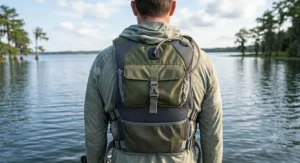
Frequently Asked Questions
❓ What is the best life vest for bass fishing?
❓ Do you have to wear a life jacket while bass fishing?
❓ Can you wear an inflatable life vest for bass fishing?
❓ What's the difference between a life vest and a life jacket for fishing?
❓ How much does a good bass fishing life vest cost?
Conclusion
Choosing a bass fishing life vest ultimately comes down to matching the vest to how you actually fish, not to whichever option has the flashiest marketing. Weekend anglers on a budget do perfectly well with a straightforward foam vest like the BPS Tournament Fishing Life Jacket or Onyx MoveVent Dynamic. Tournament competitors running fast boats need the speed-rated durability of something like the Mustang Survival Accel 100. Offshore anglers benefit from the higher buoyancy of an inflatable like the Onyx A/M-24 Auto/Manual Inflatable, and anyone who wants one comfortable vest for every activity should take a hard look at the Mustang Survival Khimera.
Whichever one you land on, the research is consistent on one point: the vest that stays in the closet doesn’t protect anybody. Prioritize fit and comfort first, because that’s what actually determines whether you’ll be wearing it on the one day it matters.
✨ Ready to Gear Up for Your Next Trip?
🎣 Compare current pricing and availability on the vest that matches your fishing style, and get out on the water knowing you’re covered for whatever the day throws at you.
Recommended for You
- Inflatable Fishing Life Jacket Guide: 7 Best PFDs for 2026
- Mechanic Jacket With Name Patch: 7 Best Picks for 2026
- 7 Best Auto Mechanic Jacket Picks for 2026 (Warm, Tough, Honest)
Disclaimer: This article contains affiliate links. As an Amazon Associate, I earn from qualifying purchases. If you purchase products through these links, we may earn a small commission at no additional cost to you.
✨ Found this helpful? Share it with your fellow anglers! 🎣💬
