
In This Article
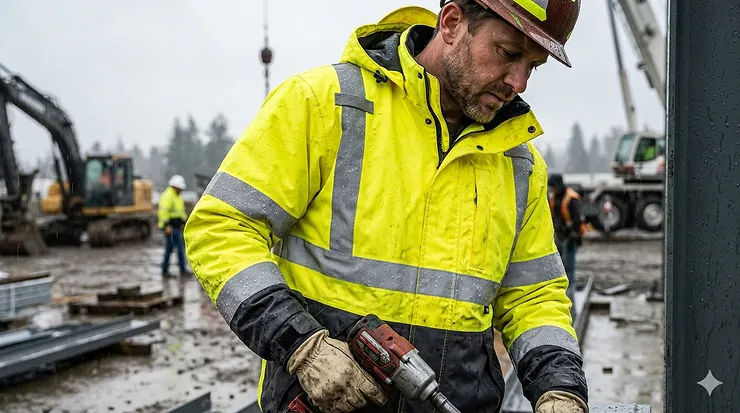
Here’s a scene most outdoor workers know too well. It’s 6 a.m., thirty-something degrees, rain coming sideways off the highway overpass, and you’re standing in it for the next eight hours. You’ve got a reflective vest over a hoodie — legal, technically — but your visibility is compromised the moment the hoodie soaks through and you fold your arms against the cold. That’s not a fashion problem. That’s a safety problem.
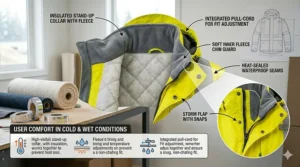
A quality hi-vis rain jacket insulated for cold conditions solves something that two separate pieces of gear never quite manage: it keeps you warm, keeps you dry, and keeps you seen — all at once, all shift long. The best versions are engineered with 160g fleece-backed thermal insulation under a waterproof shell, plus ANSI Class 3 retroreflective tape that keeps working even when visibility drops to near zero.
What is a hi-vis rain jacket insulated? Simply put: a high-visibility safety jacket featuring both waterproof outer shell construction and an insulating inner layer — either quilted thermal fill, fleece, or heat-reflective lining — rated to ANSI/ISEA 107-2020 standards for maximum visibility in low-light and adverse weather conditions. It’s the intersection of a work-ready rain jacket and a safety parka, designed for the worker who can’t choose between warmth and compliance.
According to the ANSI Blog, nearly 1 in 5 construction workplace fatalities involves a struck-by injury — and high-visibility apparel is one of the most straightforward preventive tools available. Yet plenty of workers still show up in gear that sacrifices warmth for visibility, or visibility for warmth. You shouldn’t have to make that trade.
This guide covers seven of the best insulated hi-vis rain jackets currently available on Amazon, ranked by use case, performance in real cold, and long-term value. Whether you’re a flagging crew veteran, a new construction hire, or a warehouse manager outfitting a whole team — there’s a pick here with your name on it.
Quick Comparison: Top 7 Hi-Vis Rain Jacket Insulated Options at a Glance
| Product | ANSI Class | Insulation | Waterproof | Best For | Price Range |
|---|---|---|---|---|---|
| TICONN Waterproof Safety Bomber Jacket | Class 3 | 160g Fleece | PU-coated 300D polyester | Budget buyers, everyday use | Under $35 |
| Ergodyne GloWear 8384 Quilted Parka | Class 3 | 160g Thermal + Fleece | 300D Oxford PU shell | Cold-climate professionals | $60–$85 |
| Pioneer Hi Vis Safety Bomber (B0DFGT7LGM) | Class 3 | Removable Fleece Liner | PU Oxford shell | Versatile 3-season use | $65–$90 |
| Pioneer Hi Vis 5-in-1 Waterproof Safety Jacket | Class 3 | Quilted, rated -8°F | 300D Oxford PU, heat-sealed | Extreme cold, premium buyers | $100–$145 |
| Portwest PW3 Hi-Vis Winter Jacket T400 | Class 3 | Insulatex Heat-Reflective | 300D Oxford PU | Style-conscious pros, EU compliance | $70–$110 |
| Pioneer Heated Safety Bomber (B0CWM44N95) | Class 3 | 120 GSM + Nano Heat | Heat-sealed, PU 300D | Cold nights, long outdoor shifts | $110–$160 |
| 3C Products SAJ5710 3-in-1 Hi-Vis Bomber | Class 3 | 260 GSM Removable Fleece | PU-coated 300D Oxford | Multi-use workers, small biz support | $55–$80 |
Reading this table: If price is your primary filter, TICONN delivers remarkable ANSI Class 3 compliance at a fraction of what others charge. But for anyone working sustained cold — think February road crews or night-shift utility workers — the Ergodyne 8384 or Pioneer 5-in-1 justify every extra dollar through their insulation ratings and sealed-seam construction. Budget picks sacrifice either insulation weight or waterproofing depth; premium picks do both exceptionally well.
💬 Just one click — help others make better buying decisions too! 😊
Top 7 Hi-Vis Rain Jacket Insulated Options: Expert Analysis
1. TICONN Waterproof Safety Bomber Jacket — Best Budget Hi-Vis Bomber (ANSI Class 3)
For anyone who needs a solid hi-vis rain jacket insulated without breaking the bank, the TICONN Waterproof Safety Bomber Jacket is a quiet workhorse in an overloaded market. The outer shell is 100% tear-resistant polyester with a PU coating — the same basic waterproofing architecture you’ll find in jackets costing three times as much. The 160g soft fleece insulation lining is the real story here: 160 grams is meaningful warmth, not the thin microfiber token layer you sometimes see on cheap safety gear that barely registers in low temperatures.
The 2-inch wide high-visibility reflective strip wraps the garment in a way that meets ANSI/ISEA Class 3 standards, which means it’s legal PPE for road construction, flagging, and any highway-adjacent work. The elastic waistband and cuffs seal the jacket against drafts — something that gets overlooked on cheaper builds, where insulation and waterproofing both fail at the hem. What most buyers overlook about this model is how functional those elastic cuffs actually are: when you’re directing traffic on a frozen overpass, a jacket that lets cold air up your sleeves is almost worse than no jacket at all.
Buyers consistently highlight the warmth-to-price ratio as its strongest feature, with many noting it performs well in temperatures down into the 30s°F. A fair criticism: the waterproofing won’t hold up to heavy, sustained downpours as well as sealed-seam models. It’s a jacket for the cold commute and the light-to-moderate job site rain, not a nor’easter.
✅ Genuine ANSI Class 3 compliance at a budget price
✅ 160g fleece insulation with practical elastic cuffs
Available in both yellow and orange, multiple sizes
❌ No taped/sealed seams — water can eventually penetrate in heavy rain
❌ Lighter-weight shell compared to mid-range options
Best for: Entry-level workers, seasonal hires, or budget-conscious buyers who need legal Class 3 coverage in cold weather without a large outlay. Price range: under $35.
2. Ergodyne GloWear 8384 Hi-Vis Winter Jacket Quilted Parka — Best Overall Insulated Hi-Vis Parka (ANSI Class 3)
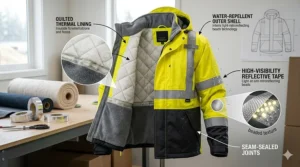
Ergodyne’s GloWear line has been the quiet standard-setter in safety workwear for years, and the 8384 Quilted Parka is the model that keeps field supervisors reaching for their credit cards. This is a full-length high visibility puffer jacket built on a 300D Oxford polyester shell with PU coating — noticeably more robust than the 150D shells you’ll find at the budget end of the market. Thicker denier means more abrasion resistance: when you’re leaning against equipment, crawling through tight spaces, or dragging this jacket across rough surfaces daily, 300D makes a practical difference.
The insulation story is compelling. Body and sleeves are lined with 160g thermal quilted insulation backed by a fleece layer — a combination that traps a meaningful amount of body heat. Ergodyne rates this jacket at a CLO of 2.68, which translates to sustained moderate work levels down to -55°F in lab testing. Real-world? Expect genuine comfort at sustained temperatures in the teens to single digits°F for workers at moderate activity levels. The 2″ ANSI/ISEA 107-2020-compliant 3M Scotchlite Reflective material provides the Class 3 visibility rating; Scotchlite is the gold standard for retroreflective performance under headlights and floodlights.
The black panels on sleeves and front are more than aesthetics — they hide the grime of daily work so your jacket doesn’t look decommissioned after a month. Buyers note the dual mic tabs and cell phone chest pocket as standout functional features for workers who carry radios and devices on shift. A common piece of feedback: sizing runs a bit large, which is actually useful if you plan to layer underneath.
✅ 160g quilted thermal + fleece dual-insulation system
✅ Industry-trusted 3M Scotchlite reflective tape
✅ Dual mic tabs, pen pocket, ID holder — built for professionals
❌ No removable liner — it’s a parka, not a 3-in-1
❌ Heavier and bulkier than bomber-style options
Best for: Road construction crews, utility workers, baggage handlers, or anyone in sustained cold environments who needs full parka coverage with serious insulation depth. Price range: $60–$85.
3. Pioneer Hi Vis Safety Bomber for Men — Best Versatile Hi-Vis Bomber with Removable Liner (ANSI Class 3)
Pioneer has been producing safety and protective gear since 1887 — yes, 1887 — and the institutional knowledge shows in the way this bomber jacket is designed. The outer shell is a PU-coated Oxford polyester build with a removable fleece liner, which turns this into a legitimately versatile piece. The liner attaches via zip, so on warmer days you’re wearing a compliant waterproof all-weather hi-vis jacket; on cold days, you zip in the fleece and suddenly you have a proper insulated safety jacket. That flexibility extends the usable calendar window dramatically compared to a fixed-liner parka.
The jacket meets ANSI/ISEA 107-22 Class 3 Type P & R — that dual Type certification matters more than most people realize. Type P covers public-facing personnel like EMS and law enforcement; Type R covers roadway workers. Having both means this jacket is legal across a broader range of job classifications without needing a second piece of gear.
The detachable snap hood with conceal pouch is worth calling out: hoods without storage pockets get left crumpled in your toolbox within a week. The black bottom panels, 2-way zipper, elastic ribbed cuffs and waist, plus internal chest pocket round out a feature set that reads like someone actually thought about what workers reach for throughout a shift. Customer feedback consistently praises fit and durability, with several reviewers mentioning it held up through multiple hard-use seasons. One thing to note: the fleece liner isn’t as thick as dedicated winter liners on premium 5-in-1 builds, so in genuinely severe cold, plan to layer.
✅ Removable fleece liner for multi-season adaptability
✅ Dual ANSI/ISEA Class 3 Type P & R certification
✅ Detachable concealed hood, 2-way zipper, black bottom
❌ Fleece liner thinner than dedicated winter parkas
❌ Slightly higher price than comparable single-layer options
Best for: Workers who move between cold and mild conditions across the season — flagging crews, survey teams, emergency responders who need Type P compliance. Price range: $65–$90.
4. Pioneer Hi Vis 5-in-1 Waterproof Safety Jacket — Best Premium Insulated Hi-Vis Jacket for Extreme Cold (ANSI Class 3)
If you’ve ever watched a thermometer drop below zero on a night-shift infrastructure project and wished your safety jacket was a different product entirely, this is the jacket that answers that wish. The Pioneer 5-in-1 is independently rated for cold weather temperature performance per ASTM F2732-11 down to -8°F — a real engineering spec, not a marketing phrase. That rating means the insulation system has been lab-tested, not just described as “warm.” In practice, construction workers on winter highway projects in the Northern states and Canada report genuine thermal comfort in conditions that make lesser jackets feel like windbreakers.
The 5-in-1 configuration means the jacket converts between multiple wear modes: full outer shell with inner jacket, outer shell alone, inner jacket alone, vest configurations — which makes it functional from early fall through deep winter without buying multiple pieces of safety gear. The outer jacket carries 4 external and 1 internal pockets; the fleece carries 2 pockets with adjustable waist and cuffs. The hi-vis plus reflective tape system is ANSI/ISEA 107 Class 3 compliant throughout.
What makes this earn its premium price isn’t any single feature — it’s the combination of a legitimate cold-weather temperature rating, real multi-mode versatility, and Pioneer’s long-standing reputation for independently tested safety products. The spec sheet won’t tell you this, but many experienced safety managers in cold-climate regions specifically source this jacket because it reduces the number of complaints about cold-related PPE non-compliance (workers wearing the wrong thing because the correct thing is uncomfortable).
✅ ASTM-rated to -8°F — tested, not estimated
✅ 5-in-1 configuration for year-round use
✅ Pioneer’s century-plus safety manufacturing pedigree
❌ Premium price point — highest in this lineup
❌ More complex to manage multiple layers for new workers
Best for: Experienced safety buyers managing winter work in cold-climate states, construction superintendents, or anyone who needs one jacket that genuinely works from September through March. Price range: $100–$145.
5. Portwest PW3 Hi-Vis Winter Jacket T400 — Best Style-Forward Insulated Safety Jacket with European Engineering (ANSI Class 3)
Portwest has been making workwear since 1904 — the Irish manufacturer is a quiet giant in global safety apparel, and the PW3 Winter Jacket T400 is the product that shows how far workwear design has come from the boxy, ill-fitting safety jackets of the past. Built on a 300D Oxford PU coated shell with a stain-resistant finish, this jacket incorporates the brand’s proprietary Insulatex heat-reflective lining panel, which works by reflecting body heat back toward the wearer rather than simply trapping warm air. In practical terms, this produces better insulation efficiency for a given fill weight compared to standard batting insulation.
The jacket meets ANSI/ISEA Class 3 Type R standards and also carries EN ISO 20471 Class 3 certification — so it’s compliant on U.S. job sites and EU worksites alike, which matters more than it might seem for international contractors or workers who travel between markets. Multiple zippered pockets, a modern contemporary fit (not the sack silhouette of older safety parkas), and the brand’s signature attention to reflective tape placement make this one of the sharper-looking insulated safety jackets in this guide.
Customer feedback is consistently strong on the quality of materials and build. A notable observation from experienced workwear buyers: Portwest’s QC on seam construction tends to be more consistent than some competing brands at similar price points, which shows up as longer jacket lifespan in hard-use environments. For anyone who cares that their safety gear doesn’t look like a prop from a 1990s highway construction stock photo, this is the pick.
✅ Insulatex heat-reflective lining panel for efficient insulation
✅ Dual ANSI + EN ISO 20471 Class 3 certification
✅ Contemporary modern fit — doesn’t look like a garbage bag
❌ Insulatex performs best at moderate activity; less suited for stationary cold
❌ Sizing can run slightly large in the torso
Best for: Workers on international projects, safety managers wanting compliance across U.S. and EU standards, or anyone who wants a professional-looking insulated hi-vis jacket that doesn’t sacrifice modern fit. Price range: $70–$110.
6. Pioneer Hi Vis Waterproof Heated Safety Bomber Jacket — Best Heated Hi-Vis Rain Jacket for Cold Night Shifts (ANSI Class 3)
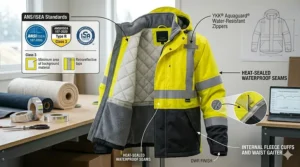
This is the jacket for the worker who’s tried everything else and still finds themselves fighting the cold at hour six of a night shift in January. Pioneer’s Heated Safety Bomber combines the waterproof all-weather hi-vis bomber architecture with a Nano Technology 3-panel heating element that runs off a standard USB power bank (sold separately — any cheap phone power bank works). Four heat settings, up to 18 hours of warmth on a full charge, and full ANSI/ISEA 107-2020 Class 3 Type P & R compliance throughout.
The 120 GSM insulated taffeta lining handles ambient warmth; the Nano heating panels handle the deeper chill that insulation alone can’t address when you’re standing motionless in subfreezing wind. The shell is PU-coated 300D Oxford polyester with heat-sealed seams and waterproof zippers — this is not a cost-cutting corner that gets cut to accommodate the heating system. Two lower slash pockets with waterproof zippers, internal zip pocket, radiophone clip straps, and the characteristic black-bottom design that Pioneer builds across its professional line round out a highly functional feature set.
Where most buyers hit a snag: the power bank adds weight and needs to be charged separately. This is easy to forget in early-season use and becomes a real irritant on cold mornings when the heating element won’t fire. The solution is simple — treat the power bank like your phone and charge it every night. Once that habit forms, the heated function becomes genuinely transformative for anyone working extended cold-weather outdoor shifts.
✅ Nano Technology 3-panel heating with 4 settings, 18-hour runtime
✅ Heat-sealed seams + waterproof zippers — genuinely waterproof
✅ Full Class 3 Type P & R compliance maintained throughout
❌ Power bank required but not included — extra purchase and charging habit needed
❌ Heating adds cost; overkill for mild-cold environments
Best for: Traffic control officers, EMS personnel, outdoor event staff, and construction workers on night shifts in genuinely cold and wet winter conditions. Price range: $110–$160.
7. 3C Products SAJ5710 ANSI Class 3 3-in-1 Hi-Vis Bomber Jacket — Best Small-Business Pick with 3-in-1 Versatility
Don’t sleep on this one just because it comes from a smaller brand. The 3C Products SAJ5710 delivers a feature set that surprises at its price: 100% Poly 300D Oxford PU coated outer shell, 260 GSM removable insulated fleece liner (notably heavier fill than TICONN’s 160g), and an impressive accessories list that includes a 2-compartment clear ID/cell phone pocket, pen holder with zipper pocket on the left sleeve, mic-tabs, and fully taped seams. That taped-seam detail is significant — it puts this jacket in a higher waterproofing category than many budget-range options and matches construction you’d expect to find in mid-tier pricing.
The ANSI/ISEA 107-2015 Class 3 Type R certification means it’s compliant for roadway work. The 260 GSM insulated fleece as a removable layer is genuinely warmer than what most jackets in this price bracket offer — 260 GSM is closer to what you’d see in a dedicated mid-layer fleece than the thin bonded liners that show up in cheaper 3-in-1 designs. The 2-compartment ID pocket is a practical professional-grade feature for workers who carry credentials, access cards, or site identification daily.
This is a small business Amazon product, which means your purchase directly supports independent manufacturing. Customer reviews mention durable construction and good color retention on the hi-vis yellow after multiple washes — an underappreciated quality metric, since faded yellow jackets eventually fall out of compliance. That said, it’s not as widely reviewed as the Ergodyne or Pioneer options, so there’s less long-term user data to draw from.
✅ 260 GSM removable fleece — heavier than many competitors
✅ Fully taped seams for genuine waterproofing in sustained rain
✅ ID/cell phone pocket, pen holder, mic-tabs — professional kit
❌ Smaller brand with less long-term review depth than larger names
❌ Less widely available in extended sizes
Best for: Workers who need genuine 3-in-1 versatility with properly taped seams at a mid-range price, and buyers who want to support small business manufacturing. Price range: $55–$80.
✨ Don’t Miss These Exclusive Deals!
🔍 Ready to upgrade your cold-weather safety gear? Click on any highlighted product above to check current pricing and availability on Amazon. These jackets are built to keep you visible, dry, and warm through every hour of every shift this winter — and that’s an investment worth making.
How to Choose the Best Hi-Vis Rain Jacket Insulated for Your Work Environment
Buying an insulated hi-vis jacket sounds simple until you’re standing in front of twenty options on Amazon and realizing they all say “Class 3” and “waterproof.” Here’s what actually separates a smart purchase from a disappointing one.
1. Match insulation weight to your actual temperature range. 160g insulation handles temperatures in the 20s–40s°F at moderate activity. If you’re standing still (traffic control, flagging, site security) in temperatures at or below 20°F for extended periods, look for 160g+ thermal fill with a fleece layer — like the GloWear 8384 — or a jacket with a legitimate cold-weather temperature rating, like the Pioneer 5-in-1’s -8°F ASTM rating. Marketing language like “warm winter jacket” means nothing; insulation weight in grams and CLO ratings mean everything.
2. Understand the difference between water-resistant and waterproof. A PU coating is water-resistant to light rain. Taped or heat-sealed seams — where every needle hole is covered with a waterproof strip — means genuinely waterproof in sustained rain. If your job site sees heavy, extended downpours, prioritize sealed seams. The 3C Products SAJ5710 and Pioneer Heated Bomber both have this construction; the base TICONN model does not.
3. Don’t buy a Class 2 jacket for a Class 3 job. OSHA’s construction standards reference ANSI/ISEA 107 Class 2 or 3 for highway rights-of-way depending on traffic speed and volume. If you’re working in a roadway environment at speed limits above 50 mph, Class 3 is the minimum. All seven jackets in this guide meet Class 3 — but verify before you buy anything outside this list.
4. Decide on removable liner vs. fixed insulation. Fixed insulation (GloWear 8384, TICONN) is simpler and tends to be warmer for the money. Removable liners (Pioneer Bomber, 3C SAJ5710) give you three or more wear configurations and effectively extend the jacket’s useful temperature range in both directions. If you work a genuinely seasonal job, removable liner is worth the extra cost. If you’re buying for one specific cold-weather deployment, fixed insulation is the better value.
5. Check for Type P certification if you’re in public safety. Type R covers roadway workers. Type P additionally covers public safety personnel — law enforcement, EMS, emergency responders. If you’re in a public safety role, confirm both Type certifications. The Pioneer models in this guide carry both.
6. Size up for layering. Every experienced cold-weather worker knows this, and every first-time buyer ignores it: you will layer underneath. Base layer, mid-layer fleece, then the jacket. Buy one size up from your normal fit, or you’ll be unable to button properly over any kind of underlayer. Most of the brands in this guide size generously to accommodate this, but check individual sizing charts.
7. Consider long-term care for reflective tape compliance. Reflective tape degrades with improper washing — fabric softener, high heat, and bleach are all killers. Once retroreflective material loses its reflectivity, your jacket is no longer technically compliant even if it still looks like a safety jacket. Machine wash cold, no fabric softener, line dry or tumble dry no-heat. Every time.
Real-World Scenarios: Which Hi-Vis Rain Jacket Insulated Fits Your Situation?
Not every job site is the same. Here’s how to match the right jacket to the right person.
The Highway Flagging Crew Member in the Northern States You’re standing still for six-to-eight hours in conditions ranging from light rain in October to below-zero wind chill in February. Activity level is low. Low activity means your body isn’t generating much heat — which means insulation has to work much harder than it would for someone doing manual labor. The Pioneer Hi Vis 5-in-1 (rated to -8°F) or the Ergodyne GloWear 8384 (CLO 2.68, 160g + fleece) are the two right answers here. The TICONN will leave you cold by hour three in genuine winter conditions.
The Construction Site Worker in the Mid-Atlantic Region Temperatures in the 25–45°F range, moderate activity, rain that comes and goes but rarely hammers for hours. You need something versatile, not extreme. The Pioneer Hi Vis Safety Bomber with its removable fleece liner is near-perfect: strip the liner on warmer days, keep it in on cold ones. The Portwest PW3 T400 is also excellent here if you value the modern fit and don’t want to manage a removable liner.
The Night-Shift Traffic Control Officer in an Urban Environment Long hours, stationary, potentially in sustained rain, February conditions. This is the use case the Pioneer Heated Safety Bomber was designed for. The Nano Technology heating panels change the experience of a cold, wet night shift in a way that no amount of insulation fill weight can fully replicate. Yes, you need to charge the power bank. Yes, it’s worth it.
The Budget-Conscious Seasonal Hire or New Worker You need ANSI Class 3 coverage in cold weather, your employer isn’t providing it, and you’re spending your own money. The TICONN Bomber at under $35 is genuinely the right call. It’s a real Class 3 jacket with real 160g fleece insulation at a price point that doesn’t require financial commitment. Upgrade when budget allows; don’t go without.
The Safety Manager Buying for a Team You’re buying six to twelve jackets, you need Class 3 compliance, and you need something that holds up for multiple seasons so you’re not reordering annually. The Ergodyne GloWear 8384 is the institutional workhorse choice here — it’s been a standard across industrial and road construction environments for years, it’s sized consistently, and its Ergodyne Tenacious Work Gear quality controls are more rigorous than most competitors at its price point.
Hi-Vis Rain Jacket Insulated vs. Standard Rain Jacket + Vest: What You’re Actually Giving Up
| Feature | Insulated Hi-Vis Rain Jacket | Rain Jacket + Separate Vest |
|---|---|---|
| Visibility in rain | ✅ Integrated, always compliant | ⚠️ Vest can shift/migrate off reflective zone |
| Warmth | ✅ Unified insulation layer | ❌ Gap at vest-jacket interface lets cold in |
| Waterproofing | ✅ Full garment coverage | ❌ Vest adds bulk, disrupts rain jacket drape |
| ANSI compliance in wind | ✅ Jacket stays compliant | ⚠️ Vest can blow open, exposing non-compliant layer |
| Convenience | ✅ One-piece system | ❌ Two garments to manage, store, and replace |
| Cost | ⚠️ Higher upfront | ✅ Cheaper per piece initially |
The “just wear a vest over a rain jacket” approach isn’t wrong — it’s what most workers default to. But it’s actually a less safe configuration in certain conditions. When a safety vest rides up during physical labor or blows open in wind, the reflective material shifts out of its required positional zone, reducing visibility from the sides and rear. An integrated all-weather hi-vis jacket eliminates that problem entirely: the reflective tape is sewn into the garment and moves with you.
The cost math also changes over time. A quality insulated hi-vis rain jacket at $70–$90 that lasts three seasons costs less in the long run than replacing a $25 vest and a $40 rain jacket annually. And it does the job better from day one.
Common Mistakes When Buying an Insulated Hi-Vis Rain Jacket
The market is flooded with options, and some of them are genuinely bad purchases in disguise. Here’s where buyers regularly go wrong.
Mistake #1: Treating “ANSI Class 3” as a quality guarantee rather than just a compliance benchmark. Any jacket can claim Class 3 on its listing. What actually matters is the quality of the retroreflective tape material, how it’s attached (hand-stitched vs. heat-sealed), and how many washes it survives before degrading. 3M Scotchlite (found in the Ergodyne GloWear 8384) is the gold standard for a reason. Cheap tape on cheap jackets can lose retroreflectivity after fifteen to twenty washes. That’s a safety issue, not just an aesthetics issue.
Mistake #2: Underestimating the value of shell denier. 150D Oxford polyester is lighter and cheaper. 300D Oxford is more resistant to abrasion and tearing. If your jacket brushes against rough surfaces, equipment, or vehicle exteriors regularly — and whose doesn’t on a job site? — 150D wears through faster. All the top-tier options in this guide use 300D. It’s not marketing: it’s the difference between a jacket that lasts one season and one that lasts three.
Mistake #3: Ignoring the waterproofing mechanism. “Waterproof” on a budget jacket usually means the fabric has a PU coating. In light rain, that’s fine. In heavy, sustained rain — especially at the seams, zipper edges, and hood attachments — non-taped seams will let water in within thirty to sixty minutes. If you work in consistently wet conditions, pay for taped seams. The price difference is usually $20–$30. The performance difference in a winter downpour is not subtle.
Mistake #4: Buying a Class 2 jacket for a Class 3 requirement. This is more common than it should be. Some listings are vague about Type and Class; some buyers don’t know the difference. According to OSHA’s safety standards, Class 3 is required for workers near roadway traffic moving at speeds above 50 mph. If your job site qualifies and you’re wearing Class 2, you’re non-compliant — and your employer is liable. Check the tag, not just the listing.
Mistake #5: Buying the wrong size because you didn’t account for layering. The number one complaint in hi-vis jacket reviews, across all brands, all price points, all styles: “bought my normal size, can’t layer underneath.” Order one size up. Non-negotiable.
What to Expect: Real-World Performance of Insulated Hi-Vis Jackets
The spec sheet tells you the insulation weight. It doesn’t tell you how the jacket actually behaves on a job site in February rain. Here’s what the real-world experience actually looks like.
Warmth in motion vs. warmth at rest: There’s a significant difference between how warm a jacket feels when you’re actively working and how warm it feels when you’re standing still. Insulation ratings are typically based on static conditions. A 160g fleece-insulated jacket that feels toasty at the start of a shift can feel much colder by hour four of a flagging job in 25°F temperatures with wind. Workers in high-activity jobs (digging, lifting, carrying) generate enough body heat that mid-range insulation is genuinely sufficient. Workers in low-activity roles (flagging, traffic control, site security) need heavier insulation than the spec would suggest.
Breathability matters more than buyers expect: Non-breathable shells cause sweat buildup during activity, which then chills dramatically when activity stops. Ergodyne’s GloWear 8384 and Pioneer’s 5-in-1 both use breathable PU coating technology that lets moisture vapor escape while blocking rain. Cheaper non-breathable builds trap that moisture, and workers end up cold-and-wet from the inside rather than the outside. If you alternate between physical activity and standing, prioritize breathability.
Reflective tape performance in real conditions: 3M Scotchlite tape reflects headlight beams from up to 1,000 feet away in ideal conditions. Lesser retroreflective materials may only reflect reliably from 200–400 feet. In practice, on a highway work zone at 60 mph, a car needs to see you from at least 300–400 feet to stop safely. This is why the material quality of retroreflective tape is not trivial — it’s the actual life-safety performance metric.
Long-Term Cost & Maintenance of a Hi-Vis Rain Jacket Insulated
The real cost of a hi-vis rain jacket isn’t the purchase price — it’s the total cost across the garment’s useful life.
A $30 jacket that needs replacing every six months costs $60/year. A $90 jacket that lasts three years with proper care costs $30/year. The math consistently favors the mid-range to premium purchase, especially for full-time workers who wear their jacket 200+ days annually.
The main killers of hi-vis jacket longevity, in order of impact:
1. Washing incorrectly. Fabric softeners coat reflective tape fibers and reduce retroreflectivity within a few wash cycles. High heat in the dryer delaminate PU coatings and can cause reflective tape adhesive to fail. The correct wash: machine cold, gentle cycle, no fabric softener, tumble dry no-heat or line dry. This one habit extends jacket life significantly.
2. Storing wet. A wet insulated jacket stored folded in a locker or toolbox develops mildew in the insulation layer within days. Hang it to dry before storing, always.
3. Mechanical damage to reflective tape. Hooking tools, equipment, or fixtures into or across the reflective strips tears the retroreflective laminate. Once that laminate is compromised, the tape doesn’t reflect correctly and the garment may no longer be compliant. Be conscious of how you handle the jacket on and off.
4. UV degradation of fluorescent material. The fluorescent yellow-green and orange-red colors in hi-vis apparel are photoluminescent dyes that degrade in UV light over time. A jacket left in direct sunlight for months on end will fade. Faded hi-vis fabric provides reduced visibility, and eventually falls below ANSI minimum fluorescent area requirements. Store out of direct sunlight when not in use.
The ANSI/ISEA 107 standard recommends inspecting hi-vis garments regularly for degraded reflective tape, faded fluorescent material, and physical damage. When in doubt about compliance, replace the garment — the cost of the jacket is always less than the cost of a struck-by incident.
Features That Actually Matter (And Those That Don’t)
Not every feature in a safety jacket listing adds real value. Here’s the honest breakdown.
Features that genuinely matter:
- Shell denier (300D vs. 150D): As covered above, durability difference is real and meaningful for job site use.
- Insulation weight in grams: The only objective warmth benchmark. Everything else is marketing.
- Taped vs. non-taped seams: The line between water-resistant and truly waterproof.
- Retroreflective tape brand (3M Scotchlite vs. generic): Directly affects visibility distance, which is the entire point of the jacket.
- Breathable PU coating: Significant for active workers who alternate motion and rest.
Features that add convenience but aren’t safety-critical:
- Mic tabs: Genuinely useful for workers who carry radios daily. Irrelevant otherwise.
- ID pockets: Nice-to-have for credentialed workers. Not a safety feature.
- Black bottom panels: Purely aesthetic — hides dirt so the jacket looks better longer. No safety value.
- Detachable hood: Useful for weather variability. Not critical if your helmet has rain protection.
Features that are mostly marketing:
- “Wind-resistant” without PU coating specifics: Every dense polyester is wind-resistant to some degree. Meaningless without context.
- “Heavy duty” zipper claims: A zipper is heavy duty when it lasts five years of daily use. You can’t verify that from a listing.
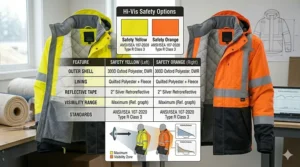
- Color options beyond hi-vis yellow and orange-red: The only ANSI-approved background colors are fluorescent yellow-green and fluorescent orange-red. “Safety blue” or “safety green” without fluorescent properties is not compliant hi-vis. Don’t be swayed by novel colors.
FAQ: Insulated Hi-Vis Rain Jackets
❓ What is the warmest hi-vis rain jacket insulated available on Amazon?
❓ Do hi-vis rain jackets with insulation meet OSHA requirements for highway work zones?
❓ How do I wash an insulated hi-vis rain jacket without damaging the reflective tape?
❓ What is the difference between a hi-vis soft shell jacket and a hi-vis rain jacket insulated?
❓ Can I wear a hi-vis rain jacket insulated as a high visibility puffer jacket off the job site?
Conclusion: The Right Hi-Vis Rain Jacket Insulated Makes the Whole Shift Different
Here’s the honest truth: a good hi-vis rain jacket insulated doesn’t just check a compliance box. It changes the experience of a cold, wet workday in a way that makes workers safer in a less obvious but equally real sense — because a worker who’s warm, dry, and comfortable makes better decisions, stays more alert, and doesn’t cut corners on PPE just to get some relief from the cold.
The TICONN Bomber is the right call when budget is the hard constraint. The Ergodyne GloWear 8384 is the institutional standard for a reason — consistent quality, serious insulation, professional feature set. The Pioneer 5-in-1 is the answer when you need cold-weather performance that a spec sheet actually backs up. And the Pioneer Heated Bomber is the jacket that fundamentally changes what a cold night shift feels like.
Whatever you pick: verify Class 3 compliance, check the insulation weight, confirm sealed seams if sustained rain is part of your environment, and size up for layering. Do those four things and you’ll land on a jacket that keeps you safe, visible, and functional through every hard hour of every hard shift this winter.
✨ Don’t Miss These Exclusive Deals!
🔍 Ready to gear up for the cold season? Click any highlighted product above to check current pricing and availability on Amazon. Stay warm, stay visible, stay safe — every shift, all season.
Recommended for You
- 7 Best ANSI Class 3 Hi-Vis Jackets in 2026 — Stay Safe & Seen
- 7 Best Low Profile Tactical Jackets for Everyday Carry (2026 Guide)
- 7 Best Concealed Carry Tactical Jacket Civilian Options 2026
Disclaimer: This article contains affiliate links. As an Amazon Associate, I earn from qualifying purchases. If you purchase products through these links, we may earn a small commission at no additional cost to you.
✨ Found this helpful? Share it with your friends! 💬🤗
