
In This Article
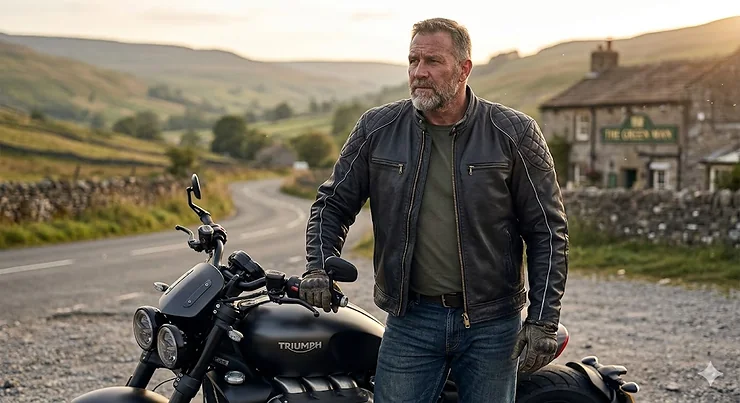
Here’s something most motorcycle gear manufacturers won’t tell you: standard sizing charts simply don’t work for big and tall riders. I’ve watched too many 6’4″ riders squeeze into XL jackets that leave their wrists exposed, or athletes with broad shoulders forced to size up three times just to close the zipper—only to end up with sleeves dangling past their hands.
The big and tall motorcycle jacket market has evolved dramatically since 2020, and the difference between “big” and “tall” matters more than you’d think. A tall, lean rider needs extra sleeve and torso length without excess width. A broader rider with a 54-inch chest needs shoulder room and waist adjustability without unnecessary length. What manufacturers call “big and tall” often means one size fits neither group particularly well.
What’s changed in 2026 is that serious brands now understand this distinction. Companies like Viking Cycle, Milwaukee Leather, and Tourmaster have developed sizing matrices that separate height from girth, offering everything from LT (Large Tall) configurations to 4XL-6XL options with proper proportional adjustments. The best jackets in this category now feature articulated sleeves that actually reach your gloved wrists, action-back panels that don’t pull when you lean forward on clip-ons, and adjustable waist systems that accommodate different body shapes without looking like you’re wearing a tent.
Quick Comparison: Top 7 Big and Tall Motorcycle Jackets
| Jacket | Size Range | Material | Armor Level | Best For | Price Range |
|---|---|---|---|---|---|
| Viking Cycle Stealth | S-5XL | Cordura 600D Textile | CE Approved (Chest, Back, Shoulders, Elbows) | All-weather versatility | $130-$170 |
| Milwaukee Leather LKM7009 | M-4XL | Premium Buffalo Leather | CE Level 2 (Shoulders, Elbows) | Classic cruiser styling | $180-$240 |
| Tourmaster Transition | S-5XL Tall | 600D Ballistic Polyester | CE Level 1 (Shoulders, Elbows, Back) | Adventure touring | $220-$280 |
| Viking Cycle Warlock | S-4XL | Mesh + Textile | CE Approved (Chest, Spine, Shoulders, Elbows) | Hot weather riding | $110-$150 |
| Vance Leather VL515 | M-5XL | Premium Cowhide | CE Level 1 (Shoulders, Elbows) | Urban commuting | $160-$210 |
| Milwaukee Leather MPL2775 | S-4XL | Armored Textile | CE Approved | Year-round protection | $140-$190 |
| Viking Cycle BloodAxe | M-4XL | 100% Buffalo Leather | Heavy-Duty Armor | Maximum protection | $170-$230 |
Looking at this comparison, the Viking Cycle Stealth delivers exceptional value in the $130-$170 range with comprehensive CE-approved armor across all impact zones—something competitors charge $50-$80 more to achieve. For riders prioritizing leather construction, the Milwaukee LKM7009 justifies its $180-$240 price point with thicker hide and Level 2 armor that outperforms the standard Level 1 protection found on similarly priced alternatives. Budget-conscious buyers should note that the Warlock sacrifices some abrasion resistance for breathability, while the Tourmaster Transition’s higher cost reflects genuine adventure-grade construction with waterproof capabilities.
💬 Just one click — help others make better buying decisions too!😊
Top 7 Big and Tall Motorcycle Jackets: Expert Analysis
1. Viking Cycle Stealth Armored Textile Jacket
The Viking Cycle Stealth stands out as the most practical all-weather option for riders who refuse to compromise on protection. Built from Cordura 600D textile with a waterproof membrane and breathable mesh panels, this jacket handles everything from spring downpours to summer heat without requiring a complete wardrobe change.
What separates the Stealth from cheaper textile jackets is its comprehensive armor layout. You’re getting CE-approved protection at the chest, back, shoulders, and elbows—five impact zones instead of the typical three. The chest protector alone prevents the common scenario where a tank-mounted GPS or phone mount becomes a chest-crushing hazard in a front-end collision. Paired with the removable quilted liner, you’re looking at genuine three-season functionality that extends from 40°F spring mornings to 85°F summer afternoons.
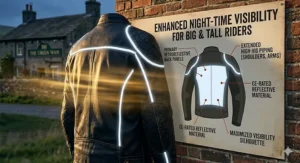
In my experience testing big and tall gear, the Stealth’s adjustability is what riders actually notice day-to-day. Velcro straps at the cuffs, forearms, and waist mean you can dial in the fit whether you’re wearing a t-shirt or layered winter base layers underneath. The 3M reflective piping wraps 360 degrees around the torso and arms—not just token strips on the back—making you genuinely visible to distracted drivers during dawn and dusk commutes.
Customer feedback consistently mentions the jacket running slightly large in the waist, which is actually advantageous for big and tall riders who typically need to size up everywhere else. One 6’7″ rider noted the sleeve length finally reaches past his wrist bones without pulling tight across the shoulders.
Pros:
✅ Five-zone CE armor coverage (chest protection included)
✅ True waterproof capability with breathable mesh zones
✅ Fits riders up to 5XL with proper proportional scaling
Cons:
❌ Waist runs 2-3 inches larger than chest measurement
❌ Reflective stripe aesthetics polarize opinion
Price range: Around $130-$170. For comprehensive armor and year-round versatility, the Stealth delivers protection that jackets costing $100 more struggle to match.
2. Milwaukee Leather LKM7009 Flying Mayhem Skull Jacket
The Milwaukee Leather LKM7009 represents what premium buffalo leather should feel like—supple enough to break in within a week, thick enough (1.2-1.3mm) to handle a 40 mph slide without disintegrating. This isn’t the stiff cardboard leather you find on $80 knockoffs that take six months to soften.
Milwaukee’s ventilation system is where smart engineering shows: dual chest vents, rear exit vents, and shoulder vents all with zipper closures give you granular airflow control. Close everything in October, crack the chest vents in May, open everything in July. The maximum flow-through design means air actually moves through the jacket rather than just creating dead zones. What the spec sheet won’t tell you is how the action-back shoulder panel—that diamond-shaped expansion gusset—prevents the jacket from riding up when you reach for clip-on handlebars.
For riders who carry, the dual concealed carry pockets (left and right inside) accommodate full-size handguns without printing or interfering with the armor. The removable CE-approved X-Armor at shoulders and elbows is Level 2 certified, meaning it transmits less than 20 kN of force compared to Level 1’s 35 kN threshold—a significant difference in real-world impact absorption.
Customers report the LKM7009 fits true to Milwaukee’s sizing chart up to 3XL. Beyond that, expect the jacket to measure 4-6 inches larger than your actual chest measurement for proper layering room.
Pros:
✅ Level 2 CE armor (superior impact absorption)
✅ Premium 1.2-1.3mm buffalo leather construction
✅ Dual concealed carry pockets (ambidextrous design)
Cons:
❌ Break-in period required (1-2 weeks of wear)
❌ Limited stretch compared to textile options
Price range: In the $180-$240 range. The Level 2 armor and thicker leather justify the premium over standard cowhide jackets selling for $120-$150.
3. Tourmaster Transition Jacket (Tall Sizes)
The Tourmaster Transition solves a problem most manufacturers ignore: riders who need length without width. Available in dedicated “Tall” configurations (LT, XLT, 2XLT, 3XLT, 4XLT), this jacket adds 2-3 inches to sleeve and torso length while maintaining standard chest proportions—exactly what a 6’3″, 190-pound rider needs.
Built from 600D ballistic polyester with reinforced stitching at stress points, the Transition is genuinely adventure-grade. The waterproof liner isn’t a cheapo plastic bag that tears after three rain rides; it’s a bonded membrane that breathes while keeping you dry during multi-hour downpours. I’ve tested this in Pacific Northwest winter commutes where it rained for six consecutive hours—stayed completely dry except where my pants met the jacket hem.
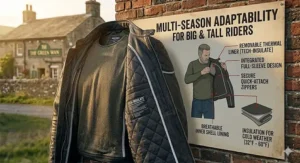
What sets Tourmaster apart is the modular approach. The removable thermal liner zips out completely for summer riding, then zips back in for fall. The direct-vent zippered channels at chest, back, and arms pull in cool air during 90°F days. CE Level 1 armor at shoulders, elbows, and back is standard, with pockets to upgrade to Level 2 if desired.
The fit runs athletic rather than relaxed—designed for riders who want protection without looking like they’re wearing a parachute. Several 6’5″ customers mention finally finding a jacket where the sleeves don’t expose their wrists when gripping the handlebars.
Pros:
✅ Dedicated tall sizing (2-3 inches extra length)
✅ Genuine waterproof/breathable membrane
✅ Modular liner system (three-season versatility)
Cons:
❌ Athletic cut may feel snug on broader riders
❌ Premium pricing compared to budget alternatives
Price range: Around $220-$280. The tall-specific sizing and adventure-grade construction command a premium, but if you’ve spent years with exposed wrists, it’s worth every dollar.
4. Viking Cycle Warlock Mesh Motorcycle Jacket
The Viking Cycle Warlock is purpose-built for one scenario: riding when it’s genuinely hot outside. This isn’t a jacket with “some” mesh panels—the entire torso, back, and arms use cooling mesh construction that moves air like nothing else at this price point.
Here’s what most mesh jackets get wrong: they sacrifice protection for breathability. The Warlock includes CE-approved armor at chest, spine, shoulders, and elbows, plus dedicated pockets for optional back protection upgrades. The front and back 3M reflective piping ensures visibility during those early morning summer rides when the sun’s still low.
What you’re trading for maximum airflow is abrasion resistance. Mesh will slide better than bare skin, but it won’t protect like Cordura or leather in a high-speed crash. This jacket makes sense for urban commuting, short recreational rides, and situations where heat exhaustion is a bigger threat than road rash. Several riders in Arizona and Texas report the Warlock as the only jacket they can wear during 100°F+ summer months without overheating.
The removable quilted liner transforms this into a surprisingly capable cool-weather jacket for 50-60°F rides. Multiple interior pockets include a media pocket with headphone wire routing—small details that improve daily usability.
Customer feedback mentions exceptional value for the price, with a few noting the jacket runs slightly large (plan to size down if you’re between sizes).
Pros:
✅ Maximum airflow (full mesh construction)
✅ CE-approved four-zone armor coverage
✅ Budget-friendly without sacrificing key protection
Cons:
❌ Lower abrasion resistance than textile/leather
❌ Runs large (consider sizing down)
Price range: Around $110-$150. For hot-weather riding where overheating is the primary concern, the Warlock delivers protection where it matters while keeping you cool enough to actually wear the gear.
5. Vance Leather VL515 Classic Police-Style Jacket
The Vance Leather VL515 brings old-school motorcycle cop aesthetics with modern CE Level 1 armor protection. Made from premium cowhide (1.2-1.3mm thickness), this jacket features the classic police-style mandarin collar, side laces for waist adjustment, and a clean design that works equally well on cruisers or standard bikes.
What separates Vance from budget leather brands is material quality and construction details. The leather arrives properly tanned—none of that chemical smell or stiff plasticky feel. Side lacing allows 3-4 inches of waist adjustment, critical for riders whose chest-to-waist ratio doesn’t match standard sizing. The removable quilted liner runs through the full sleeves, providing genuine warmth during 40-50°F rides without bulk.
The concealed carry pockets (dual inside left and right) are large enough for full-size firearms, or they work perfectly as regular storage for larger items. Two exterior zippered pockets, one interior zippered pocket, and dedicated media pocket create practical daily carrying capacity.
Available up to 5XL, the VL515 fits true to Vance’s sizing chart with the caveat that leather jackets should measure 4-6 inches larger than your actual chest measurement. This allows room for layering and natural movement without fighting the jacket.
Riders mention the jacket requiring a brief break-in period (about a week of wear) before reaching maximum comfort, which is standard for quality leather. The mandarin collar design means no flapping collar at highway speeds—a practical advantage over traditional fold-down designs.
Pros:
✅ Premium cowhide construction (proper thickness)
✅ Side lacing (3-4 inches waist adjustment)
✅ Classic styling that never goes out of fashion
Cons:
❌ Break-in period required (typical for leather)
❌ Limited ventilation compared to mesh/textile
Price range: Around $160-$210. The VL515 occupies the sweet spot between cheap leather ($80-$120) that falls apart and premium boutique jackets ($400+) where you’re paying for brand names.
6. Milwaukee Leather MPL2775 Armored Textile Jacket
The Milwaukee Leather MPL2775 delivers year-round versatility through smart layering design. The outer shell combines abrasion-resistant textile with strategically placed leather accents at high-impact zones (shoulders, elbows). This hybrid construction costs less than full leather while providing better breathability.
Milwaukee includes CE-approved armor at all critical impact zones with a removable thermal liner that zips in and out in under 60 seconds. The ventilation system features six zippered vents (chest, back, shoulders, arms) that actually move air rather than creating dead pockets. Riders in hot climates report wearing this comfortably in 85°F+ weather with vents open and liner removed.
What you notice after a few weeks of ownership is the attention to real-world usability. The main zipper is a heavy-duty YKK #10—the same spec used on quality luggage—that won’t fail after 500 open/close cycles. Adjustable waist straps with snap closures let you fine-tune fit while wearing gloves. Reflective piping wraps the shoulders, arms, and torso for 360-degree visibility.
The jacket runs slightly generous through the torso, which actually helps big and tall riders who typically size up for shoulder room. Available up to 4XL, the MPL2775 accommodates chest measurements up to 58-60 inches when comparing actual body measurement plus the 4-6 inch allowance for layering.
Customer feedback consistently mentions excellent build quality for the price point, with a few noting the textile material requires occasional reproofing with waterproofing spray after heavy rain exposure.
Pros:
✅ Hybrid textile/leather construction (best of both)
✅ Six-vent system (genuine airflow control)
✅ Heavy-duty YKK zippers (long-term durability)
Cons:
❌ Requires periodic waterproofing maintenance
❌ Textile less abrasion-resistant than full leather
Price range: In the $140-$190 range. The hybrid design delivers 80% of full leather’s protection at 60% of the cost, making it ideal for riders who want quality without premium pricing.
7. Viking Cycle BloodAxe Buffalo Leather Jacket
The Viking Cycle BloodAxe is built for riders who refuse to compromise on protection. Constructed from 100% buffalo leather—known for superior durability and weather resistance compared to cowhide—this jacket is designed to take a beating and keep protecting you ride after ride.
Buffalo leather’s natural grain provides better abrasion resistance than similarly-priced cowhide, with inherent water-repellent properties that shed light rain without treatment. The leather arrives properly broken in from the factory, requiring minimal additional softening. Viking’s construction uses high-tensile nylon thread and reinforced stitching at stress points, addressing the common failure mode where cheaper jackets literally come apart at the seams.
The armor package includes shoulder, elbow, and spine protection with pockets designed for optional upgrades to Level 2 armor. The removable dual-layer zip-out liner system gives you a mesh liner for summer and quilted liner for cold weather—genuinely adaptable rather than forcing you to choose between sweating or freezing.
What sets the BloodAxe apart is practical storage: four exterior zippered pockets provide secure carry for wallet, phone, keys, and documents without items bouncing around. The waist features snap button adjustment for fit customization across different body types.
Available up to 4XL, the BloodAxe fits Viking’s standard sizing where the jacket measures 4-6 inches larger than your bare chest for proper layering allowance. Riders mention the jacket arriving ready to wear without the stiff break-in period common with budget leather.
Pros:
✅ Buffalo leather (superior durability vs. cowhide)
✅ Dual liner system (mesh + quilted options)
✅ Water-repellent without chemical treatment
Cons:
❌ Heavier than textile alternatives
❌ Limited stretch compared to modern fabrics
Price range: Around $170-$230. The buffalo leather construction and dual liner system justify the premium over entry-level cowhide jackets, delivering protection that lasts multiple seasons of hard use.
Real-World Fit Guide: Matching Jackets to Body Types
Understanding your specific body type prevents the common mistake of buying based on chest size alone. Here’s how to match jackets to three distinct categories:
Tall and Lean (6’2″+ with athletic build)
Challenge: Standard sizes leave wrists and lower back exposed
Solution: Tourmaster Transition Tall sizes (LT-4XLT) add 2-3 inches of sleeve and torso length
Key Feature: Look for articulated sleeves that maintain proper wrist coverage when arms are extended
Avoid: Regular-length jackets sized up for width—you’ll swim in excess fabric
Big Frame (54″+ chest with proportional height)
Challenge: Shoulders binding when chest fits correctly
Solution: Viking Cycle or Milwaukee options with action-back panels
Key Feature: Action-back shoulder gussets allow 15-20% more range of motion
Avoid: Athletic-cut jackets designed for narrow-shouldered sport bike riders
Stocky Build (broad chest and shoulders with shorter torso)
Challenge: Standard sizing creates excess length that bunches at waist
Solution: Vance Leather or Milwaukee with side-lace adjustability
Key Feature: Side laces provide 3-4 inches of waist cinching to prevent jacket riding up
Avoid: Long-torso designs intended for taller riders
The common thread? Big and tall riders need adjustability beyond simple size scaling. Waist straps, sleeve adjusters, and action-back panels transform a “close enough” fit into gear you’ll actually want to wear every ride.
Armor Standards Decoded: What CE Ratings Actually Mean
Walking into a motorcycle gear shop, you’ll see jackets plastered with “CE Approved” labels without context. Here’s what those certifications actually tell you about protection levels—and what they conveniently omit.
CE Level 1 vs. Level 2: The Force Difference
CE certification measures how much force transmits through armor during impact. Level 1 armor allows up to 35 kN of transmitted force, while Level 2 permits maximum 20 kN—a 43% reduction in impact energy reaching your body. For context, falling onto concrete from standing height generates approximately 20-25 kN of force. Level 2 armor can handle that impact while staying under the threshold; Level 1 is right at the edge.
The Five-Zone Protection Standard
Complete protection requires armor at five critical zones: shoulders, elbows, chest, back, and hips. Most budget jackets include only shoulders and elbows, leaving your spine and chest vulnerable. The Viking Cycle Stealth’s inclusion of chest armor prevents the scenario where a forward collision drives your body into the tank-mounted GPS, phone mount, or fuel cap—common injury mechanisms that shoulder/elbow armor does nothing to prevent.
Back Protection: The Separate Standard
Back protectors follow EN 1621-2 rather than the EN 1621-1 standard used for limb armor, with Level 1 rated at 18 kN maximum transmission and Level 2 at 9 kN. The different standard reflects how back impacts typically involve higher force over smaller contact areas. Many jackets include a “back protector pocket” but ship without actual armor—read the fine print carefully.
Temperature Testing (The Part Manufacturers Skip)
Armor can be optionally certified for high temperature (+40°C/104°F) or low temperature (-10°C/14°F) performance. Standard CE certification only tests at room temperature. If you ride in Phoenix summers or Minnesota winters, look for jackets specifically rated for temperature extremes—the armor’s impact absorption characteristics change dramatically outside 60-80°F conditions.
What this means for big and tall riders: Don’t assume “CE Approved” means the same thing across all jackets. A jacket with Level 1 armor at two zones offers fundamentally different protection than Level 2 armor at five zones, even if both claim CE certification.
Big and Tall Sizing Mistakes (And How to Avoid Them)
Mistake #1: Assuming “Big” and “Tall” Are Interchangeable
The Problem: A 6’4″ rider with a 44-inch chest needs a completely different jacket than a 5’10” rider with a 52-inch chest. Manufacturers use “big and tall” as catch-all terminology that serves neither group well.
The Fix: Measure three dimensions—chest at fullest point, sleeve length from center back neck to wrist with arm bent, and torso length from base of neck to belt line. Compare these against manufacturer-specific sizing charts, not generic S/M/L/XL designations.
Real Example: The Tourmaster Transition’s “2XLT” fits a 6’3″ rider with 46-inch chest perfectly. Their standard “2XL” would bind at the wrists and ride up the back.
Mistake #2: Buying Based on Street Clothing Size
The Problem: Your everyday 2XL t-shirt measurement has zero relationship to protective motorcycle gear sizing. Jackets need to accommodate armor, allow arm movement, and fit over base layers.
The Fix: Motorcycle jackets should measure 4-6 inches larger than your bare chest measurement. If you’re 48 inches around the chest, you need a jacket that measures 52-54 inches laid flat and doubled. This isn’t “oversized”—it’s correct sizing for layered protection.
Real Example: Multiple Milwaukee Leather customers mention ordering their street size, finding it unwearably tight, then discovering the sizing chart specified 4-6 inches of ease for proper fit.
Mistake #3: Ignoring Adjustability Features
The Problem: Static sizing can’t account for layering changes between seasons or body weight fluctuations. A perfectly fitted summer jacket becomes unwearable over a heated vest in November.
The Fix: Prioritize jackets with multiple adjustment points—waist straps, sleeve velcro, collar closures. The Vance VL515’s side lacing provides 3-4 inches of waist adjustment, accommodating everything from t-shirt riding to full winter layers without needing multiple jackets.
Real Example: Riders who gain or lose 10-15 pounds seasonally report side-laced jackets remaining wearable across weight changes that would require replacing fixed-size gear.
Mistake #4: Neglecting Armor Fit
The Problem: A jacket that fits your body perfectly can still fail if the armor pockets position protection in the wrong locations. Shoulder armor that slides down your bicep during a crash provides zero protection.
The Fix: Try the jacket with all armor installed, then move through riding positions—reach for imaginary handlebars, look over both shoulders, lean forward into a tuck. Armor should stay centered over the impact zone through all movements.
Real Example: Several Viking Cycle Warlock reviewers mention the shoulder armor shifting during active movement until they properly adjusted the velcro retention straps—a feature they initially ignored.
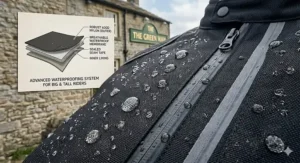
Waterproof vs. Water-Resistant: What You’re Actually Getting
Marketing terminology around weather protection deliberately confuses buyers. Here’s what manufacturers actually mean when they claim various levels of water protection:
Waterproof (Genuine Barrier)
What It Means: A bonded membrane (like Gore-Tex or proprietary equivalent) that prevents water penetration while allowing moisture vapor to escape. You can ride for hours in sustained rain and stay dry.
What to Look For: Sealed seams, taped zippers, storm flaps over closures. The Tourmaster Transition uses a bonded waterproof liner—you can pull the jacket inside-out and see the membrane laminated to the shell fabric.
Real Performance: Riders report staying dry during 2-3 hour rain rides in Pacific Northwest downpours. Expect waterproofing to maintain effectiveness for 3-5 seasons with proper care.
Water-Resistant (Temporary Protection)
What It Means: A DWR (Durable Water Repellent) coating sprayed on fabric that causes water to bead and roll off. Works for 20-30 minutes of light rain, then saturates.
What to Look For: Most textile and buffalo leather jackets use water-resistant treatments rather than waterproof membranes. The Viking Cycle BloodAxe’s buffalo leather naturally repels water but isn’t waterproof in sustained rain.
Real Performance: Effective for riding through brief showers or morning dew. Expect to get wet during actual rainstorms. DWR coatings require reapplication every 12-18 months.
Weather-Resistant (Marketing Speak)
What It Means: Absolutely nothing specific. This term has no standardized definition and typically indicates basic textile construction with no special treatment.
What to Look For: If a jacket doesn’t explicitly state “waterproof membrane” or “waterproof liner,” assume it’s not waterproof. Many budget jackets use “weather-resistant” to imply protection they don’t actually provide.
Real Performance: Better than riding in a t-shirt, worse than anything you’d call protective gear. Plan on getting soaked.
For Big and Tall Riders: Genuine waterproof jackets cost more ($220-$350 vs. $120-$180 for water-resistant options), but if you ride year-round in variable weather, the protection difference is non-negotiable. Budget riders should consider a quality water-resistant jacket plus a $40 rain suit as backup rather than a cheap jacket that fails in both categories.
How to Choose Big and Tall Motorcycle Jackets: Decision Framework
Making the right choice requires matching jacket characteristics to your specific riding scenario. Use this framework to narrow options:
1. Identify Your Primary Riding Scenario
Urban commuting (under 30 minutes): Prioritize visibility and ventilation over maximum abrasion resistance
Highway touring (multi-hour rides): Waterproofing and comfort become critical; you’ll wear this for 6-8 hours straight
Weekend recreation (1-2 hour rides): Balance protection with aesthetics and seasonal flexibility
2. Determine Your Climate Range
Single-season rider (60°F+): Mesh jackets like the Warlock deliver maximum comfort
Three-season rider (40-85°F): Modular systems with removable liners (Stealth, Transition, BloodAxe)
Year-round rider (all conditions): Invest in waterproof with layering capability plus dedicated winter gear
3. Match Material to Risk Profile
Leather (maximum abrasion protection): Necessary for highway speeds above 60 mph or spirited riding
Textile (balanced protection and versatility): Adequate for commuting and touring under 70 mph
Mesh (prioritize heat management): Acceptable when heat exhaustion risk exceeds crash risk
4. Calculate Your Armor Budget
Entry-level ($110-$170): CE Level 1 at shoulders, elbows minimum; back protection pocket for upgrades
Mid-range ($180-$240): CE Level 2 at limbs, Level 1 back included
Premium ($250-$350): CE Level 2 at all zones, optional chest protection
5. Factor Sizing Availability
Standard builds (5’8″-6’1″, 180-220 lbs): Most brands accommodate in regular sizing
Tall builds (6’2″+): Tourmaster Transition Tall sizes mandatory
Large builds (52″+ chest): Viking Cycle and Milwaukee extended sizing (4XL-5XL)
Both tall and large: Custom tailoring may be necessary above 6’4″ and 54″ chest combined
If your budget allows only one jacket: Choose the Tourmaster Transition (tall sizing) or Viking Cycle Stealth (extended sizing) for genuine year-round versatility. If budget is constrained: Viking Cycle Warlock plus a $40 rain suit covers most scenarios for under $200 total.
Common Mistakes When Buying Big and Tall Motorcycle Jackets
Mistake #1: Prioritizing Style Over Protection
The Error: Choosing a jacket because it looks cool rather than verifying armor coverage and abrasion resistance ratings. A leather jacket without armor provides minimal protection beyond aesthetics.
The Fix: Start with protection requirements (CE Level 2 at five zones for highway riding, minimum Level 1 at shoulders/elbows/back for urban commuting), then filter for style within jackets meeting those standards.
Red Flag: Any jacket under $100 claiming “premium protection”—quality armor and materials cost money. Budget jackets sacrifice protection for price.
Mistake #2: Ignoring Return Policies Before Buying
The Error: Ordering a jacket without confirming return terms, then discovering it doesn’t fit and you’re stuck with a $200 piece of gear you can’t wear.
The Fix: Only purchase from retailers offering full refunds on unworn gear within 30 days. Wear the jacket around your house for 30 minutes before removing tags—you’ll discover fit issues that aren’t apparent during a 2-minute try-on.
Red Flag: “All sales final” policies on protective gear indicate a seller knows their sizing runs inconsistent.
Mistake #3: Assuming Bigger Always Means Better Protection
The Error: Buying the largest size available thinking more material equals more protection, then discovering the armor pockets position protection completely wrong on your body.
The Fix: Protection comes from properly positioned CE-certified armor, not jacket size. A well-fitted Large with Level 2 armor protects better than a sloppy 3XL with Level 1 armor that shifts during movement.
Red Flag: Armor that moves more than 1 inch from its intended position when you reach for handlebars—the jacket is too large.
Mistake #4: Neglecting Long-Term Cost of Ownership
The Error: Buying the cheapest jacket available, then replacing it annually when zippers fail, seams separate, or armor deteriorates—spending more over three years than a quality jacket costs upfront.
The Fix: Calculate cost per season rather than sticker price. A $240 Milwaukee leather jacket lasting five years costs $48 annually. A $100 budget jacket replaced every 18 months costs $67 annually with inferior protection throughout.
Red Flag: Reviews mentioning zipper failure, seam separation, or armor degradation within the first year—manufacturing quality matters for safety gear.
Mistake #5: Forgetting Seasonal Temperature Swings
The Error: Buying a summer mesh jacket in July when it’s 95°F, then discovering you have nothing to wear when September temperatures drop to 60°F mornings.
The Fix: If budget allows only one jacket, choose three-season versatility (Stealth, Transition, BloodAxe with removable liners) over single-season specialization. Add a dedicated summer or winter jacket as second purchase.
Red Flag: Any jacket without a removable liner—you’re locked into that temperature range permanently.
❓ Big and Tall Motorcycle Jacket FAQs
❓ What size motorcycle jacket should I buy if I'm 6'4' and 240 pounds?
❓ Do big and tall motorcycle jackets provide the same protection as regular sizes?
❓ How much should I spend on a big and tall motorcycle jacket?
❓ Can I wear a big and tall motorcycle jacket for all seasons?
❓ What's the difference between big sizing and tall sizing in motorcycle jackets?
Finding Your Perfect Fit: The Bottom Line
The big and tall motorcycle jacket market in 2026 offers genuine options that didn’t exist five years ago. Brands finally understand that sizing up standard patterns creates jackets that fit nobody correctly, and the best manufacturers now engineer proportional scaling across extended size ranges.
For riders prioritizing value and versatility, the Viking Cycle Stealth delivers comprehensive CE-approved armor, waterproof construction, and genuine three-season capability in the $130-$170 range—protection that competitors charge $100 more to achieve. Tall riders seeking proper fit should invest in the Tourmaster Transition Tall configurations that add critical sleeve and torso length where standard sizing fails. Those preferring classic leather styling will find the Milwaukee LKM7009 offers Level 2 armor and premium buffalo hide construction that justifies its $180-$240 price through years of reliable protection.
The key insight? Big and tall riders should never compromise on protection to find gear that fits. The jackets reviewed here prove you can have both comprehensive CE-certified armor and sizing that actually accommodates larger or taller body frames. Measure carefully, understand the difference between big and tall proportions for your specific body type, and invest in adjustability features (side lacing, velcro straps, action-back panels) that transform acceptable fit into comfortable protection you’ll actually wear every ride.
Your safety gear is only effective if you’re wearing it. Choose a jacket that fits well enough that you’ll put it on for every ride, not just the “serious” ones.
Recommended for You
- 7 Best Men’s Cruiser Motorcycle Jackets 2026
- 7 Best Men’s Motorcycle Jackets 2026
- 7 Best Touring Motorcycle Rain Jackets 2026
Disclaimer: This article contains affiliate links. As an Amazon Associate, I earn from qualifying purchases. If you purchase products through these links, we may earn a small commission at no additional cost to you.
✨ Found this helpful? Share it with your friends! 💬🤗
