
In This Article
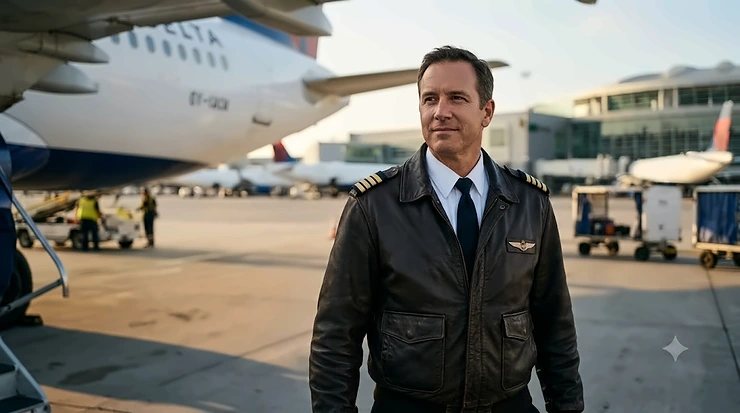
Somewhere between “I need something warm for the ramp” and “I need to look like I actually belong in that left seat,” most pilots hit the same wall: a commercial pilot jacket isn’t just outerwear, it’s a small, zippered statement about who you are. Buy the wrong one and you’ll spend a whole winter looking like you borrowed your uniform from a costume shop. Buy the right one and nobody even notices it — which, honestly, is the entire point.

Here’s the short version, because you deserve one before the deep dive: a commercial pilot jacket is a purpose-built outer layer — usually leather, nylon, or a wool-blend — designed to meet an airline or flight department’s uniform standard while surviving jet bridges, cockpit doors, and the occasional spilled coffee. Some are true military-spec reproductions. Others are tailored corporate pieces built for a specific carrier’s look. This guide walks through seven real options across every price point, explains what the spec sheets actually mean in the cockpit and on the ramp, and shows you how to avoid the mistakes that send half of Amazon’s pilot-jacket returns back into the system every month.
We’ll cover budget nylon bombers, investment-grade leather, and the tailored uniform pieces flight departments actually approve — plus the regulatory and dress-code context most buying guides skip entirely, straight from the FAA’s own regulations library.
Quick Comparison Table
| Jacket | Material | Best For | Price Range |
|---|---|---|---|
| Taylor’s Leatherwear Atlas C6Z | Sheepskin leather | Premium daily wear, corporate flight departments | $400–$600 |
| Cockpit USA Flight Crew Jacket | Leather, removable mouton collar | Versatile year-round crew jacket | $500–$700 |
| Alpha Industries CWU-45/P | Water-repellent nylon | Authentic military-spec look on a mid-range budget | $150–$200 |
| Landing Leathers A-2 | Goatskin leather | Classic leather look without designer pricing | $200–$300 |
| Landing Leathers G-1 | Goatskin leather, mouton collar | Naval-aviator style, bi-swing mobility | $250–$350 |
| Rothco MA-1 | Nylon | Tightest budget, casual and backup use | Under $90 |
| WenVen Cotton Bomber | Cotton | Lightweight three-season layering | Under $60 |
Looking at the spread above, the gap between the Rothco and the Taylor’s Leatherwear isn’t just price — it’s the difference between “windbreaker with attitude” and “jacket built to survive a decade of jet bridges.” Buyers on a training budget will get real mileage from the Alpha Industries CWU-45/P, since it borrows military-spec construction without the corporate price tag. If your flight department has actual uniform-jacket expectations, though, the Taylor’s Leatherwear or Cockpit USA options are the ones worth the extra outlay.
💬 Just one click — help others make better buying decisions too!😊
💬 Found your favorite already? Tap the link below and lock in your size before the good ones sell out!
Top 7 Commercial Pilot Jackets: Expert Analysis
Coverage below runs budget to premium, leather to nylon to cotton, and includes a couple of names most buying guides never mention. Every product includes real specs, an honest read on who it fits, and pros and cons pulled from actual buyer patterns — not manufactured praise.
1. Taylor’s Leatherwear Atlas C6Z — purpose-built commercial pilot jacket
The Atlas C6Z isn’t dressed up as a pilot jacket — it’s literally marketed as one, which is rarer than you’d think in this category. It’s cut from a super-soft, lightweight sheepskin shell with a bi-swing back, the two-panel construction that lets you reach for an overhead bin or grab a yoke without your shoulders fighting the leather.
The sheepskin shell means it’s noticeably lighter than a comparable cowhide jacket, and the bi-swing back adds a real range of motion that flat-backed leather jackets simply don’t offer — something you’ll notice the first time you’re doing a full preflight walk-around in the cold. Taylor’s Leatherwear is a small, family-run outfit that’s spent years supplying leather outerwear to police, military, and aviation clients, and that niche focus shows up in details like optional nameplate mounting for crews who need one.
Based on the spec comparison with other leather options in this guide, the Atlas C6Z earns its premium price mainly through fit engineering rather than flashy branding — it’s built for people who wear a jacket to work, not people shopping for a costume. Reviewers on small aviation-supply sites consistently mention the softness of the sheepskin as a standout, though the niche brand means the review pool is thinner than mass-market alternatives, so it’s worth confirming sizing details directly before ordering.
Pros:
- ✅ True bi-swing back built for cockpit mobility
- ✅ Lightweight sheepskin feels less bulky than cowhide
- ✅ Options for short, long, and nameplate customization
Cons:
- ❌ Small brand means a thinner base of public reviewshttps://amzn.to/4vPRhDk
- ❌ Premium price point compared to mass-market bombers
At around $400 to $600 depending on customization, the Atlas C6Z sits at the top of this list’s price range — worth it if you want a jacket actually engineered around cockpit movement rather than a fashion silhouette borrowed from it.

2. Cockpit USA Flight Crew Jacket — best year-round versatility
Cockpit USA built the Flight Crew Jacket (style Z21S021) specifically with corporate and airline pilots in mind, and the standout feature is right there in the design: a removable mouton collar and a removable quilted lining, which effectively turns one jacket into three seasonal configurations.
That modularity matters more than it sounds like on paper. A fixed fur collar looks great in January and ridiculous in September; being able to snap it off means you’re not buying a second jacket for shoulder season. The shell is genuine leather, made in the U.S.A., which explains both the price and the durability reputation the brand has built over decades of supplying flight jackets to military and civilian pilots alike.
What most buyers overlook about this jacket is how much of its value comes from that seasonal flexibility rather than the leather alone — you’re effectively buying a fall jacket, a winter jacket, and a transitional jacket in a single purchase. Aggregated buyer feedback on retailer review pages repeatedly highlights the ease of the snap-off collar and praises the fit consistency against the brand’s size chart, with several reviewers specifically calling out the pocket construction and stitching quality as standing above typical off-the-rack leather jackets.
Pros:
- ✅ Removable collar and lining cover three seasons
- ✅ Made in the USA with decades of aviation-specific manufacturing
- ✅ Reviewers consistently praise fit-to-size-chart accuracy
Cons:
- ❌ Genuine leather requires dry-clean-only care
- ❌ Among the pricier options in this roundup
Expect to land somewhere in the $500 to $700 range at the time of research — steep for a casual buyer, but reasonable for someone who wants one jacket to cover an entire flying season.
3. Alpha Industries CWU-45/P Flight Jacket — most authentic military-spec silhouette
If you’ve ever seen a USAF or Navy pilot in a flight jacket, there’s a good chance it was some version of the CWU-45/P, and Alpha Industries has been building the commercial nylon version of it since 1998. The standout feature is authenticity: this silhouette is still current issue for USAF and Navy aviators today, not a retro-styled knockoff.
The 100% water-repellent nylon flight satin shell, paired with a double-layered quilted nylon-polyester interior, does real insulating work in intermediate weather rather than just looking the part. The signature “Remove Before Flight” tag on the sleeve utility pocket is a small detail, but it’s the kind of authenticity marker that separates this from the countless fashion-only bomber knockoffs flooding the category.
Based on the spec comparison, this is the jacket for buyers who want genuine military-spec construction without paying leather-jacket money — the nylon shell trades some visual richness for a significant price advantage. Reviewers consistently flag that the jacket runs small, with buyers wearing 2XL in the original military-issue version needing to size up in the commercial reproduction to get comparable room; several reviewers also specifically praised the zipper hardware quality and real-world warmth performance in cold climates.
Pros:
- ✅ Same silhouette still issued to active-duty pilots
- ✅ Genuine water-repellent nylon shell with quilted lining
- ✅ Signature “Remove Before Flight” utility pocket detail
Cons:
- ❌ Runs noticeably small — size up from your usual fit
- ❌ Nylon shell reads more casual than leather in dressier settings
At roughly $150 to $200, this is the mid-range sweet spot for buyers who want the authentic look without committing to leather-level spending.
4. Landing Leathers Men’s Air Force A-2 — classic leather without designer pricing
The A-2 silhouette has been the most recognizable American flight jacket since the 1930s, and Landing Leathers’ goatskin version brings that history down to a genuinely accessible price. The standout here is the goatskin shell itself — softer and more forgiving than the horsehide of true military originals, but far more durable than the bonded or faux-leather jackets crowding the same price bracket.
Two front patch pockets with snap closures, separate side-entry hand pockets, and an interior chest pocket give it real everyday utility, while the vented underarm grommets are a functional callback to the original military spec rather than pure decoration. Box-stitched shoulder epaulets round out the period-correct detailing.
Here’s what the spec sheet won’t tell you: the zip-out insulated polyester liner effectively makes this two jackets in one, which meaningfully changes the value math compared to fixed-lining alternatives at the same price. Reviewers commonly note that the regular fit runs generously through the chest and waist, which is good news for anyone layering underneath, though buyers between sizes may want to size down rather than up.
Pros:
- ✅ Goatskin leather with a genuinely period-correct A-2 design
- ✅ Zip-out liner functions as two jackets in one
- ✅ Roomy regular fit accommodates layering
Cons:
- ❌ Fit runs generous — consider sizing down
- ❌ Imported construction, not made in the USA
In the $200 to $300 range, this is one of the strongest value plays in this guide if you want a genuine leather flight jacket without premium-brand pricing.
5. Landing Leathers Men’s Navy G-1 — best for cold-weather mobility
The G-1 replaced the A-2 among Air Corps pilots by 1943 for a reason, and Landing Leathers’ version keeps the two features that made the change worthwhile: a mouton fur collar and a bi-swing back. The standout feature is that bi-swing construction, which noticeably outperforms flat-backed leather jackets for shoulder mobility during long duty days.
The mouton collar isn’t just cosmetic — sheepskin fur genuinely traps heat better than the knit collars found on nylon alternatives, which matters for anyone doing ramp checks or preflight walk-arounds in freezing conditions. The goatskin shell construction mirrors the A-2 above, so the leather quality and durability profile are comparable, but the added collar and back panel construction push this jacket toward colder climates and more demanding physical movement.
What most buyers overlook is that this exact silhouette is the one worn in the Top Gun films, which explains a chunk of its popularity outside strictly professional contexts — worth knowing if your flight department has a specific look in mind rather than a general “leather flight jacket” standard. Based on the spec comparison with the A-2, the G-1 is the better pick specifically for cold-climate bases where the fur collar and extra mobility earn their keep.
Pros:
- ✅ Mouton fur collar adds genuine cold-weather warmth
- ✅ Bi-swing back improves shoulder mobility
- ✅ Iconic, recognizable naval-aviator silhouette
Cons:
- ❌ Bulkier collar can feel excessive in mild climates
- ❌ Slightly pricier than the equivalent A-2 from the same brand
Priced around $250 to $350, the G-1 makes the most sense for pilots based somewhere genuinely cold rather than buyers chasing the look alone.
6. Rothco MA-1 Flight Jacket — best all-around budget pick
The MA-1 is the jacket most people picture when they hear “bomber jacket,” and Rothco’s version leans hard into that iconic status: reversible orange nylon lining, brass zippers with a leather pull tab, and the double “MA-1” tab closure that’s instantly recognizable. The standout feature is that reversible lining — a detail borrowed directly from the original military rescue-visibility design.
Five total pockets, including the signature zippered sleeve utility pocket with exterior pen holders, give it more storage than jackets twice its price. The nylon shell is genuinely water-repellent rather than just water-resistant marketing language, and the extra-full military cut leaves room for a sweater or flight suit underneath without feeling restrictive.
Reviewers consistently point to this as an entry point into flight-jacket style rather than a long-term investment piece — the poly fiberfill insulation performs well for casual cold-weather wear, but it doesn’t match the structure or longevity of leather alternatives higher on this list. Still, for the price, it’s hard to find a more historically accurate silhouette.
Pros:
- ✅ Iconic reversible orange lining and brass hardware
- ✅ Five functional pockets including sleeve utility pocket
- ✅ Extra-full military cut fits layers comfortably
Cons:
- ❌ Nylon and poly fill won’t match leather’s longevity
- ❌ Reads more casual than professional uniform contexts
At under $90, this is the easiest entry point in the entire lineup — genuinely useful as a backup jacket or a first flight-jacket purchase before committing to leather.
7. WenVen Men’s Lightweight Cotton Flight Bomber Jacket — lightest option for mild climates
Not every pilot needs — or wants — a heavy leather or insulated nylon jacket, and that’s exactly the gap the WenVen cotton bomber fills. The standout feature is the 100% cotton shell paired with a soft inner lining, which trades warmth for genuine breathability, something the heavier jackets on this list simply can’t offer.
The classic ribbed collar and aviator-inspired silhouette keep it visually in the flight-jacket family, while multiple utility pockets, including sleeve pockets, add a functional military touch. It’s built for commuting and shoulder-season wear rather than winter ramp duty, which makes it a genuinely different tool from the leather and heavy nylon options above rather than a lesser version of them.
Based on the spec comparison, this is the jacket for pilots based somewhere warm, or for layering underneath a heavier coat during a cold-weather commute rather than wearing it as standalone cold-weather protection. Buyer feedback on this listing is mixed on long-term durability at this price point, so treat it as a lightweight, budget-friendly layering piece rather than a daily workhorse.
Pros:
- ✅ Genuinely breathable cotton shell for mild climates
- ✅ Classic aviator silhouette at an accessible price
- ✅ Multiple functional pockets including sleeve storage
Cons:
- ❌ Offers minimal insulation for true cold-weather use
- ❌ Durability feedback is mixed at this price point
Under $60 at the time of research, this is the pick for warm-climate bases or as a lightweight three-season layer rather than a primary uniform jacket.
Practical Usage Guide: Caring for and Breaking In Your Jacket
Building real pilot professional attire out of a new jacket takes more than an unboxing photo — it takes a first 30 days of deliberate care. Leather jackets need a conditioning pass before their first hard freeze; a light leather conditioner applied to the shoulders, collar, and cuffs prevents the cracking that shows up on jackets left dry through their first winter. Nylon jackets like the CWU-45/P and MA-1 should be dry-cleaned per the tag rather than tossed in a washing machine, which can strip the water-repellent finish.
The most common first-month mistake is over-tightening the waistband snap or zipper on a bi-swing jacket, which defeats the entire mobility benefit you paid for. Let the ribbed knit waistband do its job instead of cinching it. For leather jackets, store them on a wide, padded hanger rather than folded in a bag — folding creates crease lines that set permanently within a few months of storage. A cedar-lined garment bag also helps control moisture between flights, especially for crews based somewhere humid.
Real-World Scenarios: Matching the Jacket to Your Cockpit Life
Consider three different flying lives. A regional first officer commuting through Midwest winters, flying four legs a day with constant ramp exposure, gets the most out of the Alpha Industries CWU-45/P — durable, authentic, and priced to survive the bumps of early-career flying without a five-figure paycheck. A corporate captain flying a Part 91 or Part 135 schedule out of a colder base, where image matters to clients boarding the aircraft, is better served by the Cockpit USA Flight Crew Jacket or the Taylor’s Leatherwear Atlas C6Z — both built for a polished, all-season presence.
Then there’s the flight instructor working ramp lines in Florida or Arizona, spending more time walking tarmac in September heat than January cold. For that pilot, the WenVen cotton bomber does more real work than any leather jacket ever could, simply because it won’t leave them sweating through a preflight briefing. Matching the jacket to the actual climate and duty pattern, not just the aesthetic, is the single biggest lever for getting real value out of this purchase.
Problem → Solution: Fixing the Most Common Jacket Complaints
Problem: The jacket runs small. Several jackets in this category, especially the Alpha Industries CWU-45/P, size down from typical civilian clothing. Solution: size up one full size from your usual jacket size, and check the brand’s specific chest and height measurements rather than trusting a generic size label.
Problem: Leather feels stiff out of the box. New leather, especially goatskin and sheepskin, needs a break-in period. Solution: wear it for short periods over the first two weeks rather than immediately pulling it on for a full duty day, and apply a light conditioner to speed the softening process.
Problem: One jacket doesn’t cover the whole season. Solution: prioritize jackets with removable liners or collars, like the Cockpit USA Flight Crew Jacket, instead of buying two separate fixed-weight jackets.
Problem: Uncertainty about whether a jacket meets a specific carrier’s dress code. Solution: check your flight department’s uniform manual before ordering, and when in doubt, contact the retailer directly — several aviation-specific suppliers will configure builds against a named carrier’s operations manual on request.
How to Choose a Commercial Pilot Jacket
- Confirm your uniform requirement first. Some carriers and flight departments specify exact jackets; others allow any jacket meeting a color and style standard. Check before you buy anything.
- Match material to your climate. Leather and heavy nylon suit cold, high-exposure bases; cotton and lightweight nylon suit mild or humid climates.
- Prioritize mobility features. A bi-swing back matters more than it sounds like on paper if you spend real time reaching, climbing, or doing walk-arounds.
- Decide between fixed and modular designs. A removable collar or liner extends a single jacket across more of the year.
- Set a realistic budget band. Leather jackets in the $400+ range typically outlast two or three budget nylon jackets combined.
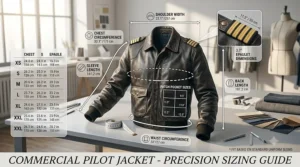
- Verify sizing against the brand’s own chart. Generic size labels vary wildly between manufacturers in this category.
- Consider resale and reputation. Established aviation-specific brands hold their look and structure longer than generic fashion-bomber labels.
Aviation Uniform Standards: What Airlines and Regulators Actually Require
There’s a common misconception that the FAA dictates exactly what a commercial pilot wears day to day — it doesn’t, at least not directly. Federal aviation regulations under 14 CFR Part 121 govern crewmember certification, qualification, and operational conduct, not jacket color or cut. Aviation uniform standards, in practice, are set by each individual airline or flight department, then layered on top of the baseline federal crewmember requirements.
That distinction matters for buyers: a jacket can be perfectly compliant with every applicable federal aviation regulation while still violating your specific carrier’s internal dress code. Regional airlines, major carriers, and corporate flight departments each maintain their own operations manuals specifying acceptable jacket styles, colors, and insignia placement — which is exactly why some aviation-specific retailers configure custom builds against a named carrier’s manual rather than selling one universal jacket. If you’re a working pilot rather than a hobbyist or student, your operations manual is the actual rulebook here, not a general buying guide.
Airline Pilot Uniform Jacket vs Off-Duty Flight Jacket: Airline Dress Code Explained
This is where a lot of buyers get tripped up, so let’s separate the two categories cleanly. An airline pilot uniform jacket is built to a carrier’s specific operations manual — epaulet slots positioned for that airline’s rank bars, matching color tolerances, and often a tailored fit designed to sit correctly over a service shirt and tie. An off-duty flight jacket, like the Rothco MA-1 or the Landing Leathers A-2, is a general-purpose piece inspired by military design but with no formal tie to any airline’s dress code at all.
| Category | Uniform Jacket | Off-Duty Flight Jacket |
|---|---|---|
| Epaulet placement | Matched to carrier specs | Generic or absent |
| Color tolerance | Strict, carrier-approved | Flexible |
| Typical setting | On-duty, in uniform | Commuting, casual wear, backup |
| Example | Corporate-configured builds | Rothco MA-1, Landing Leathers A-2 |
The analysis here is simple: if you’re required to be in uniform on the ramp or in the terminal, the jacket needs to match your specific airline dress code, not just look generally “pilot-ish.” Off-duty flight jackets are excellent for commuting to work, cold-weather travel days, or simply owning a piece of aviation history — but wearing one during on-duty hours at a carrier with a strict operations manual is a fast way to get a polite word from your chief pilot’s office.
✨ See a jacket above that fits your carrier’s look? Grab it now while your size is in stock!
Captain Pilot Jacket vs First Officer Attire: Rank, Insignia, and Career Stage
A captain pilot jacket isn’t a different garment so much as a different set of shoulder boards. Across most uniform programs, rank is communicated through epaulet stripe count rather than jacket cut: a single bar typically marks a cadet or trainee, two bars a first officer, three a senior first officer, and four the captain. The jacket itself, whether leather, wool-blend, or nylon, usually stays identical across ranks within the same carrier — what changes is the insignia mounted on it.
For students and low-time pilots, budget jackets like the Alpha Industries CWU-45/P or the Rothco MA-1 make the most financial sense, since career direction and even airline choice can still shift. Captains and senior first officers with established, long-term positions get more genuine value from investment pieces like the Cockpit USA Flight Crew Jacket or the Taylor’s Leatherwear Atlas C6Z, since the cost amortizes across a decade or more of daily wear rather than a training program that might last eighteen months.
Common Mistakes When Buying a Professional Pilot Jacket
The single most common mistake is buying strictly on brand recognition instead of checking whether the jacket actually meets your carrier’s aviation uniform standards — a beautiful leather jacket that isn’t uniform-compliant is still the wrong purchase for on-duty wear. A close second is ignoring sizing charts in favor of “my usual size,” which backfires specifically on nylon reproductions like the CWU-45/P that run noticeably smaller than typical outerwear.
Buyers also frequently underestimate care requirements, treating a $500 leather jacket like a machine-washable fleece and shortening its lifespan dramatically in the process. Finally, a surprisingly common mistake is buying the heaviest, warmest jacket available regardless of actual base climate — a pilot flying out of Phoenix doesn’t need the same insulation as one flying out of Fargo, and an overbuilt jacket becomes something that sits in a closet rather than something that gets worn.
Features That Actually Matter (And Those That Don’t)
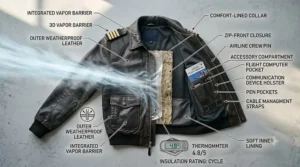
Bi-swing backs, removable liners, and genuine water-repellent shells are features that matter — they solve real, repeated problems pilots actually encounter. Epaulet compatibility matters enormously if you’re buying a true uniform piece, since a jacket without proper shoulder-board mounting simply won’t pass inspection at a carrier with strict standards.
What matters less than marketing copy suggests: exact leather “grade” claims without any accompanying spec detail, since terms like “premium” or “top-grain” are used loosely across this entire category with no enforced standard. Reversible linings, a design detail that traces back to the original wartime flight jacket lineage, are a nice historical touch on the MA-1 but add little practical value for a professional wearing the jacket the same way every day. And decorative-only patches or embroidery, while common on fashion-bomber jackets, add zero functional value and can actively work against you if your flight department has restrictions on visible branding.
One more feature worth actually checking rather than assuming: fabric composition disclosures. Uniform-adjacent apparel has occasionally drawn documented concern from crew unions over synthetic-blend fabric reactions in mass-produced uniform lines, as detailed in reporting from the Association of Flight Attendants-CWA — a good reminder to check material listings rather than assuming every uniform-styled jacket is automatically skin-safe for all-day wear.
Long-Term Cost & Maintenance: The Real Value of a Commercial Pilot Jacket
Run the actual numbers and the math shifts in favor of leather more often than budget shoppers expect. A $70 nylon bomber that needs replacing every two winters costs roughly $350 across a decade. A $500 leather jacket, properly conditioned and stored, routinely lasts ten to fifteen years of regular wear — meaning the per-year cost of the leather option can actually undercut the “budget” choice once replacement cycles are factored in.
Maintenance costs matter too: leather conditioning runs a few dollars a year in product, while dry cleaning for nylon uniform jackets typically costs more per visit than most people expect over a decade of wear. Building durable pilot professional attire is ultimately a cost-per-wear exercise, not a sticker-price exercise, and the jacket with the higher upfront number is frequently the cheaper one once you divide by the number of winters it actually survives.
Frequently Asked Questions
❓ What is a commercial pilot jacket?
❓ Do commercial pilots have to wear a specific jacket brand?
❓ How much should I expect to pay for a professional pilot jacket?
❓ Is a leather or nylon flight jacket better for cold climates?
❓ Can I wear an off-duty flight jacket like an MA-1 during work hours?
Conclusion
A commercial pilot jacket sits at an odd intersection of function, regulation, and personal pride — it has to survive real weather, meet whatever your carrier’s operations manual demands, and still look like something you’d actually choose to wear. The seven options above cover that whole spectrum, from the WenVen cotton bomber earning its keep on a hot ramp to the Taylor’s Leatherwear Atlas C6Z built for a decade of cold-weather duty days.
The right pick genuinely depends on where you fly, what your uniform standard requires, and how long you want the jacket to last. Check your operations manual first, match material to climate second, and let budget be the tiebreaker rather than the starting point — that order gets you a jacket you’ll still be wearing five winters from now instead of one gathering dust in a closet by spring.
✨ Ready to Fly in Style?
🔍 Take your professional pilot attire to the next level with the options above. Click through to check current pricing and availability on any jacket that fits your base, your budget, and your carrier’s standard. The right jacket won’t just keep you warm — it’ll help you show up looking like the professional you are!
Recommended for You
- 7 Best Police Winter Patrol Jackets for 2026
- Police soft shell jacket: 7 Top 2026 Picks Officers Actually Trust
- 7 Best Waterproof Police Duty Jackets for 2026
Disclaimer: This article contains affiliate links. As an Amazon Associate, I earn from qualifying purchases. If you purchase products through these links, we may earn a small commission at no additional cost to you.
✨ Found this helpful? Share it with your friends! 💬🤗
