
In This Article
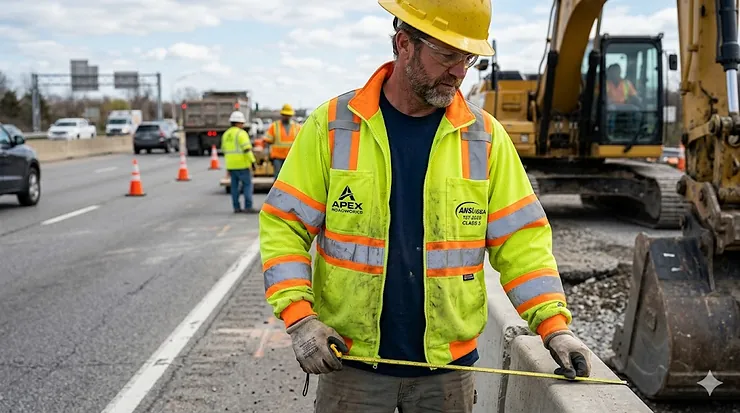
You know that sickening half-second when a truck sweeps past and you feel the air move? Road crews, utility workers, and flaggers know it intimately. An ANSI Class 3 hi-vis jacket isn’t a bureaucratic checkbox — it’s the layer of fluorescent, reflective armor standing between you and a distracted driver at 6 a.m. in a downpour. And yet, most buyers end up with something that fades after six washes, drowns them in sweat by midmorning, or fails OSHA inspection on the first site walkthrough.
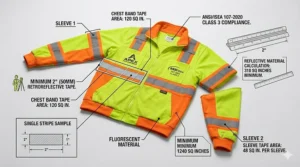
So what exactly qualifies as a Class 3 garment? Under ANSI/ISEA 107-2020 — the current governing standard for high-visibility safety apparel in the United States — a Class 3 jacket must provide a minimum of 1,240 cm² of background fluorescent material and at least 310 cm² of retroreflective tape, arranged in horizontal bands at the torso and sleeves. In plain English: more visibility coverage than any other performance class, which is precisely why Class 3 is mandated for workers on or near active roadways per FHWA regulations.
Class 2 is fine for parking lots and warehouse loading docks. But if you’re standing in a construction zone where traffic passes at speed, Class 3 is the floor — not the ceiling — of what you should be wearing.
I’ve dug deep into the Amazon listings, cross-referenced ANSI compliance data, and filtered through thousands of buyer reviews to bring you seven jackets that are actually worth your money in 2026. Whether you need a budget rain shell for occasional flagging duty or a bomber-style workhorse you can live in for twelve-hour winter shifts, there’s a pick here for you.
Quick Comparison: Top ANSI Class 3 Hi-Vis Jackets at a Glance
| Product | Type | Key Feature | Price Range | Best For |
|---|---|---|---|---|
| JORESTECH JK-03 | Rain Jacket | Detachable hood, interior mesh | Budget ($30–$45) | Occasional/seasonal use |
| TICONN Bomber | Bomber | 300D Oxford + 160g fleece liner | Budget-mid ($25–$50) | Cold-weather daily wear |
| Ergodyne GloWear 8377 | Bomber | 3M Scotchlite, 160g insulation | Mid ($55–$75) | All-day winter shifts |
| Ergodyne GloWear 8365BK | Rain Jacket | 300D Oxford, black bottom | Mid ($55–$75) | Roadwork / dirty environments |
| New York Hi-Viz WJ9012 | Bomber | 8000MM waterproof rating | Mid ($50–$70) | Wet climates, heavy rain |
| SKSAFETY 3-in-1 | 3-in-1 | Zip-out fleece liner | Mid-premium ($60–$85) | Variable-weather job sites |
| Portwest UH445 | Long Rain Jacket | Lightweight, pack-away hood | Premium ($65–$90) | Emergency services / traffic control |
What the table tells you: JORESTECH and TICONN dominate the budget end, but they make smart tradeoffs — lighter construction in exchange for price. The real value sweet spot lands squarely with the Ergodyne GloWear line, which earns its slightly higher price with 3M Scotchlite tape and proven durability over multiple seasons. If you work in genuinely wet conditions — Pacific Northwest, Gulf Coast, anywhere that sees sustained rainfall — the New York Hi-Viz WJ9012’s 8000MM waterproof rating is a spec that genuinely matters, not just marketing filler.
💬 Just one click — help others make better buying decisions too! 😊
Top 7 ANSI Class 3 Hi-Vis Jackets: Expert Analysis
1. JORESTECH Safety Rain Jacket JK-03 — ANSI Class 3, Type R
The JORESTECH JK-03 is the workhorse of the budget hi-vis category, and it’s been holding that position for years with good reason. Built from 300D Oxford polyester with a PU coating, it handles rain and wind without the stiffness you’d expect from cheaper shells.
Specs that matter in practice: The PU-coated 300D fabric gives it respectable water resistance for a jacket at this price — think heavy drizzle and moderate rain, not standing in a monsoon. The interior polyester mesh liner wicks moisture away from your skin, which sounds like a small detail until you’ve worn a non-lined jacket on a humid July morning. The detachable, hideaway hood with an adjustable face aperture means you’re not wrestling with snaps in the middle of traffic. Reflective tape meets ANSI/ISEA 107-2015 Class 3 requirements.
Expert take: The JK-03 is the jacket I’d recommend to someone doing seasonal flagging, a contractor who needs to keep a spare in the truck, or any worker whose employer doesn’t supply hi-vis and who can’t justify a $70 spend. At 3,000+ Amazon reviews with a 4.6-star average, buyers consistently praise the fit and the hood quality. Where it falls short is longevity — the PU coating on budget jackets begins to delaminate after heavy, repeated washing. Plan for 1–2 seasons of daily use.
Pros:
✅ Excellent price-to-compliance ratio
✅ Interior mesh liner for comfort
✅ Detachable hood with face shield adjustment
Cons:
❌ PU coating degrades faster with frequent washing
❌ Not designed for extreme cold (no insulation)
Price range: $30–$45 | Solid value for seasonal or backup use.
2. TICONN Waterproof Safety Bomber Jacket — ANSI Class 3
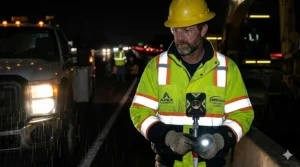
TICONN has quietly become one of the most-purchased hi-vis brands on Amazon, and their bomber jacket is the reason why. It punches above its weight class, offering a construction and warmth level that you’d normally pay significantly more for.
Specs that matter in practice: The 300D Oxford polyester with PU coating handles weather well, but the real differentiator is the 160g soft fleece insulation lining. That’s genuine warmth — enough to be comfortable through fall and into mild winter conditions without a base layer — and it doesn’t add the bulk that makes it impossible to move your arms on a full day’s work. The ANSI Class 3 reflective strips run the torso and sleeves. TICONN also added a kangaroo pocket, a zippered chest pocket, a PVC-transparent ID window, and a D-ring port for tools and keys, which is the kind of thoughtful functional detail that makes a difference at 5 a.m.
Expert take: This is the jacket for daily construction workers who need warmth and compliance without spending $80+. The fleece liner puts it firmly in “shoulder season to winter” territory. What most buyers overlook is the ID window — on DOT job sites where credentials need to be visible, this small feature saves real hassle. Customer feedback consistently highlights the value-for-money, though some buyers on the taller end note that sleeve length runs slightly short.
Pros:
✅ 160g fleece insulation for genuine cold-weather warm
✅Practical pockets including ID window and D-ring
✅ Excellent price for the feature set
Cons:
❌ Sleeve length may run short for taller workers
❌ Not a true rain jacket — heavy sustained rain will eventually penetrate
Price range: $25–$50 | Best all-weather value under $50.
3. Ergodyne GloWear 8377 Type R Class 3 Hi-Vis Winter Bomber Jacket
Ergodyne is a name that safety managers and experienced workers trust for good reason. The GloWear 8377 is what happens when a company invests in material quality rather than just hitting a price point — and it shows.
Specs that matter in practice: The 300D Oxford polyester outer shell with PU coating is paired with 160g thermal quilted insulation — matching TICONN in warmth, but Ergodyne adds 3M Scotchlite reflective material, which is the gold standard for retroreflectivity. The difference between generic reflective tape and 3M Scotchlite becomes apparent in low-angle headlight situations (exactly when it matters most). The inset hood has drawstrings and stoppers for a proper seal, and dual mic tabs mean emergency responders and radio-equipped workers don’t need aftermarket accessories. Compliant to ANSI/ISEA 107-2020.
Expert take: This is the jacket I’d buy if I worked road construction year-round. The 3M tape is a genuine safety upgrade — not just a marketing claim — and the dirt-hiding black panels on the sleeves and front mean it still looks professional after two weeks on site. It sits in the mid-range on price but delivers premium-level details. Great for utility workers, highway crews, and anyone whose job site is OSHA inspected.
Pros:
✅ 3M Scotchlite reflective material — the real deal
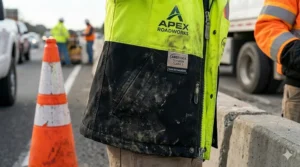
✅ Dirt-hiding black panels extend the jacket’s usable life
✅ Dual mic tabs and cell phone pocket built-in
Cons:
❌ Pricier than budget alternatives
❌ Sizing runs slightly small — order up if between sizes
Price range: $55–$75 | The best mid-range winter bomber you can buy.
4. Ergodyne GloWear 8365BK Hi-Vis Rain Jacket with Black Bottom
Where the 8377 is built for cold weather comfort, the 8365BK is engineered for waterproof performance. It’s the choice for roadwork in genuinely foul conditions — think rain-soaked utility crews, flaggers in Pacific Northwest winters, or anyone working alongside drainage and sewer projects.
Specs that matter in practice: The 300D Oxford polyester shell is heavier and more robust than the 150D used in Ergodyne’s lighter 8366 model, which translates to noticeably better abrasion resistance over time. It uses 2-inch 3M Scotchlite reflective material meeting ANSI/ISEA 107-2020 Class 3 requirements on the chest and arms. The black bottom panels aren’t just aesthetic — they actively hide the grime and staining that accumulates in construction environments, keeping the jacket looking compliant on site visits. The inset hood tucks away when not needed.
Expert take: If you’re choosing between the 8365BK and a budget rain jacket, ask yourself how many days a year you work in genuine rain. If the answer is 30+, the investment in Ergodyne pays back quickly in durability and sustained waterproofing. Budget PU coatings start losing their effectiveness after repeated washing; Ergodyne’s construction holds up significantly longer. Reviewers consistently call this their “buy once, use forever” jacket.
Pros:
✅ Heavy-duty 300D shell for durability in rough conditions
✅ 3M Scotchlite tape for superior low-light visibility
✅ Black bottom hides wear and maintains a professional appearance
Cons:
❌ Heavier than lightweight rain shells — less ideal in hot weather
❌ No insulation layer — you’ll need a base layer in winter
Price range: $55–$75 | Premium rain protection that earns every dollar.
5. New York Hi-Viz Workwear WJ9012 ANSI Class 3 Waterproof Bomber
New York Hi-Viz is a brand that doesn’t get the same marketing push as Ergodyne, but seasoned buyers who’ve worked through multiple hi-vis jackets know it well. The WJ9012 is the model that built their reputation.
Specs that matter in practice: The headline spec is the 8000MM waterproof rating — a number that actually means something. For context, 1500MM is considered waterproof for light rain; 8000MM puts this jacket into technical rain-gear territory. Paired with a 3000 g/m² breathability rating, it won’t cook you alive while keeping you dry. Reflective taping is 2-inch wide on front, back, and arms, meeting ANSI/ISEA 107-2015 Class 3. The snap-off adjustable hood, molded cuffs with hook-and-loop closures, clear ID pocket, and a mobile device pocket sized for modern phones complete a well-thought-out design.
Expert take: For workers in climates that see real, persistent rain — not the occasional sprinkle that trips up budget jackets — the WJ9012’s waterproofing is the number one reason to pay attention to this brand. The clear ID pocket accommodates full-size state IDs with the flap closed, which matters on regulated job sites. It’s also one of the few jackets in this price range with both a chest phone pocket and an arm pocket. Customer feedback is consistently strong on waterproofing performance.
Pros:
✅ 8000MM waterproof rating — among the best in its price range
✅ Full-coverage reflective taping on front, back and arms
✅ Snap-off hood and molded cuffs for a weather-tight seal
Cons:
❌ Runs slightly trim through the chest — check size chart carefully
❌ Less insulation than bomber-style competitors
Price range: $50–$70 | Best choice if waterproofing is your #1 priority.
6. SKSAFETY 3-in-1 High Visibility Winter Bomber Jacket — ANSI Class 3
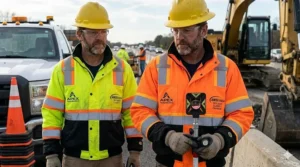
The 3-in-1 category solves a real problem: job sites where temperatures swing wildly between early morning and midday, or between seasons when you’re not sure if you need a shell or a full winter jacket. The SKSAFETY 3-in-1 is the best representative of this style at its price point.
Specs that matter in practice: The zip-out fleece liner is the core value proposition. In mild weather, pull it out and wear the outer shell alone — a lightweight, waterproof ANSI Class 3 rain jacket. Drop into the 30s? Zip it back in and you’ve got a warm winter bomber. The outer shell is waterproof with a PU coating and meets ANSI/ISEA Class 3 requirements with reflective tape on the torso and sleeves. SKSAFETY backs the jacket with a full replacement/refund promise for any manufacturing defect, which adds real peace of mind.
Expert take: Where most buyers go wrong with 3-in-1 jackets is assuming the combined garment is as warm as a purpose-built parka. It’s not — the combined warmth is moderate, suitable for most fall/early winter conditions but not sustained temperatures below 20°F. What this jacket does brilliantly is cover the widest seasonal range of any single jacket in the lineup. It’s the smart buy for workers whose job sites span spring through fall with occasional cold snaps. Budget-to-mid pricing makes it accessible without being a compromise.
Pros:
✅ Zip-out fleece liner adapts to changing temperatures
✅ Full replacement/refund guarantee
✅ Waterproof outer shell meets Class 3 compliance independently
Cons:
❌ Combined warmth limited below 20°F
❌ Slightly bulkier when worn as a full 3-in-1
Price range: $60–$85 | The most versatile Class 3 jacket in the lineup.
7. Portwest UH445 ANSI Class 3 Waterproof Long Rain Jacket
Portwest is a name you’ll encounter the moment you step into professional-grade safety gear — trusted by emergency services, rail crews, and traffic control teams globally. The UH445 brings that pedigree to Amazon shoppers in the USA.
Specs that matter in practice: The UH445 is a long-cut rain jacket — meaning it covers below the hip, which matters enormously for flaggers and workers who spend extended time in rain without movement to generate body heat. The lightweight polyester shell is specially coated to bead water off the fabric surface, and the pack-away adjustable hood keeps bulk minimal. Two front pockets with waterproof zips and a D-ring attachment point round out the practical design. ANSI Class 3 compliant, Type R.
Expert take: The extended length is the detail that separates this jacket from every other option on this list. If you’re standing at a flagging post for four consecutive hours in rain, the difference between a standard-length jacket and one that covers your thighs is not subtle — it’s the difference between arriving home soaked from the waist down and staying genuinely dry. Emergency first responders, survey crews, and traffic control workers all have reason to appreciate this design. Portwest’s quality control is consistently strong; this is a jacket that survives sustained professional use.
Pros:
✅ Extended length protects lower body in standing-rain scenarios
✅ Portwest’s professional-grade build quality
✅ Lightweight and packable despite full waterproof protection
Cons:
❌ Long cut can feel restrictive for workers who need full mobility
❌ Premium pricing compared to budget alternatives
Price range: $65–$90 | The professional’s choice for sustained rain exposure.
How to Choose an ANSI Class 3 Hi-Vis Jacket: A Practical Framework
The spec sheets all look the same at first glance. Here’s how to cut through the noise and identify what actually matters for your situation.
1. Confirm the compliance standard first
Look for ANSI/ISEA 107-2015 or ANSI/ISEA 107-2020 on the label — not just “ANSI Class 3” in the marketing copy, which any seller can write. The standard number tells you the garment was designed and tested to a defined benchmark. According to the ANSI Blog, wearing properly labeled HVSA is often legally mandated by OSHA and state transportation departments for roadway workers — so this isn’t a minor detail.
2. Match jacket type to your work environment
ANSI/ISEA 107 defines three types: Type O (off-road), Type R (roadway and traffic control), and Type P (public safety / emergency services). Most construction and road work requires Type R, Class 3. If your site supervisor specifies “Type R,” a jacket labeled only as “Class 3” without the Type designation may not technically satisfy the requirement.
3. Evaluate waterproofing honestly
A 1500MM rating is waterproof for drizzle. 5000MM+ handles sustained rain. 8000MM (like the New York Hi-Viz WJ9012) is appropriate for genuine wet-weather work environments. If you live and work in the Southeast, Pacific Northwest, or Great Lakes region, treat waterproof rating as a primary selection criterion, not a tiebreaker.
4. Think about temperature range
A rain shell without insulation is ideal for spring/fall or high-activity work. A 160g insulated bomber handles most winter conditions. Below 20°F on stationary work? You need dedicated cold-weather layering underneath — no hi-vis jacket replaces proper thermal base layers.
5. Consider the reflective tape source
Generic reflective tape and 3M Scotchlite both meet ANSI minimums, but real-world retroreflectivity differs. 3M Scotchlite reflects more light at wider angles, which becomes significant when headlights aren’t aimed directly at you. For high-traffic road environments, this distinction matters.
6. Check for practical features your workday actually needs
Mic tabs, ID windows, phone pockets, D-rings for keys — these aren’t luxury additions on a worksite. They’re the difference between a jacket you actually use versus one you leave in the truck.
7. Plan your washing and replacement schedule
Even the best ANSI hi-vis jackets lose retroreflective effectiveness over time. The Federal Highway Administration recommends retiring hi-vis garments after significant fading or 25+ wash cycles. Budget accordingly — buying a $30 jacket you replace every season is often smarter than a $70 jacket you feel guilty replacing after two years of wear.
What Your Workday Actually Looks Like in a Class 3 Jacket: Real-World Performance
The spec sheet tells you about 300D polyester and PU coatings. Here’s what that actually means when your alarm goes off at 4:30 a.m.
The morning commute in a budget shell (JORESTECH JK-03): You’re loading tools in 38°F temperatures. The jacket goes on over a hoodie, and the interior mesh liner actually prevents that clammy feeling where the outer shell presses against fabric. The detachable hood cinches down against the wind. By the time you hit the job site, you’re comfortable — not warm, exactly, but not miserable. This is a jacket built for movement in mild-to-cool conditions, not a heater.
Mid-shift in an insulated bomber (Ergodyne GloWear 8377): Eight hours in, temperatures dropped further and a light rain moved through. The 160g quilted insulation does its job quietly — no dramatic warmth, just a steady baseline that means you’re not stopping to layer up. The 3M Scotchlite tape catches a supervisor’s flashlight from forty feet away and throws it back like a mirror. The black panels on the sleeves have hidden two days of concrete dust remarkably well.
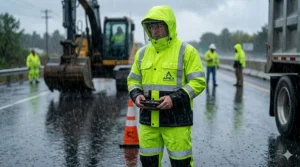
A standing flagging shift in the Portwest UH445: Four hours on a two-lane road, traffic cycling through at 40 mph, and a steady light rain that turned heavy around hour three. The long cut kept the top of the thighs dry; that’s not nothing when you’re standing still. The pack-away hood sealed without gaps. By the end of the shift, the reflective tape on the arms was clearly visible to every approaching driver — doing exactly what Class 3 standards require.
The consistent thread across all seven jackets in this review: they all do the fundamental job. What separates them is how comfortable, how durable, and how practical they make the twelve hours you spend wearing them.
Case Study: Matching the Right Jacket to Your Worker Profile
Not everyone reading this is the same worker. Here’s how to shortcut the decision based on where you actually are.
Profile 1: The Seasonal Contractor — You do flagging and site work about 30–40 days a year, mostly fall. You need OSHA compliance but can’t justify a $75 purchase for occasional use. Best pick: JORESTECH JK-03. It’s compliant, functional, and puts minimal hurt on the budget. Plan to replace it every other season.
Profile 2: The Full-Time Road Crew Member — You’re on highway construction five days a week, spring through fall, sometimes in rain and cold. You need something that survives the entire season. Best pick: Ergodyne GloWear 8377 or 8365BK. The 3M tape and construction quality pay back their premium in durability and sustained compliance. The 8377 if cold weather dominates your season; the 8365BK if rain does.
Profile 3: The Utility / Emergency Worker — You’re in traffic control and emergency response. Your jacket needs to meet Type P or Type R Class 3 specs, be highly visible at all angles, and potentially work with a radio harness. Best pick: Portwest UH445 for wet conditions, or Ergodyne GloWear 8377 for cold-weather shifts with mic tabs.
Profile 4: The Variable-Season Worker — Your job site sees temperature swings from 25°F mornings to 55°F afternoons in the same week. Layering and delayering is your daily reality. Best pick: SKSAFETY 3-in-1. The zip-out fleece liner adapts faster than any other single-jacket solution in the lineup.
Profile 5: The Budget-Aware Daily Worker — You need daily wear but your employer doesn’t supply PPE. You want warmth, compliance, and reasonable durability for under $50. Best pick: TICONN Waterproof Safety Bomber. The 160g fleece liner, ID window, and D-ring port make it the most feature-rich jacket at its price bracket.
Common Mistakes When Buying a High Visibility Safety Jacket
These are the errors that generate the one-star reviews. Avoid them.
Mistake 1: Buying “hi-vis” without checking the class. A bright yellow vest from the clearance bin may be high-visibility to the human eye but completely non-compliant with ANSI Class 3 requirements. On regulated job sites, this means removal from work until you get compliant gear. Always verify the ANSI/ISEA 107 label.
Mistake 2: Assuming Class 2 is sufficient for roadwork. FHWA regulations mandate Class 3 for workers on or near Federal-aid highways. Class 2 — common in warehouse vests and parking attendant gear — provides roughly half the background material coverage of Class 3. If a driver is approaching at speed through fog or darkness, that difference is measurable.
Mistake 3: Washing hi-vis gear with the wrong detergent. Standard detergents with optical brighteners can degrade retroreflective tape faster than normal wear. Wash hi-vis jackets in mild detergent, inside out, on gentle cycle. Most professional safety managers recommend air-drying rather than machine drying to preserve PU coatings and tape adhesion.
Mistake 4: Ignoring fit. A Class 3 jacket worn over bulky winter gear that bunches the reflective tape out of its required configuration is no longer technically compliant. Order up one size if you plan to layer heavily underneath.
Mistake 5: Keeping a jacket past its service life. Faded fluorescent background material is not compliant — it no longer meets the luminance requirements of ANSI/ISEA 107. If the lime or orange has shifted toward yellow-white, it’s time to replace it regardless of the jacket’s structural condition.
ANSI Class 3 vs. Class 2 High Visibility Jacket: When It Actually Matters
The difference between these two performance classes isn’t about fashion — it’s about the specific contexts where each is legally required and physically effective.
| Feature | Class 2 | Class 3 |
|---|---|---|
| Minimum background material | 775 cm² | 1,240 cm² |
| Minimum retroreflective tape | 201 cm² | 310 cm² |
| Sleeve coverage required | No | Yes |
| Required for Federal highway work | No | Yes (FHWA) |
| Typical garment types | Vest, shirt | Full jacket, coverall |
| Visibility distance (ideal conditions) | ~400–600 ft | ~1,000+ ft |
Analysis: The numbers confirm what common sense suggests — Class 3 coverage wraps the entire upper body including arms, making the wearer identifiable as a human figure from much greater distances and from more angles. Class 2 vests, worn without high-vis sleeves, disappear at the arm and become ambiguous silhouettes in poor light. For roadway workers, that ambiguity is dangerous. If your employer specifies Class 2 and you work near vehicle traffic, this table is worth showing to your safety manager.
The ANSI/ISEA 107-2020 standard makes the rationale clear: Class 3 exists specifically for “tasks that place workers within the right-of-way of a highway or street,” where the full-body silhouette identification is a survival requirement, not a preference.
Long-Term Cost & Maintenance: What Owning a Hi-Vis Jacket Really Costs
A $30 jacket replaced every year is $30 per year. An $80 jacket that lasts four years is $20 per year — plus it keeps you safer throughout its longer service life because quality retroreflective material degrades more slowly.
That math doesn’t mean you should always buy premium. It means you should be honest about your usage pattern.
Washing correctly extends service life dramatically. Machine washing on hot with heavy detergent is the fastest way to destroy both the PU waterproofing and the reflective tape. Cold water, gentle cycle, mild detergent — this simple change can easily double a jacket’s compliant lifespan.
Store hi-vis gear away from direct UV exposure. Prolonged UV exposure degrades fluorescent dyes faster than any washing cycle. A jacket left in a sun-baked truck cab for six months will show visible fading that a jacket stored indoors won’t. This isn’t theoretical — FHWA service life guidelines specifically account for UV exposure conditions.
Inspect the tape, not just the jacket. The outer shell may look fine while the retroreflective tape has cracked or peeled at the edges. Run your hand along the tape seams monthly. Peeling tape doesn’t just look bad — it compromises the 310 cm² retroreflective minimum and makes the garment non-compliant.
Budget for annual replacement if you’re in daily road-adjacent work. Professional PPE programs in most state DOTs operate on a one-year replacement cycle for hi-vis outerwear. If your employer doesn’t supply gear, budget $30–$80 annually depending on your quality tier and climate conditions.
Reflective Tape Placement: Why It’s a Safety Standard, Not a Design Choice
This is the section most buyers skip — and the one that safety managers check first.
ANSI/ISEA 107-2020 doesn’t just require a minimum area of retroreflective tape; it specifies where that tape must be placed to create a recognizable human silhouette in low-light conditions. The standard requires horizontal bands encircling the torso and retroreflective material on the sleeves. This combination is what makes a dark roadway worker look like a person rather than a signpost.
When evaluating jackets, verify:
- Torso bands are circumferential (going all the way around), not just front-facing
- Sleeve tape runs horizontally to create arm definition
- Tape width is at minimum 2 inches, which is the ANSI-specified minimum for Class 3
- Tape is attached securely with no bubbling or edge separation
The placement requirement is also why buying a Class 3 vest and wearing it open over a dark jacket is problematic — the tape configuration gets disrupted, potentially taking the garment out of compliance. For jacket-style hi-vis gear, fit and wear matters as much as the initial purchase.
FAQ
❓ What does ANSI Class 3 mean on a hi-vis jacket?
❓ Is a Class 3 high visibility jacket required by OSHA?
❓ What is the difference between an ANSI compliant safety jacket Class 2 and Class 3?
❓ Can I wear an ANSI Class 3 hi-vis jacket in the rain?
❓ How often should I replace my ANSI Class 3 high visibility safety jacket?
Conclusion
The ANSI Class 3 hi-vis jacket is the kind of gear nobody thinks about until they need it — and by then, it’s too late to make a thoughtful choice. The good news: the Amazon market in 2026 is genuinely competitive, which means excellent compliance and quality are available at every price point.
For everyday value and warmth, the TICONN Bomber and JORESTECH JK-03 are hard to beat under $50. Step up to the Ergodyne GloWear 8377 or 8365BK for professional-grade durability and genuine 3M Scotchlite tape. Need maximum waterproofing? The New York Hi-Viz WJ9012‘s 8000MM rating stands alone in its tier. Versatility across seasons? The SKSAFETY 3-in-1 adapts without complaint. And for flaggers and emergency workers who spend full shifts standing in rain — the Portwest UH445‘s extended length is a quality-of-life feature that pays dividends every wet shift.
Buy for how you actually work, not for the best case scenario. A Class 3 jacket in the truck because it was “too expensive to risk getting dirty” is doing exactly nothing for your safety.
✨ Don’t Miss These Exclusive Deals!
🔍 Take your worksite visibility to the next level with these carefully selected ANSI Class 3 jackets. Click on any highlighted product name to check current pricing and availability on Amazon. Your safety is worth the two minutes it takes to find the right fit.
Recommended for You
- 7 Best Low Profile Tactical Jackets for Everyday Carry (2026 Guide)
- 7 Best Concealed Carry Tactical Jacket Civilian Options 2026
- 7 Best Civilian Tactical Jackets 2026 (CCW Ready & Urban Tested)
Disclaimer: This article contains affiliate links. As an Amazon Associate, I earn from qualifying purchases. If you purchase products through these links, we may earn a small commission at no additional cost to you.
✨ Found this helpful? Share it with your friends! 💬🤗
