
In This Article
Here’s a number worth sitting with: over 800 construction workers are killed annually in struck-by accidents in the United States, and a significant chunk of those deaths come down to one brutal, preventable cause — the driver simply didn’t see the worker in time. Not because they were distracted. Not because the light was terrible. Just because the worker blended into the chaos of the jobsite.

A quality construction hi-vis jacket is, quite literally, the simplest piece of lifesaving gear you can own.
But here’s the thing — not all hi-vis jackets are created equal. Walk into any supply store and you’ll find a wall of neon yellow and orange. Some will last through three winters and a hundred wash cycles. Others will fade to a sad, murky beige by February. Some will keep you bone-dry in a downpour. Others will soak through in a drizzle and leave you cursing your purchasing manager for the rest of the shift.
What is a construction hi-vis jacket, exactly? It’s a fluorescent, retroreflective outer garment engineered to meet ANSI/ISEA 107 standards, designed to make workers visible to vehicle operators and equipment operators in all lighting conditions — daylight, dusk, night, and everything in between. The best ones also tackle weather, comfort, and pocket organization with the kind of thoughtfulness that makes a long shift feel a lot shorter.
In this guide, I’ve researched and analyzed the seven best construction hi-vis jackets currently available on Amazon, covering everything from budget-friendly options for new contractors to premium, feature-loaded parkas for crews working year-round in brutal conditions. I’ve dug into real ANSI specs, waterproofing ratings, reflective tape quality, and genuine customer feedback — so you don’t have to wade through a hundred reviews to find the right jacket.
Whether you’re a general contractor outfitting a crew, a solo tradesman shopping for yourself, or a safety manager trying to keep a team compliant and comfortable, this guide has you covered.
Quick Comparison: Top 7 Construction Hi-Vis Jackets at a Glance
| Product | ANSI Class | Waterproofing | Key Feature | Best For | Price Range |
|---|---|---|---|---|---|
| SKSAFETY Hi Vis Reflective Parka | Class 3 | 6,000mm | Fleece-lined, removable hood | Cold-weather crews | $35–$55 |
| KwikSafety TORRENT Rain Jacket | Class 3 | Waterproof polyester | Hideaway hood, 360° reflective | Roadside & rainy jobsites | $35–$50 |
| Portwest PW365 3-in-1 Jacket | Class 3 | Double PU coat | Detachable sweatshirt liner | Versatile 3-season use | $70–$100 |
| Ergodyne GloWear 8390 | Class 3 | PU-coated shell | AmpliFIRE™ heat-reflective lining | Extreme cold weather | $90–$130 |
| New York Hi-Viz WJ9012 Bomber | Class 3 | 8,000mm rated | Snap-off hood, ID pocket | Highway & utility work | $40–$65 |
| Portwest US365 3-in-1 Bomber | Class 3 | Waterproof | Zip-in liner, mic tabs | All-weather flexibility | $65–$95 |
| SKSAFETY Heated Safety Bomber | Class 3 | TPU laminate shell | 3M reflective tape, heated elements | Winter construction | $80–$120 |
What this table tells you: The Ergodyne GloWear 8390 and Portwest PW365 are the standout picks for buyers who work in cold, wet conditions and want a jacket that truly performs beyond just visibility. Budget buyers will find real value in the SKSAFETY Reflective Parka and KwikSafety TORRENT — both hit ANSI Class 3 compliance at a price point that won’t raise eyebrows on any purchase order. The Portwest US365 and WJ9012 sit in the middle ground, offering honest durability and smart features without the premium price tag.
💬 Just one click — help others make better buying decisions too! 😊
✨ Don’t Miss These Exclusive Deals!
🔍 Take your jobsite safety to the next level with these carefully selected products. Click on any highlighted item to check current pricing and availability. These jackets could be the most important gear investment you make this year!
Top 7 Construction Hi-Vis Jackets: Expert Analysis
1. SKSAFETY Hi Vis Reflective Jacket — Waterproof Parka (Class 3)
The SKSAFETY Reflective Parka is the definition of no-nonsense value — it punches well above its price tag, and if you’re outfitting a crew on a tight budget, this is where I’d start.
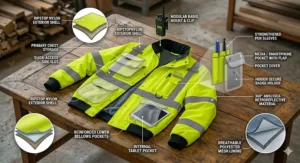
The jacket is fully compliant with ANSI/ISEA 107-2020, Type R Class 3, with a 6,000mm waterproofing rating and 2″ reflective strips running 360° around the body. The 300D polyester shell features taped and sealed seams — that’s the detail most budget jackets skip, and the one that determines whether you’re dry or soaked at hour four of a rainy shift. The fleece lining adds genuine warmth without adding bulk, and the removable hood means you can adapt to changing site conditions. SKSAFETY includes an impressive 11-pocket layout: inner chest pocket, cell phone pocket, clear ID holder, mic tabs, and pen holders on the sleeves. That’s contractor-level organization at an entry-level price.
Who is this for? General laborers, site supervisors, and anyone who needs a reliable, OSHA-compliant jacket without a premium price. It’s not the jacket you’d wear to a -20°F winter job in Minnesota, but for three-season use across most of the U.S., it’s remarkably capable. Customers consistently call out the true-to-size fit and the quality of the reflective tape, noting it holds up through repeated machine washing.
✅ ANSI/ISEA 107-2020 Type R Class 3 certified
✅ Sealed seams — not just “water resistant,” actually waterproof
✅ Generous 11-pocket storage for tools and accessories
❌ Not rated for extreme sub-zero temperatures
❌ Sizing can run slightly large — check the chart carefully
Price range: Around $35–$55. Outstanding value — this is the workhorse pick for budget-conscious buyers who still demand compliance.
2. KwikSafety TORRENT Class 3 Safety Rain Jacket (Model KS5516)
KwikSafety built their reputation in Charlotte, NC, on one principle: actually test your products to ANSI standards, because most companies don’t. The TORRENT is their flagship rain jacket, and it shows.
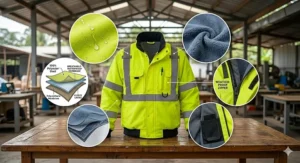
The TORRENT features fluorescent yellow high-visibility material with 1″ trim and 2″ silver retroreflective tape bands, certified Class 3 Type R under ANSI/OSHA standards. The combination of trim sizes matters more than most buyers realize — the 2″ bands provide the primary nighttime retroreflection, while the 1″ trim creates a layered visibility profile that makes the wearer stand out even in complex visual environments like busy intersections with competing light sources. The hideaway hood is a practical touch: it folds neatly into the collar when not needed, keeping your sight lines clear during normal conditions, and deploys fast when weather rolls in. Adjustable cuffs seal out wind and rain at the wrists.
This jacket is purpose-built for road construction workers, flaggers, surveyors, and EMS personnel who spend time near moving traffic. It’s not insulated — KwikSafety positions the TORRENT as a rain layer rather than a cold-weather jacket, which is the right call. Layer it over a fleece or thermal base, and you’ve got a system that outperforms any single all-in-one jacket in wet conditions. Customers particularly love the fit for women, noting the cut is more tailored than the boxy unisex silhouettes that dominate this category.
✅ Third-party ANSI tested — not just self-certified
✅ Ideal as a layering piece for wet jobsite conditions
✅ Comfortable hideaway hood design
❌ No insulation — not a standalone cold-weather option
❌ Color selection limited compared to some competitors
Price range: Around $35–$50. Excellent rain-specific performance; best paired with a thermal layer in colder months.
3. Portwest PW365 Hi-Vis 3-in-1 Waterproof Rain Jacket
Portwest has been in the protective workwear game for over 120 years. That kind of institutional knowledge shows up in details like the PW365’s HiVisTex Pro segmented reflective tape — a proprietary design that increases retroreflective performance over standard solid-strip tape, particularly in the side-angle perspectives that matter most when a vehicle is approaching from a non-direct angle.
The PW365 is a 3-in-1 system: a waterproof outer shell made from 300D 100% polyester with a double PU coating, paired with a full zip-in sweatshirt liner that can be detached and worn independently. In practice, this means you get three garments for the price of one — a lightweight spring/fall jacket (liner only), a waterproof outer shell for wet conditions, and a fully integrated winter jacket when both are worn together. The pack-away ergonomically shaped hood is one of the better-designed hoods in this category, fitting naturally over a hard hat without creating the awkward bulk you often see on cheaper designs. Twin-stitched seams add structural durability, and the drawcord adjustable hem lets you customize the fit over tool belts and harnesses.
This is the jacket I’d recommend to the foreman or site supervisor who needs one jacket to handle everything from March mud season to October rain. It’s certified to ANSI Class 3 standards and is currently one of the most consistently rated safety jackets on Amazon.
✅ True 3-in-1 versatility — three jackets in one system
✅ HiVisTex Pro segmented tape for superior angle visibility
✅ Twin-stitched seams for long-term durability
❌ Higher price point than single-layer alternatives
❌ The liner alone doesn’t meet Class 3 by itself — outer shell required for compliance
Price range: $70–$100. Worth every dollar for workers who want a single jacket that handles multiple seasons and conditions.
4. Ergodyne GloWear 8390 Hi-Vis Winter Jacket with AmpliFIRE™ Lining
This is the jacket that changes the conversation about cold-weather hi-vis gear. Most winter safety jackets are essentially padded neon — they keep you warm and visible, but they don’t solve the deep-cold problem. The GloWear 8390 does something genuinely clever: its AmpliFIRE™ heat-reflective lining uses aluminum insulation to capture and reflect your body’s own heat back toward you. The result is a CLO rating of 3.21, which Ergodyne rates for moderate work levels at temperatures down to -55°F.
Let that sink in: -55°F. That’s not a spec you’ll find on any other jacket in this price range.
The outer shell is 300D polyester with a PU coating for wind and water resistance, backed by 180g of thermal insulation in the body and 140g in the sleeves — a strategic distribution that keeps your core warm without restricting arm movement. The gusseted sleeves are a detail I appreciate; they flex with you rather than pulling tight when you’re reaching overhead or swinging tools. The GloWear 8390 hits ANSI/ISEA 107-2020 Class 3 with 2″ reflective stripes, and the left sleeve badge leaves the back panel open for custom logo work — a practical touch for companies that want branded safety gear. Five pockets, D-rings, mic tabs, and an insulated tablet pocket round out a thoughtfully designed package.
This is the jacket for winter concrete pours, utility crews working through January, pipeline workers, and anyone who has learned the hard way that ordinary jackets don’t cut it when it’s genuinely frigid.
✅ AmpliFIRE™ aluminum lining — unmatched cold-weather performance
✅ Gusseted sleeves for full range of motion
✅ Insulated tablet pocket — surprisingly practical on modern jobsites
❌ Price reflects the premium engineering
❌ Heavier than lightweight rain alternatives — not ideal for warm climates
Price range: $90–$130. The most technically advanced jacket on this list; worth it for crews working in serious cold.
5. New York Hi-Viz Workwear WJ9012 ANSI Class 3 Bomber Jacket
New York Hi-Viz built this jacket to meet a specific, uncompromising standard: genuine waterproofing, not just water resistance. The WJ9012 carries an 8,000mm waterproof rating — among the highest in the mid-price bracket — and backs it up with a breathability rating of 3,000 G/M², which matters because a jacket that keeps rain out but traps sweat is just a different kind of miserable.
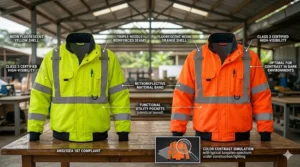
The Class 3 compliance comes via 2″-wide reflective taping on the front, back, and arms, meeting ANSI/ISEA 107-2015 standards. The snap-off adjustable hood is designed with a clear ID pocket — 6″ × 3.5″ — sized for standard state IDs and New York State IDs specifically, a small but useful detail for worksites that require visible ID badge compliance. A molded adjustable cuffs system with hook-and-loop closures seals the wrists against wind and rain, and the mobile device pocket handles devices up to 7″ × 3.5″ — fitting most modern smartphones and even a small tablet.
This is the jacket I’d recommend to highway construction crews, utility maintenance workers, and anyone who works near traffic on federally funded roads, where FHWA’s 23 CFR Part 634 mandates Class 3 or better. The bomber cut is classic and comfortable, and the overall build quality holds up well through a full season of heavy use.
✅ 8,000mm waterproof rating — genuinely waterproof, not just resistant
✅ Thoughtfully sized ID pocket for badge compliance
✅ Clean, professional bomber styling
❌ Insulation is minimal — better as a three-season jacket
❌ Sizing feedback suggests ordering up for layering purposes
Price range: $40–$65. Excellent waterproofing performance at a competitive price point.
6. Portwest US365 Hi-Vis Class 3 3-in-1 Bomber Jacket
The US365 is Portwest’s workhorse bomber — similar in concept to the PW365 but with a slightly more traditional cut that many workers find more comfortable for physical tasks. It’s built around a zip-in liner system that creates a flexible 2-in-1 setup: waterproof outer bomber for wet conditions, detachable sweater for mild days, or both combined for cold weather.
The 2″ silver reflective tape is ANSI Class 3 compliant, and the pack-away adjustable hood tucks cleanly into the collar. Elastic waistband and adjustable cuffs with hook-and-loop closure ensure the fit stays snug and wind-resistant across a range of movement. Two chest pockets, a sleeve pocket, internal storage, and mic tabs check the organizational boxes that working professionals need. Machine washable.
What the spec sheet doesn’t tell you: the US365 fits generously through the shoulders, which makes it genuinely comfortable worn over a harness system — a detail that full-time riggers and iron workers will appreciate. Portwest’s quality control is consistent at this price point, which is more than can be said for many brands in the $65–$95 range.
✅ 3-in-1 flexibility for changing weather conditions
✅ Generous shoulder fit — comfortable over harnesses
✅ Consistent Portwest quality across production runs
❌ Reflective tape is standard, not the premium segmented HiVisTex Pro of the PW365
❌ Not rated for extreme cold on its own
Price range: $65–$95. A smart pick for crews who need one jacket to handle variable conditions across the workweek.
7. SKSAFETY Professional Level Heated Safety Bomber Jacket (Class 3)
The heated safety jacket category has matured significantly in the last two years, and the SKSAFETY Heated Bomber is one of the most compelling examples of where it’s landed. This isn’t a gimmick — it’s a Class 3 ANSI 107 compliant jacket with 3M retroreflective tape, 260T polyester with a TPU laminated shell (windproof, waterproof, tear-resistant), and an integrated heating system built in.
The 3M reflective tape distinction is worth emphasizing: 3M Scotchlite-grade tape is the industry benchmark for retroreflective performance. When headlights hit 3M tape at distance, the return brightness is measurably higher than generic retroreflective materials — and at the margins of visibility, that difference is what keeps workers alive. The TPU laminate shell provides better abrasion resistance than standard polyester PU coatings, translating to longer jacket life in environments where the jacket makes contact with rough surfaces, scaffolding, and equipment.
The heating system extends working comfort in temperatures that would otherwise send crews to the truck every 20 minutes. This is the jacket for outdoor winter utility work, underground construction access points, and any job where staying on-task in the cold is a productivity and safety priority simultaneously.
✅ 3M Scotchlite-grade reflective tape — best-in-class retroreflective performance
✅ TPU laminate shell — superior durability over standard PU coatings
✅ Heated system extends cold-weather working range
❌ Premium price for the heated version
❌ Battery life and charging requirements add a management consideration for crews
Price range: $80–$120. The heated option is worth the investment for crews working regular winter shifts in genuinely cold conditions.
How to Choose a Construction Hi-Vis Jacket: 6 Criteria That Actually Matter
Choosing a construction hi-vis jacket sounds simple until you’re standing in front of fifteen options at various price points and wondering what actually separates them. Here’s the framework I use — and it’s the same one a competent safety manager would run through.
1. ANSI Class — Know What Your Job Requires
This is the non-negotiable starting point. The ANSI/ISEA 107-2020 standard defines three classes of high-visibility apparel based on the risk level of your working environment.
- Class 1 is for low-risk environments where workers have full attention on traffic and separation from vehicles is maintained.
- Class 2 is for workers with some traffic exposure — warehouse receiving docks, parking lot maintenance, road shoulder work.
- Class 3 is mandatory for highway construction, work zone flaggers, utility crews, and anyone working adjacent to moving vehicles without a barrier. It requires a minimum of 1,240 cm² of fluorescent background material and 310 cm² of retroreflective tape.
If you’re on a construction site near traffic in the U.S., you almost certainly need Class 3. All seven jackets in this guide meet Class 3 — that’s the baseline for any serious jobsite recommendation.
2. Waterproofing Rating — And Why “Water-Resistant” Is Not Enough
A jacket rated “water resistant” will handle light drizzle. A jacket with a 6,000mm to 10,000mm waterproof rating will keep you dry through a full day of heavy rain. The rating measures how much water pressure the fabric can withstand before it leaks — and in construction, you don’t get to stop working because it’s raining. Look for at minimum 5,000mm for genuine waterproofing, and verify that the seams are taped and sealed, not just stitched.
3. Reflective Tape Quality
Not all reflective tape is equivalent. Standard retroreflective tape works. 3M Scotchlite-grade tape — used in products like the SKSAFETY Heated Bomber and verified as meeting ANSI retroreflectivity thresholds — performs measurably better at distance and at oblique angles. If you’re working on high-speed roadways or in environments with complex lighting, the tape quality genuinely matters.
4. Insulation Level — Match It to Your Climate
Jacket warmth is measured in CLO ratings. A lightweight rain shell (0–1 CLO) works for spring through fall. A mid-layer insulated jacket (1–2 CLO) handles mild winters. The Ergodyne GloWear 8390’s 3.21 CLO is engineered for extreme cold. Match your jacket’s insulation level to the actual temperatures you work in — not the warmest day of the season, but the coldest morning you’ll be on-site.
5. Pocket Configuration for Your Actual Use Case
This sounds minor until it isn’t. A jacket with a clear ID holder built in saves you from carrying a separate badge clip. Mic tabs matter if you’re on radio communication. An insulated tablet pocket matters if you carry digital plans. The SKSAFETY Parka’s 11-pocket layout is overkill for some workers and exactly right for others. Think about what you actually carry on a shift before you buy.
6. Fit Over PPE
Construction workers don’t wear hi-vis jackets over a t-shirt. They wear them over harnesses, tool belts, and thermal layers. A jacket that fits perfectly on its own may bind across the shoulders when layered over a harness. The Portwest US365, in particular, is cut generously through the chest and shoulders specifically to accommodate this reality. When in doubt, size up.
Real-World Scenarios: Matching the Right Jacket to Your Situation
Not every construction worker has the same job. Here’s how I’d match these seven jackets to three common profiles.
The Highway Road Crew Worker
You’re on or near active traffic lanes all day. You need maximum visibility, genuine waterproofing because weather doesn’t stop road work, and compliance with FHWA’s 23 CFR 634 requirement for Class 3 on federal-aid highways. The KwikSafety TORRENT is purpose-built for this scenario — its third-party ANSI certification is critical here, because a self-certified jacket that doesn’t actually meet Class 3 in testing is a liability issue waiting to happen. Pair it with a thermal layer in cold months for a lightweight, compliant, and highly visible system.
The Year-Round General Contractor
You’re moving between indoor and outdoor tasks, the weather changes week to week, and you need one jacket that justifies its price by handling everything. The Portwest PW365 3-in-1 is the answer. The detachable liner gives you three garments in one, the Class 3 certification keeps you compliant on the sites that require it, and Portwest’s build quality means it’ll survive the abuse of a full construction season without looking defeated by November.
The Winter Utility or Pipeline Worker
You’re working outdoors in genuinely cold conditions — sub-freezing temperatures, exposed environments, extended shifts. The Ergodyne GloWear 8390 with its -55°F rating and AmpliFIRE™ lining is the only sensible choice on this list. Yes, it costs more. But the alternative is a crew that takes constant cold breaks, or worse, workers who layer so many garments that their mobility and safety are compromised.
✨ Found the Right Jacket for Your Crew?
🔍 Click any highlighted product name to check current pricing and availability on Amazon. These picks are updated for 2026 and reflect real-world performance — not just spec sheet comparisons.
Common Mistakes When Buying a Construction Hi-Vis Jacket
I’ve seen these mistakes made repeatedly — by individuals shopping for themselves and by safety managers ordering for entire crews. Learn from them.
Mistake #1: Buying Class 2 When Your Job Requires Class 3
This is the most common compliance error, and it’s also the most dangerous. Class 2 jackets look similar to Class 3 at a glance, and they’re often cheaper — which makes the temptation real. But if OSHA’s 29 CFR 1926.651(d) or FHWA’s 23 CFR 634 applies to your work — and for most highway-adjacent construction, it does — Class 2 isn’t a legal substitute. A $20 savings on the jacket is not worth a citation, a fine, or worse.
Mistake #2: Ignoring the Waterproof Rating (and Seam Quality)
Buyers often focus on the fluorescent material and reflective tape — the visible safety features — and completely overlook the waterproofing. A jacket that soaks through in a rainstorm becomes a wet, heavy liability. More importantly, workers who are soaked and cold are distracted workers. Check for both the waterproof rating (minimum 5,000mm for serious protection) and seam construction. “Sealed seams” and “taped seams” are meaningfully different from standard stitching.
Mistake #3: Buying the Wrong Size for Winter Layering
This one stings when it happens. You order your normal size, the jacket arrives, it fits great — and then in November when you need it most, you can’t zip it over your thermal base and fleece. Always size up at least one when you plan to wear a hi-vis jacket over warm layers. Portwest and SKSAFETY both include detailed chest and length measurements in their size charts — use them.
Mistake #4: Not Checking the Wash Durability
Reflective tape degrades with washing. Quality jackets — particularly those meeting the newer ANSI/ISEA 107-2020 standard — are rated for a minimum number of wash cycles (SKSAFETY’s parkas are rated for 50 washes, for example). A cheap jacket’s retroreflective performance may drop significantly after ten washes, taking it out of actual compliance even if it still looks fine. Ask how many cycles the tape is rated for, or check the product specifications.
Mistake #5: Assuming “OSHA Approved” Is a Meaningful Certification
OSHA doesn’t approve individual products. OSHA references ANSI/ISEA 107 standards as the compliance benchmark, and individual manufacturers self-certify or pursue third-party testing. “OSHA compliant” printed on a hangtag means the manufacturer claims compliance. Brands like KwikSafety and Ergodyne that specifically pursue third-party ANSI testing lab certification are offering a meaningfully higher assurance than those that self-certify.
Hi-Vis Jacket vs. Hi-Vis Vest: When One Outperforms the Other
This question comes up constantly on jobsites, and the answer isn’t as clean as either side of the debate wants it to be.
| Feature | Hi-Vis Jacket | Hi-Vis Vest |
|---|---|---|
| Weather protection | ✅ Significant | ❌ Minimal |
| Range of motion | ✅ Good (modern cuts) | ✅ Excellent |
| Cost | $35–$130+ | $10–$30 |
| Visibility coverage | ✅ Full torso + arms | ⚠️ Torso only |
| Layering ease | ⚠️ Bulkier | ✅ Very easy |
| Best for | Year-round outdoor work | Indoor/dry warm-weather sites |
The vest wins in two specific scenarios: when you’re working indoors or in warm, dry conditions where weather protection is irrelevant, and when you need maximum freedom of movement for tasks that require reaching, climbing, or working in confined spaces.
The jacket wins everywhere else. The arms-forward reflective coverage of a Class 3 jacket is significantly better than a vest in low-light vehicle-traffic environments. When a driver’s headlights sweep across a construction zone, they’ll catch the reflective bands on a jacket’s sleeves and torso — a vest only gives them the torso. That fraction of a second of additional recognition time is the difference between a near-miss and a tragedy.
For most full-time construction workers on outdoor jobsites, a quality construction hi-vis jacket is the more comprehensive and appropriate PPE choice. According to OSHA’s official guidance, workers exposed to vehicular traffic near excavations and flaggers are specifically required to wear high-visibility garments — and in these cases, full jacket coverage consistently outperforms vest-only solutions.
Features That Actually Matter (And the Marketing Hype You Can Ignore)
Let me be honest about something: safety gear marketing is full of language that sounds impressive but doesn’t translate to meaningful performance differences.
Features that genuinely matter:
- ANSI/ISEA 107-2020 compliance — The current standard. Jackets referencing the older 107-2015 version are still compliant, but the 2020 version adds updated retroreflectivity requirements and performance testing methodology.
- Tape width and placement — 2″ bands across chest, back, and arms provide the 360° coverage required for Class 3. Single-band configurations on the back only fall short.
- Waterproof rating + sealed seams — The number alone (6,000mm, 8,000mm) matters, but only when combined with sealed seams. A high rating with unsealead seams is like a waterproof tent with open seams — it leaks where it matters most.
- Third-party certification — KwikSafety and Ergodyne both pay for third-party ANSI testing. Most brands don’t. It matters.
- CLO rating — For cold-weather jackets, this is the actual measure of thermal performance. Vague terms like “warm fleece lining” mean nothing without a CLO value.
Features you can largely ignore:
- “Military-grade” fabric — This phrase is used by manufacturers to evoke toughness without actual specification. Ask for the denier rating (300D is standard, 600D is tougher) rather than accepting “military-grade” as meaningful.
- “Premium visibility” — All Class 3 jackets provide the same minimum visibility as defined by ANSI. Some use better tape (3M vs. generic), which matters, but “premium visibility” without specification is filler language.
- Generic “OSHA approved” claims — As discussed: OSHA doesn’t approve products. This phrase on its own means nothing.
Long-Term Cost & Maintenance: What Your Hi-Vis Jacket Actually Costs Over Time
The sticker price is just the beginning of the conversation. Here’s how to think about total cost of ownership on a construction hi-vis jacket.
A $35 jacket that loses ANSI-compliant retroreflectivity after 15 washes needs to be replaced roughly three times per year for a worker who washes their jacket weekly — at $35 × 3 = $105 annually. A $90 jacket rated for 50 washes needs replacing once per year at most, for the same $90 annual cost with meaningfully better performance throughout.
Maintenance practices that extend jacket life:
- Wash in cold water, gentle cycle. Hot water degrades retroreflective tape faster than anything else.
- Air dry when possible. Tumble drying on high heat is the quickest path to a faded, cracked reflective strip.
- Inspect reflective tape monthly. Hold the jacket toward a light source — if the tape doesn’t reflect sharply and brightly, it’s time to replace the jacket, not the tape.
- Clean mud and construction debris promptly. Grime embeds into fluorescent fabric and reduces daytime conspicuity over time.
- Store flat or hung, not compressed. Folded compression weakens sealed seams over time.
When to replace: The ANSI/ISEA 107-2020 standard doesn’t specify a mandatory replacement interval, but as a practical rule, any jacket that shows visible fading in the fluorescent background material, cracked or peeling reflective tape, or damaged sealed seams should be retired immediately. Visibility in poor conditions degrades long before the jacket looks obviously worn.
Jobsite Visibility Requirements: OSHA, FHWA & What You’re Actually Legally Required to Wear
This section exists because the regulatory landscape around hi-vis gear is genuinely confusing, and getting it wrong has consequences.
The core federal rules:
- OSHA 29 CFR 1926.651(d): Requires workers exposed to public vehicular traffic near excavations to wear warning garments made of reflective or high-visibility material. This is the foundational requirement for construction sites.
- OSHA 29 CFR 1926.201: Requires flaggers to wear red or orange warning garments; nighttime flagging requires reflective material specifically.
- FHWA 23 CFR 634: Requires all workers within the right-of-way of a federal-aid highway who are exposed to traffic or construction equipment to wear Class 2 or Class 3 high-visibility safety apparel. This is the broadest and most frequently applicable rule for road construction crews.
What this means in practice:
If you’re working on a federally funded highway project — which covers the vast majority of major road construction in the U.S. — Class 3 is your baseline. If you’re working on a private construction site away from traffic, Class 2 may technically suffice, but most general contractors default to Class 3 sitewide as a practical safety standard. If you’re unsure what your specific job requires, the OSHA High Visibility FAQ page is the authoritative reference.
One often-overlooked point: under OSHA regulation 29 CFR 1926.651(d) and FHWA’s 23 CFR 634, employers must provide high-visibility clothing at no cost to workers when it’s required. If you’re a worker whose employer isn’t providing compliant hi-vis gear on a qualifying site, that’s an OSHA violation worth flagging.
FAQ
❓ What ANSI class hi-vis jacket do I need for construction?
❓ How many times can I wash a construction hi-vis jacket before it loses compliance?
❓ Can I wear a hi-vis vest instead of a hi-vis jacket on a construction site?
❓ What's the difference between Class 2 and Class 3 hi-vis jackets?
❓ Are heated hi-vis jackets OSHA compliant?
Conclusion: The Right Construction Hi-Vis Jacket Is the One You’ll Actually Wear
At the end of the day — literally — the best construction hi-vis jacket is the one that’s on your back when the sun goes down and traffic is moving twenty feet away.
The SKSAFETY Reflective Parka is where I’d start for budget-conscious crews. The KwikSafety TORRENT is my pick for anyone working near live traffic who needs third-party certified Class 3 in a rain-ready shell. The Portwest PW365 is the smartest single investment for three-season versatility. And if you’re working in genuinely cold conditions, the Ergodyne GloWear 8390 with its AmpliFIRE lining is in a class by itself.
Whatever you choose, verify the ANSI class, check the wash durability rating, confirm the seams are sealed, and buy the right size for layering. These aren’t trivial details — they’re the factors that determine whether your jacket actually keeps you compliant and visible when you need it most.
Being seen isn’t just good practice. On a construction site near moving traffic, it’s the single most important thing you can do.
✨ Ready to Gear Up?
🔍 Click on any highlighted product to check current pricing and availability. Your safety is worth the right gear — don’t compromise on visibility.
Recommended for You
- Best Hi-Vis Rain Jacket Insulated: 7 Top Picks for 2026
- 7 Best ANSI Class 3 Hi-Vis Jackets in 2026 — Stay Safe & Seen
- 7 Best Low Profile Tactical Jackets for Everyday Carry (2026 Guide)
Disclaimer: This article contains affiliate links. As an Amazon Associate, I earn from qualifying purchases. If you purchase products through these links, we may earn a small commission at no additional cost to you.
✨ Found this helpful? Share it with your friends! 💬🤗
