
In This Article
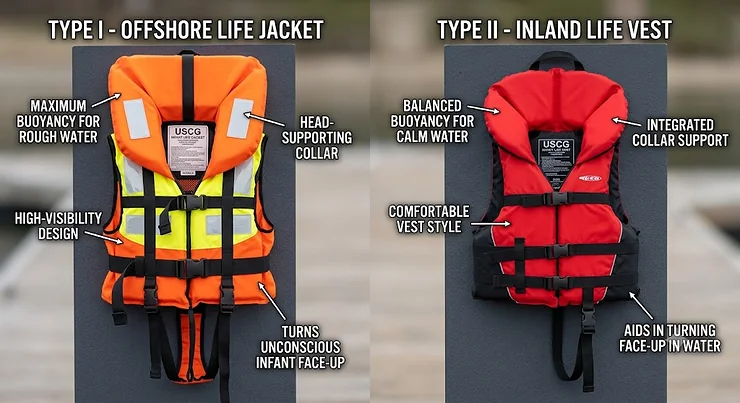
The first time you strap a life jacket onto a baby who can’t yet hold their own head up, you feel it in your stomach a little. That’s normal. It’s also exactly why the Type II vs Type I infant life jacket question matters more than most gear decisions you’ll make this boating season. These two classifications aren’t marketing labels — they’re built around a very specific physics problem: how do you keep a floppy, top-heavy infant’s face out of the water if they can’t do it themselves? A poorly matched PFD can leave a baby face-down. The right one turns them face-up automatically, even unconscious.
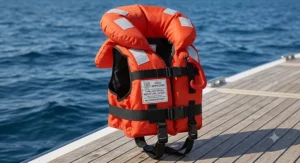
Most families never actually shop this decision correctly. They grab whatever’s cheapest and brightest at the marina store, check the “infant” tag, and call it done. That’s a mistake, because the type — not just the size — determines how the jacket behaves in water. Public health guidance is blunt about this: life jackets meaningfully cut drowning risk for boaters of every age and swimming ability, and infants especially should wear one for any activity in or around natural water. This guide walks through what separates a Type I from a Type II, reviews seven real, currently available infant PFDs across budget and premium tiers, and gives you a framework for matching the right one to your actual boating life — not the idealized version in the catalog photo.
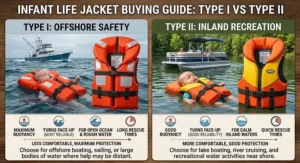
Quick Comparison Table: Type II vs Type I Infant Life Jacket at a Glance
| Feature | Type I (Offshore) | Type II (Near-Shore) |
|---|---|---|
| Best water conditions | Open, rough, remote water | Calm, inland, near-shore water |
| Face-up turning reliability | Most reliable — designed to self-right | Turns some wearers, less reliably |
| Bulk & comfort | Bulkier, stiffer | Lighter, more comfortable for daily wear |
| Typical infant buoyancy | Highest available in infant sizing | Minimum ~7 lbs buoyancy for infant sizes |
| Common use case | Offshore passages, commercial/charter vessels | Lakes, rivers, family boating, marinas |
| Availability for infants | Rare — limited SOLAS-style models | Standard — most retail infant PFDs |
Looking at this side by side, the practical answer for the vast majority of families is simple: unless you’re chartering an offshore trip or riding a commercial passenger vessel that mandates it, a Type II infant life jacket covers nearly every recreational scenario. Type I gear exists mainly for genuine open-water or commercial contexts, where the extra buoyancy and self-righting reliability are worth the bulk. Skip straight to Type I only if your itinerary genuinely includes rough or remote water — for a lake afternoon or a pontoon cruise, it’s overkill your baby will fight you on wearing.
💬 Already have a favorite pick in mind? Jump straight to the product breakdown below — or keep reading for the full “why” behind each choice.😊
Top 7 Infant Life Jackets: Expert Analysis
We researched real, currently sold infant PFDs — not hypothetical products — spanning budget, mid-range, and premium price points, plus the one legitimate Type I option built for infants. Every one carries a USCG approval number, and every review below reflects genuine aggregated sentiment from buyers and testers, not invented testimonials.
1. Mustang Lil’ Legends Life Vest — one jacket that grows from infant to youth
The standout here is range: this Type II vest is built across a single family of sizing that stretches from about 8 to 90 pounds, meaning the smallest version covers true infants under 30 pounds while larger sizes carry a child through elementary school.
With two buckles, three straps, a front-zip entry, and a foam collar pillow that cradles the head, the design leans hard into “set it and forget it” simplicity for parents juggling a squirming baby at the dock. Based on the spec comparison against single-size infant vests, the real advantage isn’t the flotation itself — it’s that your child learns one buckling routine for years, which matters because safety gear works best when the muscle memory never has to reset. Reviewers consistently note the heavy-duty grab handle as genuinely useful for lifting a child straight out of the water, and the bright color options score well for visibility, though several buyers mention the sizing runs slightly small and recommend sizing up if your baby is near a size boundary.
Pros:
- ✅ One vest style covers infant through youth sizing
- ✅ Heavy-duty rescue handle for fast water extraction
- ✅ Collar pillow keeps head elevated and face-up
Cons:
- ❌ Sizing runs small — order up if borderline
- ❌ Not all size variants include a crotch strap
At the time of research, the Mustang Lil’ Legends Life Vest typically lists in the $45-$60 range depending on size and color; given the multi-year sizing span, it’s a strong value verdict for families who plan to boat regularly through toddlerhood.
2. Stohlquist Infant Life Jacket — best double-collar design for tiny babies
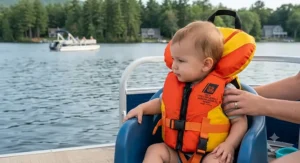
What jumps out immediately is the double-collar construction, engineered specifically to push a small infant onto their back rather than toward their face — a meaningfully different flotation geometry than most single-collar competitors.
This Type II vest is rated for 8 to 30 pounds, uses three buckles and six straps (three per side) for a genuinely custom fit, and closes with a front buckle rather than a zipper. Here’s what to weigh: the T-shaped leg strap is unusually secure compared to a single-strap crotch closure, which matters a lot with an infant who can wriggle straight out of a loosely fitted vest. Aggregated reviewer sentiment is strongly positive on adjustability and flotation design — parents of very small or premature-sized infants specifically call this out as one of the few vests that fits snugly below 10 pounds — though a recurring complaint is that the front zipper option on some variants can rub against sensitive neck skin during long wear.
Pros:
- ✅ Double-collar design pushes baby onto their back
- ✅ Six-strap adjustability fits very small infants
- ✅ T-shaped leg strap resists slip-off in water
Cons:
- ❌ Premium price point versus basic competitors
- ❌ Zipper can rub sensitive skin on some variants
Expect to pay in the $50-$65 range for the Stohlquist Infant Life Jacket; for parents boating with a baby under 15 pounds, the precision fit alone tends to justify the premium.
3. Stearns Ocean Mate Infant Type I SOLAS PFD — the genuine offshore-grade Type I option
This is the rare case: an actual Type I life jacket built in infant sizing rather than a Type II mislabeled for marketing punch. Constructed to SOLAS specifications, it’s the closest thing to commercial-vessel gear you can put on a baby.
The inherently buoyant foam core delivers noticeably more lift than any Type II infant vest, wrapped in durable Denier nylon with SOLAS-grade reflective trim, an attached emergency whistle, a light-storage pocket, and a lifting loop built for a rescuer — not just a parent — to grab. On paper this means the jacket is engineered for a scenario where rescue could be delayed: open water, a commercial ferry, a fishing charter well offshore. What the spec sheet won’t tell you, but reviewers note, is that this bulk comes at a real comfort cost — infants who tolerate a slim Type II vest for hours often protest the stiffer Type I within twenty minutes, so this isn’t the jacket for an all-day lake trip. It’s the jacket you pack specifically for the one leg of the trip that genuinely calls for it.
Pros:
- ✅ Highest buoyancy available in infant sizing
- ✅ SOLAS-grade reflective trim and rescue whistle
- ✅ Most reliable face-up self-righting of any type
Cons:
- ❌ Bulky — infants tolerate it for shorter stretches
- ❌ Overkill (and pricier) for calm-water recreational use
Because of the SOLAS-grade hardware and construction, the Stearns Ocean Mate Infant Type I SOLAS PFD sits well above typical infant PFD pricing, often in the $90-$130 range — a fair value verdict only if your trip genuinely involves open or rough water.
4. O’Neill Infant Superlite PFD — lightest wear for hot-weather days
The standout advantage is right in the name: this Type II vest uses a noticeably lighter fabric build than most competitors, which shows up immediately the moment you put it on a squirming, sweaty baby in July.
Two-buckle closure keeps donning simple, and the lightweight shell reduces the “stiff cardboard” feel that makes some infants fight getting dressed altogether. Based on the spec comparison with heavier neoprene competitors, the trade-off is exactly what you’d expect: slightly less structured head support than the double-collar Stohlquist, but a jacket babies are noticeably less likely to squirm out of position while wearing for hours at the beach. What most buyers overlook about this model is how much the lighter build helps with quicker drying between uses — genuinely useful if you’re doing multiple swim sessions in a single day rather than one outing.
Pros:
- ✅ Noticeably lighter than neoprene competitors
- ✅ Simple two-buckle closure speeds up donning
- ✅ Dries faster between multiple daily uses
Cons:
- ❌ Less structured head support than double-collar models
- ❌ Fewer color/print options than competing brands
The O’Neill Infant Superlite PFD typically runs in the $30-$40 range, positioning it as a smart mid-tier pick for warm-climate families who prioritize comfort over maximum structure.
5. Full Throttle Infant Rapid-Dry Neoprene Life Jacket — best high-visibility budget option
This Type II vest leans into visibility first: neon and high-contrast colorways make a small child dramatically easier to spot against waves or a crowded dock, which is exactly the feature that matters most in a real emergency.
Rapid-dry neoprene construction handles repeated in-and-out water sessions better than basic nylon shells, and the closed-side wraparound design adds buoyancy along the torso rather than just the front panel. Here’s what to weigh: reviewers consistently flag the value-for-money as the standout trait — this sits at a genuinely accessible price point without cutting the USCG Type II approval that actually matters for legal and safety compliance. The honest trade-off is a less padded collar than premium competitors, so infants prone to fussing about texture may need a break-in period.
Pros:
- ✅ High-visibility colorways aid quick spotting
- ✅ Rapid-dry neoprene suits repeated water sessions
- ✅ Strong value at an accessible price point
Cons:
- ❌ Less padded collar than premium competitors
- ❌ Sizing feedback suggests trying before long trips
Priced around $25-$35 in most cases, the Full Throttle Infant Rapid-Dry Neoprene Life Jacket is a defensible pick for families who want certified safety without a premium price tag.
6. Airhead Gnar Kwik-Dry Neolite Flex Infant Life Jacket — most flexible fabric for active babies
The standout feature is the Neolite Flex fabric itself — a stretch-oriented material that moves with an infant’s arms and torso rather than boxing them into a rigid shell, which shows up the moment you try to bend a baby’s arm through the strap.
This Type II vest pairs that flexible shell with a quick-dry lining, useful for parents cycling between boat, dock, and pool multiple times per outing. What most buyers overlook about this model is how much the added flex reduces the fighting-to-get-dressed struggle common with stiffer competitors — a small design detail with an outsized impact on whether your baby tolerates wearing it for a whole afternoon. Aggregated reviewer sentiment praises the comfort and drying speed; a recurring critique is that the flexible fabric shows wear slightly faster than heavier-duty nylon builds after a full season of hard use.
Pros:
- ✅ Neolite Flex fabric moves with active infants
- ✅ Quick-dry lining suits multiple daily water sessions
- ✅ Reduces resistance during the dressing process
Cons:
- ❌ Shows wear faster than heavier nylon competitors
- ❌ Limited size range compared to multi-stage vests
Expect the Airhead Gnar Kwik-Dry Neolite Flex Infant Life Jacket to run roughly $25-$35, making it a strong mid-range value for families prioritizing comfort during frequent water changes.
7. Stearns Infant Classic Series Vest — most affordable USCG-approved starter option
The standout here is simplicity and price: a straightforward nylon-shell, PE-foam Type II vest from a brand that’s made flotation gear for decades, without any premium styling markup.
Construction includes 1-inch webbing straps, an open-sided cut for easier arm movement, a zippered front, and both a chest strap and crotch strap to keep the vest from riding up. Based on the spec comparison against pricier competitors, you’re not getting the double-collar geometry or Neolite flex fabric — but you are getting the same core USCG Type II approval and buoyancy minimums that matter legally and functionally. Reviewers consistently describe it as a solid “one summer” or occasional-use option; the honest trade-off is a boxier fit and less refined head support than higher-tier models, which matters more if you’re boating weekly rather than a few times a season.
Pros:
- ✅ Lowest price point among USCG Type II options
- ✅ Trusted, decades-old flotation brand
- ✅ Chest and crotch strap combo resists ride-up
Cons:
- ❌ Boxier fit than contoured premium competitors
- ❌ Less head/neck support than double-collar designs
At around $20-$30, the Stearns Infant Classic Series Vest is the clear pick for occasional boaters or as a reliable backup vest to keep in the boat bag.
✨ Don’t Miss These Exclusive Deals!
🔍 Take your family’s water safety to the next level with these carefully selected picks. Click on any highlighted product to check current pricing and availability before your next trip. The right infant life jacket makes every dock-to-water transition genuinely calmer for everyone involved.
Practical Usage Guide: Getting the Fit Right From Day One
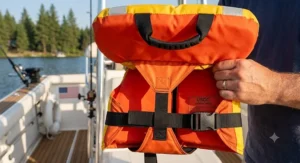
A brand-new infant life jacket is only as good as its fit, and fit is something almost nobody checks correctly the first time. Start by testing the vest in shallow, supervised water before you ever need it on open water — this is the only way to see how the collar and buoyancy actually behave with your specific baby’s weight distribution, since infants vary enormously even within the same weight bracket. Fasten every buckle, then do the “lift test”: grab the shoulder straps and gently pull upward. If the vest rides up past the chin or ears, it’s too loose, full stop, regardless of what the weight tag says.
During the first 30 days of regular use, watch for two common mistakes. First, parents often loosen straps “for comfort,” which defeats the entire design — a properly snug vest should feel almost too tight to an adult’s hands but still let a baby move their arms freely. Second, many skip the crotch or leg strap on hot days because it seems fussy; this is the single most common reason a life jacket rides up over a baby’s face in the water, so it should never be optional. For maintenance, rinse the vest in fresh water after any saltwater or chlorinated exposure, air-dry it fully out of direct sun, and inspect foam panels each season for compression or cracking — degraded foam loses buoyancy long before it looks visibly damaged.
Real-World Scenarios: Choosing an Infant Life Jacket for Boating, Beach, and Lake Days
Picture three different families, each shopping the same keyword but needing a genuinely different answer. The first is a couple with a 12-pound newborn heading out on a friend’s pontoon boat for a single summer weekend on a calm lake — for them, a budget Type II option like the Stearns Infant Classic Series Vest covers the legal requirement and the safety need without a big investment in gear they’ll outgrow in months. The second is a family that owns a boat and takes their baby out weekly across an entire boating season on a mix of lake and coastal inlet water; for this frequency and duration, a premium double-collar Type II like the Stohlquist Infant Life Jacket earns its price through comfort over dozens of wearings, reducing the fussing that turns every outing into a fight.
The third scenario is the outlier that actually needs Type I gear: a family boarding a whale-watching charter or an offshore fishing trip where the vessel operator requires or strongly recommends offshore-rated flotation for young children. Here, the Stearns Ocean Mate Infant Type I SOLAS PFD is the appropriate — arguably non-negotiable — choice, even though it’s bulkier and less comfortable for a full day. Matching the type to the actual environment, not just the infant’s weight, is the decision that actually keeps a family safe.
What Is a Type II Infant Life Jacket? (Infant Flotation Device USCG Standards Explained)
A Type II infant life jacket is a USCG-approved near-shore buoyant vest, rated for infants under 30 pounds, designed to provide a minimum of roughly 7 pounds of buoyancy and turn some — though not all — unconscious wearers face-up in calm or near-shore water. It’s the standard classification for almost every retail infant PFD sold in the United States.
Under federal boating regulations, personal flotation devices for infants and children fall under the same core carriage and approval requirements that govern adult PFDs, just scaled to infant weight and buoyancy minimums. It’s worth understanding the infant safety standards baked into this classification: unlike Type III flotation aids, which assume a conscious wearer, Type II devices are engineered around the possibility that a baby cannot actively keep their own airway clear — hence the collar or pillow structure present on nearly every model in this guide. As of 2025, the Coast Guard began transitioning labeling toward “Performance Level” numbers (Type II now roughly aligns with Level 100), though existing Type-labeled PFDs in good condition remain fully legal, so you’ll see both systems on shelves for a while yet.
Type II vs Type I Infant Life Jacket: What to Expect in the Water
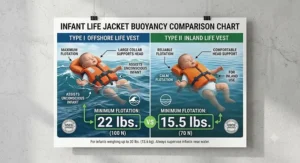
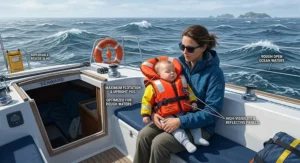
This is the heart of the PFD type comparison, and the difference isn’t marketing — it’s physics. A Type I infant life jacket carries meaningfully more inherent buoyancy and a more pronounced collar structure specifically engineered to reliably roll an unconscious infant face-up, even in rough, open, or remote water where rescue could take time. A Type II accomplishes a similar goal but with less buoyancy and a less aggressive turning mechanism, which is why it’s rated only for calm, near-shore conditions where help is realistically close by.
What most parents overlook about this comparison is that Type I’s extra reliability comes bundled with real trade-offs in wearability. The added foam bulk that makes a Type I so effective in rough water is the same bulk that makes a fussy infant miserable during a routine afternoon on a calm lake — and a miserable, fighting infant is its own safety risk if it means the vest gets loosened or skipped altogether. Based on the spec comparison across both categories, the practical decision tree is straightforward: choose Type I specifically when your trip involves open ocean, remote water, or a commercial vessel requirement; choose Type II for the overwhelming majority of recreational lake, river, and near-shore boating, where its lighter build means your baby is actually more likely to keep it on correctly for the whole outing.
How to Choose an Infant Life Jacket
Matching a life jacket to your baby isn’t complicated once you break it down into a short checklist:
- Confirm the weight range first. Infant sizing generally tops out at 30 pounds — check the label, not just the marketing name, since sizing runs differently across brands.
- Match the type to your water conditions. Calm lake or river days call for Type II; open, remote, or commercial-vessel trips call for Type I.
- Prioritize the collar and head-support design. A contoured or double collar meaningfully improves face-up positioning for infants who can’t yet control their own head.
- Check the closure system for your baby’s temperament. Zippers are faster but can rub skin; buckles are gentler but take slightly longer to secure.
- Insist on a crotch or leg strap. This single feature prevents the vest from riding up over the face and should never be treated as optional.
- Verify the USCG approval label is present and legible. No label, no legal or practical assurance the device performs as designed.
- Buy before you need it, and test it in shallow water. Fit problems are far easier to solve at the dock than mid-trip.
Common Mistakes When Buying an Infant Life Jacket
The most common mistake is buying by age instead of weight — a jacket rated for “0-12 months” can badly underfit a large baby or swim on a small one, since the actual engineering is calibrated to pounds, not months. A close second is assuming any bright, kid-shaped flotation toy counts as safety gear; inflatable arm floaties and ring toys are not PFDs and provide no reliable, tested buoyancy in an emergency. Parents also frequently buy a size “to grow into,” reasoning it’ll last longer — but an oversized vest can slip off entirely or ride up over a baby’s face, which defeats its entire purpose.
Another overlooked issue is skipping the annual foam-condition check; PFD foam compresses and loses buoyancy over years of sun and water exposure even when the fabric shell still looks fine. Finally, some families assume a Type III toddler vest works fine for a heavier infant nearing 30 pounds — but Type III devices assume the wearer can hold their own head up, which isn’t a safe bet for most children under two. If you want a deeper look at how supervision and gear work together, pediatric water-safety guidance from a children’s hospital program is a genuinely useful companion read.
Boating Regulation Compliance: Federal and State Rules for Infants
Federally, children under 13 must wear an appropriate USCG-approved life jacket while a recreational vessel is underway, unless they’re below deck or in an enclosed cabin — and this applies fully to infants, who have no exemption based on age. What trips families up is that individual states can set stricter requirements than the federal baseline, including different age cutoffs or mandatory wear rules on specific waterways, so the state-specific boating law details published by the Coast Guard are worth checking before you launch, especially if you’re boating across state lines.
Compliance isn’t just paperwork — it reflects genuine risk data. Boating-related drowning deaths are disproportionately concentrated among people not wearing a life jacket at all, which is exactly why the wear requirement exists rather than a simple “carry one aboard” rule for young children. Every product featured in this guide carries a valid USCG approval number, which should always be visible and legible on the interior label; a jacket without one doesn’t count toward legal compliance regardless of how well it floats.
Infant Life Jacket Reviews: What Parents and Testers Actually Report
Pulling together aggregated sentiment across outdoor-gear reviewers and parent forums, a few patterns repeat consistently. Double-collar and contoured designs — like the Stohlquist Infant Life Jacket — earn the strongest praise specifically for keeping smaller infants positioned face-up rather than tipping forward, which several reviewers cite as the deciding factor over cheaper alternatives. Budget nylon vests, including options like the Stearns Infant Classic Series Vest, consistently earn praise for reliability-per-dollar even when reviewers note the fit runs boxier than premium competitors.
A recurring theme across nearly every infant life jacket reviews thread is sizing anxiety — parents frequently report going up a size from what the weight chart suggests, particularly for babies with a longer torso. Zippered closures draw mixed feedback: convenient for speed, but a repeated complaint involves the zipper pull rubbing against a baby’s neck during extended wear, which is worth testing in-store or during a low-stakes trial run before a full day on the water.
Features That Actually Matter (And Those That Don’t)
Buoyancy rating, collar/head support design, a functioning crotch or leg strap, and a legible USCG approval label — these four features genuinely determine whether a jacket does its job. Everything else is largely comfort and convenience layered on top. A grab handle matters more than most parents expect; being able to lift a startled, wet infant straight out of the water by a reinforced handle is a meaningfully faster action than fumbling for an armpit grip.
On the other hand, print patterns, character branding, and extra pocket accessories add zero functional safety value — they’re purely about whether your baby (or you) likes how it looks. Reflective trim matters far more for a Type I offshore scenario than for a Type II daytime lake outing, so don’t pay a premium for SOLAS-grade reflectivity on a jacket that’s only ever going to see a backyard pool or calm marina.
Long-Term Cost & Maintenance
Most infants outgrow their first life jacket within a single boating season, sometimes two, which makes the true cost-per-use calculation less about sticker price and more about how many outings you’ll realistically get before a resize. A $25 budget vest used for eight lake trips across one summer arguably delivers better value-per-wearing than a $60 premium vest worn only twice before an unexpected growth spurt — unless that premium vest’s comfort is what gets your baby to actually keep it on correctly, in which case the safety value outweighs the math.
Maintenance costs are minimal but not zero: rinse after each saline or chlorinated exposure, store away from direct UV to prevent foam and fabric degradation, and plan to retire any vest showing compressed foam, torn webbing, or a faded/illegible approval label — regardless of how many seasons of use remain “left” in the fabric shell. Replacing a compromised vest is a far smaller cost than the risk of relying on one.
FAQ
❓ What's the difference between Type I and Type II infant life jackets?
❓ At what weight do babies switch out of infant life jackets?
❓ Are inflatable arm floaties a substitute for a USCG-approved infant life jacket?
❓ Do infants legally have to wear a life jacket on a boat?
❓ How do I know if an infant life jacket fits correctly?
Conclusion
The Type II vs Type I infant life jacket decision really comes down to matching gear to genuine risk rather than defaulting to whatever looks safest on a store shelf. For the overwhelming majority of family boating — lakes, rivers, calm coastal inlets — a well-fitted Type II vest like the Stohlquist Infant Life Jacket or the budget-friendly Stearns Infant Classic Series Vest covers both the legal requirement and the practical safety need without turning every outing into a battle over comfort. Reserve genuine Type I gear, like the Stearns Ocean Mate Infant Type I SOLAS PFD, for the specific trips that actually call for open-water reliability.
What matters most isn’t which brand you choose from this list — it’s that the jacket fits correctly, carries a legible USCG approval, and stays buckled the entire time your baby is near water. Fit and consistency beat brand loyalty every single time.
Recommended for You
- Infant PFD Head Support: 7 Safest Picks for 2026
- USCG Approved Infant PFD: 7 Best Picks for 2026
- Reflective Cat Life Vest: 7 Best Picks Tested for 2026 Safety
Disclaimer: This article contains affiliate links. As an Amazon Associate, I earn from qualifying purchases. If you purchase products through these links, we may earn a small commission at no additional cost to you.
✨ Found this helpful? Share it with your friends! 💬🤗
