
In This Article
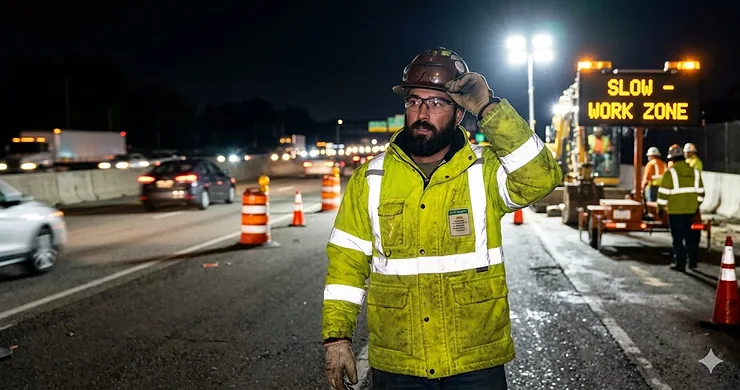
Here’s a number that should stop you cold: according to the Bureau of Labor Statistics, struck-by incidents are among the leading causes of fatal workplace injuries for construction and road workers in the U.S. — and a significant portion happen in low-light or nighttime conditions. The difference between going home and not going home can come down to one thing: whether drivers and machine operators can see you.
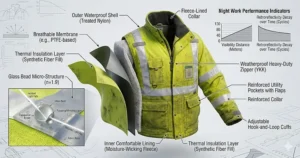
A reflective safety jacket for night work isn’t just a piece of PPE you grab off a shelf and forget about. It’s a life-safety decision — one that involves understanding ANSI compliance classes, reflective tape placement, waterproofing, and whether the jacket you’re wearing at 2 a.m. on a highway overpass is actually doing its job. The spec sheet matters. But more than that, how a jacket performs when truck headlights hit it at 300 feet, in drizzle, in January, while you’re crouching over a utility trench — that’s what matters.
This guide covers the seven best options available on Amazon right now, from budget-friendly waterproof shells to serious insulated parkas rated for -40°F. Whether you’re a night shift road crew worker, a warehouse forklift-zone employee, a construction supervisor, or someone who just started a job requiring PPE and doesn’t know where to begin — this breakdown gives you the real-world information you need.
What is a reflective safety jacket for night work? Simply put, it’s an outer garment combining fluorescent background fabric (for daytime visibility) with retroreflective striping (the silver bands that bounce headlight beams back to drivers at night), certified to ANSI/ISEA 107-2020 standards. Class 3 is the gold standard for high-risk night work environments.
Let’s get into it.
Quick Comparison Table: Top 7 Reflective Safety Jackets at a Glance
| Product | ANSI Class | Waterproof | Insulation | Best For | Price Range |
|---|---|---|---|---|---|
| Ergodyne GloWear 8377 | Class 3 Type R | Water-resistant | 160g quilted | Cold-weather night crews | Mid-range |
| SKSAFETY Hi-Vis Reflective Jacket | Class 2 Type R | 10,000mm WR | Fleece lined | Budget-conscious daily workers | Budget |
| TICONN Waterproof Safety Bomber | Class 3 | Waterproof | 160g fleece | All-season road workers | Budget–Mid |
| Portwest PW3 Hi-Vis Winter Jacket (T400) | Class 3 | Waterproof, taped seams | Insulatex 170g | Serious winter conditions | Mid–Premium |
| JORESTECH Hi-Vis Waterproof Rain Jacket | Class 3 Type R | Full waterproof | Mesh lining | Warm-weather rain use | Budget |
| SMASYS 6-in-1 Reflective Jacket | Class 3 | Waterproof | Fleece liner | Versatile multi-season use | Mid-range |
| KwikSafety UNIVERSE Bomber (KS5522) | Class 3 | Waterproof shell | Fleece lined | OSHA-site compliance | Mid-range |
What the table tells you: The choice isn’t just about price. The JORESTECH wins for warm-climate or summer rain duty because it’s lightweight and uninsulated. But running that same jacket through a Minnesota February would be a mistake — that’s where the Portwest PW3 or Ergodyne 8377 earns its keep. Notice that SKSAFETY is the only Class 2 on this list, which is fine for warehouse and low-traffic environments but not suitable for active roadway work. Always match your class to your hazard level.
💬 Just one click — help others make better buying decisions too! 😊
Top 7 Reflective Safety Jackets for Night Work: Expert Analysis
1. Ergodyne GloWear 8377 Hi-Vis Winter Bomber Jacket — Best Overall
Ergodyne’s GloWear line has been the go-to choice for professional safety managers for years, and the GloWear 8377 is the sweet spot in their lineup — serious enough for real winter conditions, without ballooning you into the Michelin Man.
The outer shell is 300D oxford polyester with a PU coating that resists wind and water effectively through a full shift. The 160g thermal quilted insulation delivers genuine warmth without the bulk that restricts movement on a job site — and that CLO rating of 2.35 means it’s rated for moderate work levels down to -40°F. That’s not marketing copy; that’s an actual tested thermal rating. The 2″ reflective stripes are ANSI/ISEA 107-2020 compliant, Type R Class 3 — the highest standard for roadway and highway workers.
What most buyers overlook: the dirt-hiding black panels on the sleeves and front. After six months on a road crew, a pure lime-yellow jacket looks like something from an archaeological dig. The GloWear 8377’s strategic black panels keep it looking professional (which matters when OSHA inspectors show up). The inset hood zips in or out, and hook-and-loop cuffs seal out cold air even with heavy gloves on.
Customer feedback consistently highlights comfort during extended wear — 8, 10, 12-hour shifts — without the chafing and constraint that cheaper shells cause. The two external pockets, one chest pocket, and two mic tabs cover most job-site needs.
✅ ANSI/ISEA 107-2020 Type R Class 3 certified
✅ Practical dirt-hiding panels for extended field use
✅ Tested thermal rating to -40°F at moderate work levels
❌ Not fully waterproof — water-resistant but not sealed-seam
❌ Hood isn’t detachable, only zip-in/out
Price range: Mid-range. Solid long-term value for any crew member working in traffic-adjacent environments year-round.
2. SKSAFETY High Visibility Reflective Jacket for Men — Best Budget Pick
Sitting at the top of the Amazon best-seller charts in safety jackets is the SKSAFETY Hi-Vis Jacket, and it’s not hard to see why. At its price point, it outperforms expectations in almost every measurable way.
The 300D oxford polyester shell with taped and sealed seams delivers a 10,000mm waterproof rating — a number that actually means something. For context, a light rain jacket is typically 1,500-2,000mm; 10,000mm handles sustained heavy rain without leaking through at the seams. The fleece lining adds comfort in cool to cold weather. The 2″ reflective strips run 360° — shoulders, chest, hem, arms, and back — so a driver approaching from any angle gets a clear retroreflective signal.
ANSI/ISEA 107-2020 Type R Class 2 certification is the honest caveat here. Class 2 is appropriate for off-road construction sites, warehouses, and parking lots. If you’re working directly on or adjacent to a live roadway, Class 3 is what OSHA and MUTCD require. But for the majority of construction workers, warehouse employees, and utility teams not on active highways, Class 2 is fully compliant and this jacket delivers serious value.
It offers eight pockets total, a removable hood, mic tabs, and an ID holder — features you’d expect from a jacket costing twice as much.
✅ 10,000mm waterproof rating with taped seams
✅ Machine washable up to 50 times without performance degradation
✅ Exceptional value for non-roadway environments
❌ Class 2 only — not suitable for live highway work
❌ Fleece lining may feel warm in mild temperatures
Price range: Budget — one of the best dollars-per-protection ratios on this list.
3. TICONN Waterproof Safety Bomber Jacket — Best Value for ANSI Class 3
The TICONN Waterproof Safety Bomber does something impressive: it hits ANSI Class 3 at a price point that most shoppers associate with Class 2 gear. That’s a meaningful distinction for crews where every worker needs compliant roadway PPE and the purchasing budget is tight.
The 2″ (5cm) wide reflective strips meet ANSI Class 3 standards, and the 160g soft fleece insulation lining keeps workers comfortable through cool-to-cold shifts. The kangaroo pocket with zippered closure is a genuinely smart design choice — deep, secure, and easy to access with gloved hands. The double-layer PVC transparent chest pocket handles ID cards, work permits, and documents. Two woven mic-tab straps on the upper chest accommodate walkie-talkies and whistles.
The hood includes drawstring adjustment and can fold and hide inside the collar — crucial on sites where a loose hood creates a snag hazard. Elastic waistband and cuffs offer a snug fit that doesn’t restrict movement.
Where buyers have flagged limitations: the waterproofing is solid but not at the 10,000mm level of the SKSAFETY. In extended downpours, moisture can eventually work through. For routine wet-weather work, it handles fine; for maritime, sewer, or sustained storm exposure, consider stepping up.
✅ Full ANSI Class 3 compliance at a budget-friendly price
✅ Kangaroo pocket designed for gloved-hand access
✅ Hood can be hidden to eliminate snag risk
❌ Waterproofing adequate but not heavy-duty
❌ Sizing runs slightly large — check measurements carefully
Price range: Budget–Mid. The best argument for not compromising on Class 3 compliance to save money.
4. Portwest PW3 Hi-Vis Winter Jacket T400 — Best for Extreme Cold
Portwest has been manufacturing protective workwear since 1904 — that’s not a typo — and the PW3 T400 carries that institutional knowledge into every stitched seam. This is the jacket serious winter crews reach for when temperatures stop being merely uncomfortable and start being dangerous.
The standout feature is Insulatex — a heat-reflective lining panel that reflects body heat back inward rather than simply insulating against external cold. The result is meaningful warmth at lighter overall jacket weight, which matters when you’re doing physical labor. A 300D Oxford weave shell with double PU coating and Texpel stain-resistant finish handles both water and the kind of general job-site abuse that eats cheaper jackets alive.
The ANSI Class 3 certification comes via EN ISO 20471 (the European equivalent standard, which is actually stricter in some respects) and ANSI/ISEA 107:2015 Type R Class 3 — making this jacket compliant for both U.S. and international job sites, which matters for multinational contractors.
HiVisTex Pro segmented reflective tape is Portwest’s proprietary take on retroreflective striping — segmented to allow more fabric movement while maintaining retroreflective performance. Real users on construction and highway projects report it holds its reflectivity wash-over-wash better than the plain silver tape on budget alternatives.
Maximum wash cycles are 25 — lower than SKSAFETY’s 50. Plan replacement schedules accordingly.
✅ Insulatex heat-reflective lining for serious cold
✅ Texpel stain-resistant finish for high-abuse environments
✅ International CE and ANSI dual certification
❌ 25 max wash cycles (replace annually for heavy users)
❌ Premium price reflects premium materials — not the budget choice
Price range: Mid–Premium. Worth every dollar for workers in sustained sub-freezing conditions.
5. JORESTECH Hi-Visibility Waterproof Rain Jacket JK-03 — Best for Warm-Climate Night Shifts
Not every night-shift worker is bundling up in January. Florida utility crews, Texas highway workers, and California night construction teams need ANSI Class 3 visibility without being cooked inside a quilted parka. The JORESTECH JK-03 is built exactly for them.
Fully waterproof with a mesh lining instead of insulation, this is the rain-protection jacket without the thermal commitment. ANSI/ISEA 107 Class 3 Type R certification means it meets roadway-worker standards. The lightweight, wind-resistant construction layers easily over a base layer or work shirt without becoming cumbersome during active labor.
The mesh lining deserves specific attention: it allows airflow that a solid fleece lining blocks, making sweat management on a humid Georgia night meaningfully more comfortable. Customer feedback across thousands of reviews highlights fit, durability, and the reliability of the waterproofing during sustained rain events.
Where this jacket underperforms: the moment ambient temperature drops below 45°F and you’re standing still for any period, the absence of insulation becomes very apparent. This isn’t a year-round solution in northern climates — it’s a warm-climate or shoulder-season specialist.
✅ True ANSI Class 3 Type R for roadway compliance
✅ Mesh lining allows airflow — essential in humid climates
✅ Lightweight enough to layer efficiently
❌ No insulation — unsuitable for cold-climate winter use
❌ Lighter construction than heavy-duty alternatives
Price range: Budget. An excellent specialized choice for warm-climate night workers.
6. SMASYS Safety High Visibility 6-in-1 Reflective Jacket — Best Versatile Multi-Season Option
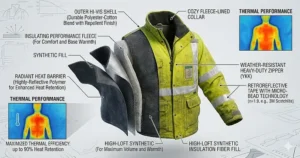
The SMASYS 6-in-1 addresses a real frustration: workers who need different levels of protection across seasons but don’t want to budget for multiple jackets. The modular design allows the outer shell and fleece liner to be worn together or separately — effectively three jackets in one footprint.
ANSI/ISEA 107-2020 Class 3 certification with 2″ high reflective tape running shoulders, chest, hem, arms, and back delivers 360° visibility. Eight total pockets — including an ID window, chest patch pocket, deep side pockets, and tool storage — make this practical for workers who need to carry more than just a phone.
The heavy-duty resin zipper is a specific upgrade worth noting. Budget jackets use lightweight zippers that fail at cold temperatures or under repeated stress. A heavy zipper that operates smoothly in work gloves is a daily-use comfort that you don’t think about until a cheap zipper jams at 3 a.m. in 20°F weather.
The size range, S through 5XL, accommodates a genuinely wide workforce, which matters for crew managers outfitting an entire team.
✅ Modular 6-in-1 design across three wear configurations
✅ 8 pockets with practical design for tool-carrying workers
✅ Heavy-duty zipper rated for gloved-hand operation
❌ “6-in-1” versatility means components run lighter than single-purpose alternatives
❌ Slightly heavier overall than single-layer options
Price range: Mid-range. Excellent value for individual workers who want one jacket that covers multiple seasons.
7. KwikSafety UNIVERSE Safety Bomber Jacket (Model KS5522) — Best for OSHA-Site Compliance Documentation
KwikSafety has built its reputation on ANSI Class 3, OSHA-tested gear designed specifically for U.S. job-site compliance, and the UNIVERSE Bomber (KS5522) is their flagship expression of that philosophy.
The waterproof shell, fleece lining, and full ANSI Class 3 / OSHA compliance certification make it a strong all-rounder. What sets KwikSafety apart from more generic brands is documentation: their garments come with compliance testing certificates that safety managers can produce during OSHA inspections — a detail that matters significantly on federally regulated worksites.
The limited edition design includes reflective tape placement engineered beyond the ANSI minimum, strategically positioned to maximize conspicuity from the most common vehicle approach angles. The fleece lining is mid-weight — warm enough for cool nights, not stifling in mild fall temperatures.
Buyers note that KwikSafety’s customer service is responsive and domestic — important for site managers who need replacement garments quickly and can’t wait weeks for overseas shipping resolution.
✅ ANSI Class 3 and OSHA compliant with documentation
✅ Reflective tape exceeds minimum ANSI placement requirements
✅ Domestic customer service for rapid replacement
❌ Limited edition designs sell out periodically — check availability
❌ Fleece lining is mid-weight, not rated for extreme cold
Price range: Mid-range. The choice when compliance documentation is as important as the jacket itself.
How to Choose a Reflective Safety Jacket for Night Work: 6 Decision Criteria That Actually Matter
Shopping for a reflective safety jacket for night work generates a wall of specs that looks intimidating but breaks down cleanly once you know what drives each decision.
1. Match Your ANSI Class to Your Actual Hazard Level
This is the non-negotiable starting point. The ANSI/ISEA 107-2020 standard defines three performance classes based on the quantity of fluorescent background material and retroreflective striping:
- Class 1: Minimum coverage — parking attendants, warehouse workers away from forklifts. Not for roadway work.
- Class 2: Moderate risk — construction sites without active lane exposure, warehouse forklift zones, airport ramp work.
- Class 3: Maximum visibility — workers on or adjacent to public roadways, highway construction, utility work in traffic. Sleeves required.
If your work zone borders a live lane of traffic, Class 3 is required. Non-negotiable. A Class 2 jacket on a highway worksite is a compliance violation and a genuine safety risk.
2. Understand What “Waterproof” Actually Means on the Label
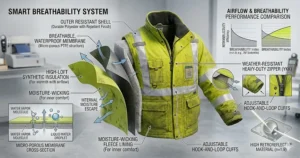
“Water-resistant” means it sheds light rain. “Waterproof” means it can handle sustained downpours. The difference is measured in millimeters of water column (WR rating). Under 5,000mm handles moderate rain; 10,000mm and above handles heavy sustained rain without leaking through. Look for taped seams on any jacket marketed as truly waterproof — untaped seams leak regardless of the shell rating.
3. Insulation: Match Weight to Work Intensity
A 160g insulation rating keeps you warm when you’re moving moderately. Sedentary workers (flaggers, traffic control officers) need more — 200g or above, or the Portwest Insulatex technology that adds radiant heat retention. Workers doing heavy physical labor often find anything above 160g overheating them. Modular jackets like the SMASYS 6-in-1 solve this by letting you adjust insulation to conditions.
4. Wash Cycle Ratings — The Hidden Compliance Countdown
Retroreflective tape degrades with washing. ANSI/ISEA 107-2020 requires garments to maintain performance after the number of washes specified on the care label. The SKSAFETY is rated 50 washes; the Portwest PW3 is rated 25. A worker washing their jacket twice a week hits 50 washes in six months, at which point ANSI compliance is no longer guaranteed. Track this. Replace jackets on schedule.
5. Pocket Layout for Your Specific Job
This sounds trivial until you’re reaching for a pen in a chest pocket while wearing nitrile gloves in a January wind. Mic tabs matter for radio workers. A clear ID window matters if you work a badged facility. Deep zippered hand pockets matter for warmth. Map your typical work items to the jacket’s storage before purchasing.
6. Hood: Detachable vs. Fixed vs. Foldaway
A fixed hood catches wind and reduces hearing in traffic zones. A detachable hood is cleanest but risks loss. A foldaway hood (like TICONN’s) hides behind the collar when not needed — the safest option for active worksites where snagging is a concern.
Real-World Scenarios: Matching the Right Jacket to Your Situation
Understanding who each jacket actually serves cuts decision time dramatically.
The Highway Night Crew Worker (Northern Climate): You’re working lane closures on an interstate from October through March, 8-12 hour overnight shifts. Temperature drops to single digits. You need maximum Class 3 compliance, serious insulation, and waterproofing. The Portwest PW3 T400 is your jacket. The Insulatex lining and taped seams handle sustained cold and rain; the Class 3 certification covers roadway compliance. The Ergodyne GloWear 8377 is a strong alternative if you run warmer or prefer the bomber silhouette.
The Warehouse Forklift Zone Worker: You work in a temperature-controlled facility but share aisles with forklifts and need visibility PPE per your employer’s safety policy. Class 2 compliance is almost certainly sufficient. The SKSAFETY Hi-Vis Jacket gives you 10,000mm waterproofing (useful for loading dock exposure), machine washability, and eight-pocket utility at a price your employer can reasonably stock for the whole team.
The Southern-State Night Shift Utility Worker: You’re in Houston or Atlanta doing overnight utility maintenance. It’s 65°F and raining. You need Class 3 visibility and rain protection but will sweat through anything with insulation. The JORESTECH JK-03 with its mesh lining is purpose-built for you. Layer a moisture-wicking base layer underneath and you’re comfortable and compliant.
The Worker Who Covers Multiple Seasons: You’re self-employed — a contractor or site supervisor — and you need one jacket that covers April through November in a mid-Atlantic climate. The SMASYS 6-in-1 earns its keep. Wear the shell alone in fall, add the fleece liner for winter, remove it again in spring. One investment, three configurations, Class 3 coverage year-round.
The Safety-Conscious Employer Equipping a Team: You’re outfitting 15 workers for a federally regulated highway project and need to produce compliance documentation for inspections. The KwikSafety UNIVERSE KS5522 comes with compliance certificates. Budget for the mid-range cost per unit and avoid the paperwork headache.
Common Mistakes When Buying a Reflective Safety Jacket for Night Work
Even experienced buyers make these errors. Don’t be them.
Mistake 1: Buying Class 2 for a Class 3 Environment
It’s the most common and most dangerous mistake. Class 2 gear costs a few dollars less per unit. On a live highway worksite, the legal and human cost of that shortcut is incalculable. OSHA’s General Duty Clause requires employers to provide appropriate PPE for recognized hazards. A Class 2 jacket in a Class 3 environment is a citable violation.
Mistake 2: Ignoring Wash Cycle Limits
Workers wash their jackets. Retroreflective tape loses certification-level reflectivity after its rated number of washes. A jacket past its wash-cycle limit may look fine and feel fine but will reflect headlights at sub-ANSI levels. Set a replacement schedule and stick to it.
Mistake 3: Buying Insulation for Sedentary Work — or Not Enough for Standing Work
A 160g insulated jacket is excellent for a laborer moving all shift. A flagger standing motionless at a lane closure for six hours in 25°F weather needs heavier insulation or heated base layers. Match the thermal rating to your actual activity level.
Mistake 4: Ignoring Retroreflective Tape Width
ANSI/ISEA 107-2020 requires a minimum tape width of 1.37 inches (35mm). Many budget jackets skate by at exactly that minimum. The products on this list all use 2″ (50mm) tape — a meaningful upgrade in visibility, especially at the angles and distances that matter most in traffic.
Mistake 5: Skipping the Size Chart
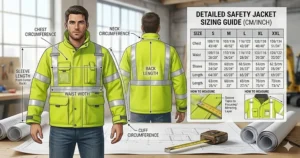
High-vis jackets are designed to be worn over layers. A size that fits snugly over a t-shirt will be uncomfortable over a thermal mid-layer. Check manufacturer size charts — not generic size assumptions — and size up if you plan to layer heavily in winter.
ANSI Compliance & Safety Regulations: What Night Workers Need to Know
The regulatory framework around high-visibility safety apparel is more nuanced than most workers realize. Here’s the practical breakdown.
According to ANSI/ISEA 107-2020, garments are classified by both Type (based on work environment) and Class (based on amount of visible materials). For night work, the combination matters:
- Type R (Roadway): Designed for workers on or near public roadways. All roadway-environment products on this list are Type R.
- Type P (Public Safety): Emergency responders, law enforcement — incorporated into the 107-2020 standard from the former 207 standard.
- Type O (Off-Road): Off-roadway environments with no public traffic exposure.
The Federal Highway Administration’s Manual on Uniform Traffic Control Devices (MUTCD) mandates ANSI/ISEA 107-compliant apparel at minimum Class 2 for all workers in federally funded highway work zones — and Class 3 when work is in active lanes. This is federal law with enforcement teeth.
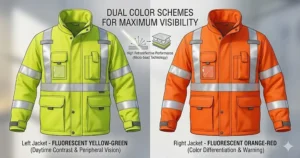
Retroreflective vs. fluorescent material: Both serve different visibility functions. Fluorescent background (the lime-yellow or orange body) is what makes you visible in daylight and at dusk when ambient light exists. Retroreflective tape (the silver bands) is what bounces vehicle headlight beams back to the driver at night — it doesn’t generate its own light, it reflects the driver’s. A jacket without both components is not ANSI-compliant for night work.
Garment replacement isn’t just about damage — it’s about certified performance degradation. Once a jacket hits its rated wash cycle count, the manufacturer can no longer certify its retroreflective performance meets ANSI minimums. For workers on compliance-sensitive sites, that’s a replacement trigger, not a suggestion.
✨ Don’t Miss These Exclusive Deals!
🔍 Take your night-shift safety to the next level with these carefully selected jackets. Click any highlighted product name to check current pricing and availability. The right visibility gear isn’t an expense — it’s the difference between walking to your truck at shift’s end and not.
Features That Actually Matter (and the Marketing Fluff to Ignore)
Jacket listings are full of adjectives. Here’s what deserves your attention and what you can safely scroll past.
Features That Actually Matter:
- ANSI certification class and type — The only spec that legally defines compliance. Verify it.
- Retroreflective tape width — 2″ beats minimum-spec 1.37″ at distance and in rain.
- Waterproof rating (WR in mm) with taped seams — Both matter. A 15,000mm rating with untaped seams still leaks at stress points.
- Insulation weight (in grams) — Matches thermal protection to activity level. A concrete number, not vague adjectives like “warm” or “cozy.”
- Wash cycle rating — Determines replacement schedule for compliance maintenance.
- Hood design (detachable / foldaway / fixed) — Directly impacts worksite safety and comfort.
Marketing Fluff to Question:
- “Ultra-premium reflective material” without ANSI certification numbers — means nothing without the standard.
- “Military-grade” with no reference to actual military spec — a descriptor attached to nearly everything.
- “Breathable waterproof” on a jacket under $30 — genuine breathable membranes (Gore-Tex class materials) are expensive; a budget jacket claiming full breathability deserves scrutiny.
- “Lifetime warranty” from an unverifiable overseas brand — warranty enforcement requires an accessible company. Verify before you trust it.
The products reviewed in this guide all come with verifiable ANSI certifications, documented wash cycle ratings, and established brand track records. That’s the baseline.
Frequently Asked Questions
❓ What ANSI class do I need for a reflective safety jacket for night work on a highway?
❓ How often should I replace my high visibility reflective safety jacket for night work?
❓ Can I wear a reflective safety jacket for night work in rain — will it stay waterproof?
❓ Is an ANSI Class 3 reflective jacket required for warehouse workers around forklifts?
❓ What is the difference between fluorescent and retroreflective material on a night work safety jacket?
Conclusion: The Jacket That Keeps You Visible Is the One Worth Buying
Here’s the honest truth about choosing a reflective safety jacket for night work: the best jacket is the one that matches your actual work environment, fits correctly over your typical layering, and gets replaced on schedule. Not the most expensive. Not the one with the most impressive bullet points on the listing page.
For most highway and road construction workers: the Ergodyne GloWear 8377 or Portwest PW3 T400 are the standards by which everything else gets measured. For budget-conscious teams in non-roadway environments: the SKSAFETY delivers remarkable performance per dollar. For warm-climate night crews: the JORESTECH JK-03 is the logical choice. For versatile year-round use: the SMASYS 6-in-1 earns every dollar of its mid-range price.
The retroreflective tape on these jackets is doing something remarkable: taking the headlights of a vehicle moving at 60 mph and sending those photons directly back to the driver’s eyes across 300+ feet of darkness. That’s physics doing the work. But only if the jacket is compliant, maintained, and actually worn. Buy right. Wear it every shift. Replace it on schedule.
Your visibility is your safety margin. Don’t shortchange it.
✨ Don’t Miss These Exclusive Deals!
🔍 Click any of the highlighted products above to check current pricing and availability on Amazon. Prices change frequently — verify before you buy.
Recommended for You
- 7 Best 360 Degree Reflective Jackets in 2026: Stay Seen, Stay Safe
- 7 Best Construction Hi-Vis Jackets 2026 — Stay Safe & Compliant
- Best Hi-Vis Rain Jacket Insulated: 7 Top Picks for 2026
Disclaimer: This article contains affiliate links. As an Amazon Associate, I earn from qualifying purchases. If you purchase products through these links, we may earn a small commission at no additional cost to you.
✨ Found this helpful? Share it with your friends! 💬🤗
