
In This Article
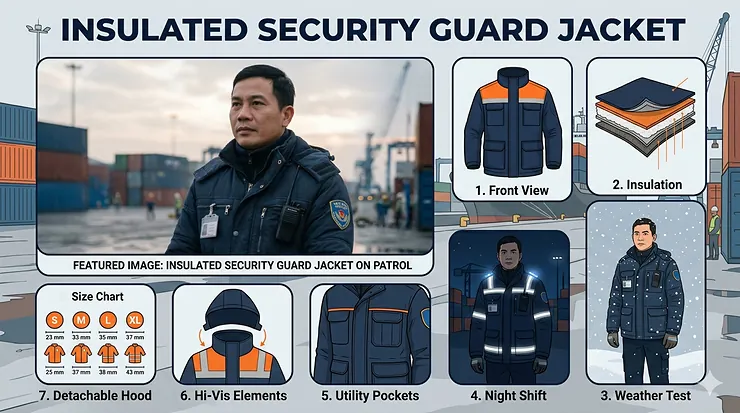
There’s a very specific kind of cold that comes from standing still. Hikers and skiers stay warm by moving — security work doesn’t offer that luxury. You’re parked at a gate at 2 a.m., walking the same forty feet of parking garage on loop, or holding a post by a loading dock while the wind finds every gap in your collar. An insulated security guard jacket isn’t really about looking the part (though the SECURITY lettering helps with that too) — it’s about surviving an eight-to-twelve-hour shift without your hands going numb on the radio.
Most “winter jacket” advice online is written for people skiing in the Alps, not standing a post in a strip-mall parking lot. The needs are different: you need pockets that fit a duty belt, a cut roomy enough for a vest underneath, and insulation that holds up through a hundred wash cycles, not twenty Instagram-worthy descents. This guide skips the ski-jacket generalities and looks at jackets actually built — or actually used — for guard duty: real products, real price brackets, and the trade-offs nobody puts on the product page.
We’ve pulled together seven currently available options spanning budget bomber jackets, tactical softshells, and one premium non-uniform pick that a lot of guards quietly switch to once their first uniform jacket falls apart. Whether you’re outfitting a whole crew or just trying to make it through January without buying a second coat, there’s something here that fits your post — and your budget.
Quick Comparison Table
| Jacket | Style | Insulation Type | Best For |
|---|---|---|---|
| Rothco MA-1 Flight Jacket w/ Security Print | Bomber | Poly fiberfill | Budget-conscious, classic look |
| Rothco Spec Ops Soft Shell Security Jacket | Tactical softshell | Fleece lining | Active patrol, lots of gear |
| Rothco Lined Coaches Security Jacket | Coach’s jacket | Fleece lining | Tightest budget, mild climates |
| RYNO GEAR Tactical Security Soft Shell | Tactical softshell | Micro-fleece | Duty belt access, low-light visibility |
| First Class Watch-Guard Bomber | Bomber | Poly insulation | Fur-collar warmth, static posts |
| Carhartt Rain Defender Insulated Hooded | Workwear jacket | Insulated lining | Long-term durability, non-uniform sites |
| TACVASEN Fleece-Lined Softshell | Tactical softshell | Brushed fleece | Tight budgets needing a tactical cut |
Looking at the table, there’s a clear split between bomber-style jackets (warmer in stillness, less mobile) and softshell tactical jackets (better range of motion, slightly less heat retention at a dead stop). If your post involves a lot of standing — gate duty, lobby desk, static checkpoint — lean toward the bombers. If you’re walking patrol routes or climbing in and out of a vehicle all night, the softshells earn their keep. The Carhartt sits in its own category: it’s not a “security jacket” at all, just a genuinely well-built insulated coat that happens to survive uniform-grade abuse better than some uniforms do.
💬 Just one click — help others make better buying decisions too!😊
✨ Don’t Miss These Exclusive Deals!
🔍 Take your cold-weather duty gear to the next level with the picks below. Click any highlighted jacket to check current pricing and availability on Amazon — these are the kind of jackets your future, much-warmer self will thank you for.😊
Top 7 Insulated Security Guard Jackets: Expert Analysis
1. Rothco MA-1 Flight Jacket with Security Print
The Rothco MA-1 Flight Jacket with Security Print is the jacket most people picture when they hear “security guard winter coat” — and there’s a reason that image stuck around for decades. It runs on poly fiberfill insulation under a nylon, water-repellent shell, which means it handles wind and light snow better than it handles a real downpour. That’s a fair trade for the price: fiberfill insulation traps body heat efficiently in dry cold but gets noticeably heavier and slower to dry if it actually gets soaked through, so this shines on dry, bitter nights more than sleety ones.
What most buyers overlook is the cut: Rothco builds this with extra room specifically so a base layer or even a thin vest fits underneath without restricting your arms — useful if your post requires reaching for a radio or duty belt constantly. The ribbed knit collar, cuffs, and waistband do real work sealing out drafts, which matters more on a static post than people expect.
✅ Classic, professional bomber silhouette
✅ Roomy cut for layering
✅ Five pockets including a zippered sleeve pocket
❌ Water-repellent, not waterproof — struggles in sustained rain
❌ Bulkier than softshell alternatives for active patrol
Price range: roughly $45–$65. Verdict: the safest budget pick if your shifts are mostly dry-cold rather than wet.

2. Rothco Spec Ops Soft Shell Security Jacket
The Rothco Spec Ops Soft Shell Security Jacket trades bomber warmth for mobility, and for anyone doing actual patrol routes rather than standing a fixed post, that trade is worth making. It’s built with a three-layer construction — fleece lining inside, wind-resistant softshell outside — plus underarm ventilation zippers, which matters more than it sounds like it would once you’re walking stairwells in a heavy coat and start overheating despite the cold outside.
The pocket layout is the real story here: dual chest pockets with internal D-rings and a cable pass-through (handy for a radio mic or earpiece wire), shoulder pockets, internal zip pockets, and a high-capacity back pocket. This is a jacket designed by people who’ve actually thought about what a guard carries, not just what looks tactical.
✅ Far better mobility than bomber-style jackets
✅ Pocket layout built around actual duty gear
✅ Detachable hood and underarm vents for temperature regulation
❌ Less warm at a dead stop than the fiberfill bombers
❌ Polyester shell shows wear faster than nylon under heavy abrasion
Price range: roughly $55–$75. Verdict: the pick for foot patrol and anyone who moves more than they stand still.
3. Rothco Lined Coaches Security Jacket
The Rothco Lined Coaches Security Jacket is about as no-frills as insulated duty wear gets — a nylon shell, a fleece lining, snap-front closure instead of a zipper, elastic cuffs, and a drawstring hem. It’s the jacket you buy when the budget is the budget and you need something warm by Friday.
Here’s the honest trade-off most listicles won’t tell you: this is consistently the cheapest jacket in the category, and the durability feedback reflects that — it’s fine for moderate climates and lighter-duty wear, but officers working genuinely harsh winters or rough environments report it wearing out faster than the softshell or bomber options above. Snap closures also let in slightly more wind than a true zipper. For seasonal hires, part-time event security, or backup jackets kept in a vehicle, that trade-off is completely reasonable. For a primary, everyday-wear jacket in a brutal climate, it’s a stopgap, not a long-term solution.
✅ Lowest price point in this guide
✅ Lightweight enough for mild-to-moderate cold
✅ Easy on/off with snap-front design
❌ Less durable under heavy daily use
❌ Snap closure isn’t as wind-sealed as a zipper
Price range: roughly $30–$45. Verdict: fine as a backup or for short-term assignments; budget elsewhere if this is your only coat through a real winter.
4. RYNO GEAR Tactical Security Soft Shell Jacket
The RYNO GEAR Tactical Security Soft Shell Jacket is built specifically with duty-belt access in mind — it has a side zipper designed so you’re not fighting your own jacket to reach your belt. The shell is a stretch windproof, water-resistant softshell with a laminated film insert and a fixed inner lining, plus reflective tape across the midsection and sleeves with bold SECURITY ID lettering front and back.
That reflective detailing isn’t just branding — it’s a genuine visibility advantage in parking structures, loading docks, or roadside posts where being seen by a passing vehicle at night matters for actual safety, not just professionalism. The fabric also runs noticeably thicker than most softshells in this price bracket, which shows up as better wind-blocking on exposed posts.
✅ Side-zip duty belt access — rare in this category
✅ Reflective detailing genuinely improves nighttime visibility
✅ Thicker fabric than typical softshells at this price
❌ Stretch fabric runs slightly small — consider sizing up
❌ Fixed lining means less layering flexibility than removable-liner jackets
Price range: roughly $50–$70. Verdict: best all-around tactical softshell here if duty-belt access and visibility are priorities.
5. First Class Watch-Guard Bomber Jacket with Reflective Security ID
The First Class Watch-Guard Bomber Jacket leans into old-school bomber styling with a faux fur collar — and that collar is doing more than aesthetic work. A fur or faux-fur collar traps a pocket of warm air right against your neck, which is one of the biggest heat-loss points on a still, cold night. Combine that with windproof/insulated construction and elastic cuffs and waistband, and this jacket performs best exactly where it’s least mobile: lobby desks, gatehouses, static checkpoints.
The wide inside storage pockets are a nice practical touch for officers who carry a phone, notepad, and incident-report forms rather than tactical gear. It’s a jacket built for presentation as much as performance, and at well-staffed sites where appearance matters to clients, that’s not a minor consideration.
✅ Faux fur collar adds genuine neck-level warmth
✅ Wide interior pockets for paperwork and personal items
✅ Strong, professional bomber presentationLess suited to high-mobility patrol than softshell options
❌ Faux fur collar requires more careful laundering
Price range: roughly $50–$70. Verdict: the front-desk and gatehouse pick — warm, professional, not built for hiking stairwells.
6. Carhartt Men’s Rain Defender Insulated Hooded Jacket
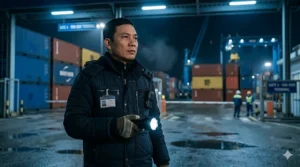
The Carhartt Men’s Rain Defender Relaxed Fit Lightweight Insulated Hooded Jacket isn’t marketed as security gear at all — no SECURITY lettering, no tactical branding — and that’s exactly why a lot of veteran guards quietly own one anyway. It’s built with Cordura reinforcement and triple-stitched seams, the kind of construction details that show up as “still intact after two winters” rather than “replace every season.” The relaxed fit accommodates a vest or extra layers, and the Rain Defender treatment handles wind and light rain meaningfully better than the nylon shells on the budget bombers.
What this lacks is identification branding — fine if your employer issues a separate ID jacket or patch system, a problem if your post specifically requires visible “SECURITY” text. Many sites solve this with an iron-on or sewn patch, which the heavier Carhartt fabric handles better than thinner softshells anyway.
✅ Genuinely superior long-term durability (Cordura + triple stitching)
✅ Better rain resistance than nylon bomber shells
✅ Relaxed fit comfortably layers over a vest
❌ No built-in security branding or ID printing
❌ Sits at the higher end of this list’s price range
Price range: roughly $90–$130. Verdict: the buy-it-once option if your site allows non-branded outerwear or patches.
7. TACVASEN Fleece-Lined Softshell Winter Coat
Rounding out the list, the TACVASEN Fleece-Lined Softshell Winter Coat gives you a tactical-style cut — stand collar, multiple zippered pockets, adjustable hem and cuffs — without the security-branding markup. It carries a 10,000mm waterproof rating on the shell fabric, which on paper outperforms several of the “water-repellent” nylon bombers above when it comes to standing rain, not just drizzle.
The fleece interior is brushed rather than pile-style, which keeps bulk down — useful if you’re wearing it under a duty vest rather than over one. It won’t satisfy a dress code requiring printed SECURITY branding out of the box, but for officers buying their own gear at private, less uniform-strict sites, it’s a strong budget tactical alternative to the RYNO GEAR option above.
✅ Genuinely high waterproof rating for the price bracket
✅ Tactical cut without security-jacket markup
✅ Multiple pockets including chest and inner storage
❌ No built-in branding or ID printing
❌ Sizing reportedly runs slightly inconsistent across colors
Price range: roughly $40–$60. Verdict: the budget tactical pick when branding isn’t mandatory.
Real-World Scenario: Matching the Jacket to the Post
Not every guard job has the same cold-weather problem, so let’s break it down by situation rather than just specs.
The static-post officer — gatehouse, lobby desk, parking booth — spends ten hours mostly standing still in one spot. Heat loss from inactivity is the enemy here, not wind chill from movement. The First Class Watch-Guard Bomber or Rothco MA-1 make more sense than a softshell, because fiberfill insulation and a fur collar outperform breathable tactical fabric when you’re barely moving.
The foot-patrol officer — walking a property perimeter, checking stairwells, doing rounds every hour — generates body heat through movement and needs a jacket that breathes and doesn’t restrict the arms. The Rothco Spec Ops Soft Shell or RYNO GEAR Tactical Security jacket fit this profile better; underarm vents and stretch fabric matter more than maximum insulation.
The budget-limited part-timer or seasonal hire, working occasional event security or short-term contracts through one winter, doesn’t need a $120 jacket they’ll outgrow the role for. The Rothco Lined Coaches Jacket or TACVASEN softshell cover the actual cold without the premium spend.
Practical Usage Guide: Getting More Life Out of a Duty Jacket
A jacket’s insulation rating only tells half the story — how you treat it determines whether it’s warm in year three or just looking tired.
Wash less aggressively than you think. Fleece-lined and fiberfill jackets lose loft (and therefore warmth) when over-washed on hot cycles. Cold wash, low or no-heat dry, and spot-clean between full washes whenever possible.
Re-treat water repellency annually. Nylon shells with a DWR (durable water repellent) coating lose that coating gradually through washing and abrasion against duty belts. A spray-on DWR reapplication once a season — available cheaply at any outdoor retailer — restores most of the original water resistance.
Watch the zippers, not just the fabric. Most duty jacket failures aren’t insulation breakdown — they’re zipper pulls snapping from constant on/off-duty-belt friction. A little zipper lubricant (even candle wax in a pinch) extends zipper life significantly.
Rotate two jackets if your budget allows it. One drying out, one in use. This single habit does more for jacket longevity than almost any fabric choice, since insulation that’s allowed to fully dry between shifts retains loft far longer than insulation worn damp shift after shift.
Problem → Solution: Common Cold-Weather Complaints on Patrol
Problem: “My hands go numb before my core does.” Insulated jackets focus warmth on the torso; hands and extremities lose heat fastest because of reduced blood flow to extremities in cold conditions. Solution: pair any jacket here with insulated, touchscreen-compatible gloves rather than relying on the jacket’s cuffs alone.
Problem: “I overheat indoors, then freeze the second I step back outside.” This is extremely common for officers splitting time between heated lobbies and exterior posts. Solution: a softshell with underarm vents (Rothco Spec Ops, RYNO GEAR) handles this transition far better than a sealed bomber jacket.
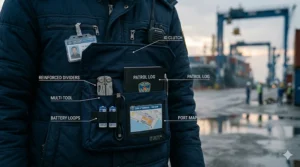
Problem: “The jacket’s warm, but I can’t reach my radio or belt fast.” Solution: prioritize side-zip duty belt access (RYNO GEAR) or wide chest pockets with D-rings (Rothco Spec Ops) over jackets optimized purely for warmth.
Problem: “It looked fine in the listing photos, but the fabric feels thin in person.” Solution: check the listed fabric weight and lining type before buying, and lean toward Cordura or reinforced nylon (Carhartt) if your site involves rough surfaces, fences, or vehicle work.
How to Choose an Insulated Security Guard Jacket
What is an insulated security guard jacket? It’s outerwear built specifically for long, often stationary, outdoor security shifts — combining wind/water-resistant shells with insulation (fiberfill, fleece, or quilted lining) plus duty-specific features like belt access, ID branding, and radio-pocket placement that a standard winter coat doesn’t prioritize.
Use this sequence when narrowing down options:
- Identify your post type first. Static posts favor maximum insulation; foot patrol favors breathability and mobility.
- Check your dress code for required branding. If SECURITY lettering is mandatory, that immediately rules out the Carhartt and TACVASEN unless patches are allowed.
- Match insulation to your actual climate, not the harshest winter you’ve ever heard about — over-insulating causes overheating and sweat-driven cold just as often as under-insulating causes shivering.
- Prioritize duty belt and radio access if you carry gear constantly; this is the most overlooked spec on every product listing.
- Set a realistic durability budget. A $35 jacket replaced twice a season can cost more than one $90 jacket worn for three years.
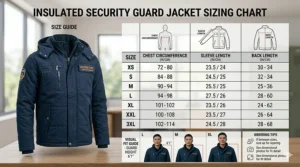
- Confirm sizing room for layers. Cold-weather work often means base layers or a vest underneath — buy the cut, not just the size label.
- Check water resistance separately from wind resistance. Many “winter jackets” handle wind well but soak through in sustained rain — a real distinction this category often blurs.
Insulated Security Guard Jacket vs. Standard Winter Coat
The temptation to just buy a regular winter parka instead of a “security” jacket is understandable — but the differences matter more than they look on paper. Standard winter coats are designed around recreational movement: walking to a car, shoveling snow, a brisk outdoor errand. Security jackets are designed around sustained stationary exposure and constant gear access.
Practically, that shows up in three places: pocket placement (duty belt clearance vs. standard hand pockets), durability against constant friction from belts and equipment, and visibility features like reflective tape that civilian coats rarely include. A $150 outdoor-brand parka might out-insulate every jacket on this list, but if it lacks side access to a duty belt or starts pilling against a radio holster within a month, that insulation advantage stops mattering quickly. The reverse is also true — RYNO GEAR and Rothco’s tactical features would be entirely wasted on someone just walking the dog.
What to Expect: Real-World Performance in Cold and Wind
Marketing copy rarely tells you how a jacket actually feels at 11 p.m. in 20°F wind. A few patterns worth knowing: fiberfill bombers (Rothco MA-1, First Class Watch-Guard) feel noticeably warmer than softshells at a dead stop, but that gap narrows fast once you start walking — softshells breathe better and prevent the sweat-then-chill cycle that makes stationary insulation feel cold again twenty minutes later.
Wind is the bigger variable than temperature alone. The National Weather Service’s wind chill chart shows how dramatically wind drops the felt temperature even when the thermometer reading barely moves — a 25°F night with 20 mph wind feels closer to single digits. That’s exactly why windproof shell fabric (RYNO GEAR’s laminated softshell, TACVASEN’s 10,000mm-rated shell) matters as much as insulation thickness for exposed posts.
Common Mistakes When Buying a Security Guard Duty Jacket
Buying for the coldest day instead of the average shift. Over-insulated jackets cause sweating, and damp insulation loses effectiveness — sometimes leaving you colder by 3 a.m. than a moderately insulated jacket would have.
Ignoring fit around the shoulders and arms. A jacket that fits well standing still can bind badly when reaching for a radio or restraining gear — try the reach test, not just the mirror test.
Skipping fabric weight in the listing. “Insulated” and “lined” appear on jackets with wildly different actual warmth — check reviews specifically mentioning cold-weather performance, not just general impressions.
Assuming all reflective detailing is equal. Printed reflective ink fades faster than sewn reflective tape; if nighttime visibility on a roadway-adjacent post matters, check which type a listing actually uses.
Long-Term Cost & Maintenance
Run the numbers past the sticker price. A $35 jacket needing replacement every single winter costs roughly the same over three years as a $95–$110 jacket bought once — and that’s before counting the inconvenience of a mid-winter gear gap while you wait on a replacement shipment. Reinforced fabrics (Cordura, heavier nylon) and quality zippers are the two biggest predictors of whether a jacket survives past one season of actual duty wear rather than recreational use.
Features That Actually Matter (And Those That Don’t)
Matters: windproof shell rating, duty belt or side-zip access, pocket placement relative to where you actually carry gear, reinforced high-wear zones (forearms, elbows).
Doesn’t matter as much as marketing suggests: camo-style “tactical” patterning (it’s cosmetic on a civilian security jacket), an excessive pocket count if half are too small for anything but a pen, and faux-leather trim that looks rugged but adds zero functional warmth.
FAQ
❓ What is the warmest insulated security guard jacket?
❓ Are softshell security jackets warm enough for winter?
❓ How much does a security guard duty jacket cost?
❓ Do security guard jackets need to be waterproof?
❓ Can I wear a non-branded jacket like Carhartt for security work?
Conclusion
There’s no single “best” insulated security guard jacket — there’s only the best one for your specific post, climate, and budget. Static gate and lobby work rewards maximum insulation and a sealed bomber cut; active patrol rewards breathable softshells with duty belt access; tight budgets are served fine by the Rothco Lined Coaches or TACVASEN picks as long as you’re realistic about their limits in genuinely harsh winters.
If you remember nothing else from this guide, remember this: the jacket that wins isn’t the one with the most features on the listing page — it’s the one that matches how you actually spend your shift. Buy for your post, not for the spec sheet, and you’ll stay warmer for less money than you’d expect.
✨ Don’t Miss These Exclusive Deals!
🔍 Ready to gear up for the season? Check current pricing and availability on any of the seven picks above — your next cold shift is a lot more bearable with the right jacket already in the closet.😊
Recommended for You
- Best Leather Welding Jacket Maintenance Guide: 7 Picks (2026)
- Leather Welding Jacket vs FR Cotton: 7 Best Picks (2026)
- Best Split Leather Welding Jacket: 7 Top Picks for 2026
Disclaimer: This article contains affiliate links. As an Amazon Associate, I earn from qualifying purchases. If you purchase products through these links, we may earn a small commission at no additional cost to you.
✨ Found this helpful? Share it with your friends! 💬🤗
