
In This Article
You’ve been there. Halfway up a ladder, wrench in one hand, three stories of cold air in the other — and your flat-head screwdriver is absolutely nowhere. Again. The floor. The truck. The void between worlds where missing tools apparently live.
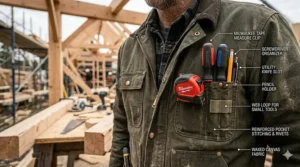
A great work jacket with tool pockets doesn’t just keep you warm. It reorganizes how you move through a job. Pocket placement matters as much as pocket count. The wrong jacket gives you eight pockets you never use and zero where you actually need them. The right one means the voltage tester is in the left chest — always — and you haven’t touched a floorboard to grab a pencil since March.
What exactly are we talking about? A work jacket with tool pockets is any insulated or uninsulated outerwear garment specifically engineered with reinforced, strategically placed pockets — chest pockets with pencil slots, deep lower-front pockets with tool-abrasion reinforcement, interior organizer pockets, and sometimes dedicated slots for bits, blades, or tape measures. It’s different from a regular winter jacket the way a set of Klein pliers is different from a kitchen knife. Same general shape, completely different job.
The market in 2026 is genuinely crowded. Budget options flood Amazon. Premium brands have gone even more premium. And the mid-range has quietly gotten very good. According to the U.S. Bureau of Labor Statistics, over 7.3 million Americans work in construction and extraction — and the majority of those workers spend their shifts in outdoor or semi-outdoor conditions where the right outerwear is not optional, it’s operational.
This guide cuts through the noise. Seven real, currently available jackets. Honest analysis. Who each one is for, who should skip it, and what the spec sheet isn’t telling you.
Quick Comparison: Top 7 Work Jackets with Tool Pockets at a Glance
| Product | Pocket Count | Shell Material | Best For | Price Range |
|---|---|---|---|---|
| Carhartt Men’s Washed Duck Active Jac | 5 | 12oz Duck Canvas | All-around tradesman | $100–$135 range |
| Wrangler Riggs Tough Layers Twill Jacket | 4 | Cotton Twill/CORDURA | Carpenters, framers | $55–$75 range |
| Milwaukee M12 Heated TOUGHSHELL Jacket | 5 | ToughShell Polyester | Electricians in cold climates | $170–$230 range |
| Dickies Men’s Eisenhower Insulated Jacket | 3 | 8.5oz Polyester-Cotton | Budget utility, light work | $45–$65 range |
| Wrangler Riggs Ranger Jacket | 5 | Cotton-Poly Blend | Multi-trade, mid-budget | $65–$90 range |
| DEWALT DCHJ102 20V Heated Work Jacket | 5 | Duck Fabric Shell | Contractors in extreme cold | $150–$185 range |
| Red Kap Men’s Slash Pocket Quilt-Lined Jacket | 3 | Polyester-Cotton | Service techs, light outdoor | $35–$50 range |
Looking at the table above, the budget tier (Red Kap, Dickies) sacrifices pocket count and shell toughness for price — reasonable for service technicians or inside workers who just need occasional outdoor coverage. The mid-range sweet spot is Carhartt and Wrangler Riggs, where you get genuine tradesman-grade pocket layouts without the heated-jacket price premium. If cold weather is your primary enemy and your Milwaukee batteries are already on the charger, the M12 Heated TOUGHSHELL earns every extra dollar.
💬 Just one click — help others make better buying decisions too! 😊
Top 7 Work Jackets with Tool Pockets: Expert Analysis
1. Carhartt Men’s Washed Duck Active Jac
The Carhartt Washed Duck Active Jac is the measuring stick every other work jacket in this category gets measured against — and for good reason. Built from 12-ounce, 100% cotton duck canvas, this is not a jacket you baby. You throw it in the back of your truck, spill hydraulic fluid on the sleeve, and wash it once a week. It comes back every Monday ready to work.
What that 12oz duck weight actually means in practice: thinner canvas jackets at 8-9oz will wear through at the cuff corners and lower pocket edges within a year of hard use. Carhartt’s heavier weave resists abrasion at those high-stress points significantly longer. The quilted flannel lining adds warmth without bulk, letting you layer a hoodie underneath comfortably on sub-20°F mornings.
The tool storage design is where this jacket earns its reputation. The bottom section of the front pockets is reinforced specifically to resist tool abrasion — meaning your screwdrivers and tape measure won’t gradually shred through the pocket fabric. There’s also a secure interior zip pocket that most buyers overlook: it’s the right size for a smartphone or a folded-up cut sheet you don’t want blowing away.
Customers consistently cite durability as the standout feature, with many reporting 3-5 years of daily trade use before needing replacement. The main gripes: the zipper can be stiff out of the box, and some buyers wish for a dedicated pencil slot in the chest pocket (there isn’t one on the standard model).
✅ 12oz duck canvas outlasts lighter alternatives by years
✅ Reinforced tool-abrasion lower pockets — built for actual tool storage
✅ Interior zip pocket holds phone or documents securely
❌ No chest pencil slot — a genuine miss for carpenters
❌ Zipper can be stiff; break it in before your first cold morning
Best for: The carpenter, plumber, or farmer who needs a jacket that’s essentially indestructible and will still be in rotation five seasons from now. In the $100–$135 range — one of the strongest value propositions in work outerwear.
2. Wrangler Riggs Workwear Men’s Tough Layers Twill Shirt Work Jacket
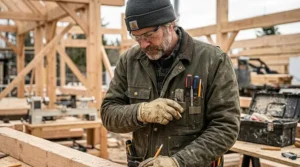
Wrangler Riggs doesn’t get enough credit. This is a brand that genuinely designs for tradespeople — not for the person who looks like a tradesperson on the weekend. The Tough Layers Twill Shirt Work Jacket proves that point immediately with its pocket layout: two patch chest pockets, a CORDURA-reinforced right chest welt pocket, and a left chest patch pocket with snap flap closure. Four pockets, all accessible, all intentional.
That CORDURA reinforcement on the right chest welt pocket is the detail that sets this apart from generic workwear. CORDURA is the same abrasion-resistant nylon fabric used in military gear — its presence here means the pocket that takes the most abuse (reaching in and out for a pencil, a utility knife, a voltage pen) will last considerably longer than a standard cotton patch. This jacket is positioned as a shirt-jacket hybrid, which means it’s lighter than an insulated coat — ideal as a transitional layer in fall and spring, or as a mid-layer in deep winter under a heavier shell.
Electricians and finish carpenters have flagged this one specifically because the chest pockets sit at exactly the right height for quick one-handed access while on a ladder. For woodworkers, that snap flap on the left chest keeps pencils and small squares from falling when you crouch.
Customer feedback is warm — most buyers mention the fit is truer to size than comparable Carhartt options, and the cotton twill exterior handles multiple washes without the fabric turning stiff or misshapen.
✅ CORDURA-reinforced chest pocket — rare in this price range
✅ Shirt-jacket fit works well as a standalone or mid-layer
✅ Snap flap chest pocket secures small tools on the move
❌ Not insulated — you’ll need a base layer in real cold
❌ Lighter shell than duck canvas; not for abrasive environments
Best for: Electricians, finish carpenters, and woodworkers who want smart pocket placement without the bulk of a full work coat. In the $55–$75 range — outstanding value.
3. Milwaukee M12 Heated TOUGHSHELL Jacket
Let’s just say it: the Milwaukee M12 Heated TOUGHSHELL Jacket is a different category of product. It’s not just a jacket with tool pockets. It’s a heated, carbon-fiber-element, battery-powered thermal management system that you also happen to put your pencil in. And for the right person — working in unheated warehouses, outdoor construction sites, or attic/crawlspace environments where you can’t layer up without losing mobility — it’s worth every extra dollar.
The ToughShell stretch polyester delivers five times the lifespan of standard softshell fabrics, according to Milwaukee’s testing data. More importantly for tool storage: the five-pocket layout includes two hand-zippered pockets, one interior zip pocket, one exterior zip pocket, and — the feature every Milwaukee user loves — a zippered battery pass-through pocket that lets you run the M12 battery in either the front or the back for comfort optimization. No dangling battery pack, no awkward bulk.
The carbon fiber heating elements push heat to the chest, back, and hand pockets on a three-setting LED controller. Cold hands are a job-site hazard — stiff fingers fumble wire connections, drop fasteners, miss cuts. The M12’s hand pocket heating is a genuine functional advantage, not a luxury feature.
Buyers from electrical and HVAC trades specifically praise this jacket’s ability to keep them productive in temperatures where competitors’ offerings would have them retreating to the truck every 20 minutes.
✅ Carbon fiber heat elements in chest, back, AND hand pockets
✅ Battery pass-through pocket works front or rear — flexible carry
✅ ToughShell polyester rated 5x longer life than standard softshell
❌ Requires M12 battery — adds cost and dependency on Milwaukee system
❌ Wind/water resistant, not waterproof — heavy rain needs a shell over it
Best for: Electricians, HVAC techs, and outdoor contractors who work in sustained cold. In the $170–$230 range (kit with battery), it’s an investment — one that pays back in retained productivity on the coldest months of the year.
4. Dickies Men’s Eisenhower Insulated Front-Zip Jacket
The Dickies Eisenhower is a workwear institution. It’s been on the backs of warehouse workers, delivery drivers, and general laborers for decades, and the current iteration still does what it’s always done: provide warm, affordable, no-fuss outerwear that doesn’t fall apart by February.
Built from an 8.5-ounce polyester-cotton blend, this jacket is lighter than duck canvas options — which is actually a feature, not a flaw, depending on your work environment. If you’re in a mixed indoor-outdoor role (warehouse receiving, HVAC installation in partly heated spaces, delivery/logistics), the lighter shell prevents the overheating-to-freezing cycle that comes with heavier jackets every time you step inside.
The pocket situation is modest: two lower front pockets (slash-style, not patch), and a chest pocket with a pencil division. For pure tool storage, this is not the jacket. But for keeping a multimeter, a phone, some pens, and a cutter nearby? Entirely functional. The pencil division in the chest pocket is one of those small-but-critical details that separates a workwear-designed jacket from a regular coat.
Customer sentiment skews pragmatic: “It does the job and it’s not $150” is basically the consensus. Wear over a hoodie for warmth in most climates; it’s not rated for extreme cold on its own.
✅ Chest pocket pencil division — practical detail missing on many budget options
✅ Lighter shell works well for mixed indoor/outdoor environments
✅ Excellent price-to-warmth ratio for non-extreme conditions
❌ Only 3 pockets — not enough for organized tradesman tool storage
❌ 8.5oz polyester-cotton won’t last as long as duck canvas under abrasion
Best for: Delivery drivers, warehouse workers, or light-duty general laborers who need warmth and basic utility at a no-regrets price. In the $45–$65 range — the smart budget pick.
5. Wrangler Riggs Workwear Men’s Ranger Jacket
The Wrangler Riggs Ranger is the multi-trade Swiss Army knife of work jackets — five pockets, cotton-poly blend construction, and a pocket layout that works for everyone from a utility maintenance tech to a weekend ranch hand. Two secure chest pockets, two flap pockets at the lower waist, and one snap flap pocket on the sleeve. That sleeve pocket is the interesting one — most buyers don’t realize how often they use it until the jacket is on their back and they’ve stuffed a folded work order in it for the third day in a row.
The cotton-poly shell sits lighter than Carhartt’s full duck, which comes with trade-offs: better breathability and flexibility, reduced abrasion resistance over time. Triple-stitched main seams extend the life considerably relative to price. The water-repellent finish handles light rain and morning dew without soaking through — not a rain jacket, but functional for the start-of-shift walk across a wet parking lot.
For multi-trade environments where your role shifts — plumbing in the morning, electrical afternoon, framing on Fridays — the Ranger’s versatile pocket layout means you’re not working against the jacket’s design. Everything is where you’d want it to be regardless of your trade.
Customer reviews highlight the fit as particularly well-engineered: not boxy, not slim — genuinely relaxed without adding bulk.
✅ Five pockets including unique sleeve pocket — versatile layout
✅ Relaxed fit accommodates layering without restricting arm movement
✅ Water-repellent finish handles light outdoor conditions
❌ Lighter shell shows wear faster than 12oz duck canvas
❌ Not insulated enough for serious cold without a base layer
Best for: Multi-trade workers, utility maintenance techs, and small contractors who need a go-anywhere jacket that doesn’t lock them into one trade’s workflow. In the $65–$90 range — excellent value for the pocket count.
6. DEWALT DCHJ102 20V MAX Heated Work Jacket
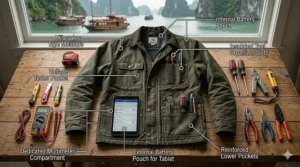
DEWALT’s entry into heated workwear is characteristically tool-brand: purpose-built, battery-ecosystem-integrated, and deeply practical. The DCHJ102 runs on 20V MAX batteries — the same system most contractors already have on the charger — which means no new battery investment if DEWALT is already your jobsite standard.
The outer shell is duck fabric, which immediately separates this from Milwaukee’s softshell approach. Duck fabric plus heated interior means you get genuine abrasion resistance on top of the thermal advantage — a combination that suits outdoor framers and concrete workers who need warmth but also need a jacket that can absorb the punishment of a real construction site. Five heat zones, including arm heating, powered through an LED controller with three settings and a preheat function that gets warmth moving in under 30 seconds on a cold start.
Two large fleece-lined riveted front pouch pockets provide hand warming and tool storage simultaneously. The riveted construction on the pockets — borrowed from denim workwear heritage — reinforces the pocket attachment points, which is exactly where standard stitched pockets fail after months of heavy loads. What most buyers don’t notice until they’ve owned it six months: the duck shell on this jacket holds up to rough surfaces (concrete walls, rebar, rough lumber) far better than polyester-based heated jackets from competing brands.
Customers working in outdoor construction widely praise the DEWALT’s ability to extend their comfortable outdoor working hours in winter by 2-3 hours per day — a real productivity metric in cold-weather climates.
✅ Duck fabric shell — rare in heated jackets, much tougher than softshell
✅ 20V MAX battery compatibility — perfect for existing DEWALT users
✅ Preheat function reaches warmth in under 30 seconds
❌ Heavier than softshell heated options — trade-off for durability
❌ Requires 20V battery; costs rise if you’re not already on DEWALT
Best for: Outdoor contractors, framers, and concrete workers already in the DEWALT ecosystem who need winter warmth without sacrificing the shell toughness their job demands. In the $150–$185 range — a strong competitor to Milwaukee for DEWALT loyalists.
7. Red Kap Men’s Slash Pocket Quilt-Lined Jacket
Red Kap is the unsung hero of industrial workwear. You’ll find it on automotive technicians, HVAC service specialists, and manufacturing floor workers — the people whose jobs are mostly indoors with regular trips outside to vans and loading docks. The Slash Pocket Quilt-Lined Jacket serves that audience exactly: a quilted polyester-cotton shell, two inset slash pockets for hands and basic tool access, and a utility pocket on the sleeve for quick-grab essentials.
The sleeve utility pocket is a smarter feature than it sounds. For service technicians who regularly reach into vehicles, tight equipment cabinets, or crawl spaces, having a frequently needed item (a pencil, a small flashlight, a pair of wire nuts) on the sleeve means one less time you need to stand up or back out to dig in a lower pocket.
Red Kap’s workwear DNA comes from decades of supplying uniform programs to automotive dealerships and industrial facilities — which means the construction prioritizes wash durability and colorfast performance as much as raw shell toughness. This jacket goes through industrial laundry cycles and holds up. The trade-off: it’s not designed for outdoor construction environments where abrasion and weather resistance are critical. Think of it as the perfect shop-to-loading-dock jacket, not the perfect scaffold-to-roof jacket.
Customers consistently give high marks for warmth relative to weight, and note that the sizing runs true.
✅ Sleeve utility pocket — genuinely useful for service tech workflows
✅ Quilt lining delivers warmth without excessive bulk
✅ Holds up to repeated industrial washing better than fashion-adjacent workwear
❌ Only 3 total pockets — not enough for organized field tool storage
❌ Not designed for outdoor construction; shell is lighter than tradesman-grade
Best for: Automotive technicians, HVAC service specialists, and manufacturing workers who need a professional, washable work jacket with basic utility. In the $35–$50 range — the most budget-friendly legitimate option on this list.
How to Use Your Work Jacket Tool Pockets Effectively: A Practical Setup Guide
Buying the right jacket is step one. Actually organizing it so it makes you faster on the job is the step most buyers skip entirely. Here’s what separates the tradespeople who love their work jacket from the ones who forget it in the truck.
Assign every pocket a permanent job. Sounds obvious. Almost nobody does it deliberately. Chest left = pencils and markers. Chest right = voltage tester or utility knife. Interior zip = phone, folded documents, permit card. Lower left = multimeter. Lower right = wire nuts or small fasteners in a baggie. The moment everything has an address, the jacket becomes a second brain. You stop thinking, you just reach.
Don’t over-stuff the lower pockets. Heavy tools dragging at the front bottom of a jacket pull the whole garment forward, binding your shoulders and straining the stitching at the pocket attachment points — which is exactly how pockets fail. Tools heavier than about 8oz should stay on your belt. The jacket pockets are for access items, not weight-bearing storage.
Use the interior zip pocket for your phone and nothing sharp. This is the pocket most tradespeople misuse by treating it as overflow. A loose utility blade in your interior pocket is a liability. Keep it dedicated to flat, non-lethal items.
At the end of the day — audit and reset. Spend 60 seconds clearing out pocket debris (bent nails, wire scraps, loose fasteners) before you leave the job. A jacket that starts the morning clean lets you work faster than one where you’ve got to sift through yesterday’s junk to find today’s pencil.
Seasonal adjustment: In summer or in heated environments, a utility work jacket with tool pockets worn unzipped works as a light organizer layer over a t-shirt. You still get the pocket layout without the thermal load. This extends a single jacket’s usefulness across three seasons.
Real-World Scenarios: Which Work Jacket Fits Your Situation?
Different trades have different jacket needs. Here’s how to match the right option to your actual workday — not the idealized version of it.
The Residential Electrician working new construction moves between heated and unheated spaces constantly. Temperature regulation matters as much as pocket layout. The Wrangler Riggs Tough Layers Twill wins here: the CORDURA chest pocket handles the voltage pen and the marker that live there all day, and the lighter construction means you’re not sweltering in a framed house by 10 AM. In genuinely cold climates — Minnesota Januarys, Montana jobsites — upgrade to the Milwaukee M12 Heated TOUGHSHELL for sustained thermal management.
The Framing Carpenter spends most of their day outside, bending, reaching, lifting. Shell durability and sleeve freedom matter more than interior pocket count. The Carhartt Washed Duck Active Jac is the answer here — the 12oz duck canvas handles the physical abuse of framing environments, the reinforced lower pockets take the weight of a speed square without fraying, and the quilted lining is warm enough to handle fall and early spring without layering until temperatures drop below 20°F.
The HVAC & Plumbing Contractor often works in tight spaces — attics, crawlspaces, mechanical rooms — where bulk is the enemy. The Wrangler Riggs Ranger Jacket works well: five pockets, relaxed fit with real freedom of movement, and a shell light enough not to bind in confined spaces. The sleeve pocket is unexpectedly useful for storing a refrigerant identifier or small fittings you reach for constantly.
The Service Technician (automotive, appliance repair, facilities maintenance) primarily works in climate-controlled environments with regular outdoor exposure. The Red Kap Quilt-Lined Jacket is purpose-built for this profile: washable, professional-looking, sleeve pocket for the one tool you need every five minutes, warm enough for loading dock walks without being a sauna inside.
How to Choose a Work Jacket with Tool Pockets: 6 Key Criteria
The market will try to sell you on pocket count. Resist that instinct. Here’s what actually determines whether a work jacket with tool pockets will improve your efficiency or just clutter your morning routine.
1. Shell Weight vs. Work Environment 12oz duck canvas for outdoor construction. 8-10oz polyester-cotton blend for mixed environments. Lightweight softshell for primarily indoor work. Match the shell to your worst-case-day conditions, not your average day.
2. Pocket Placement Over Pocket Count Six pockets in the wrong location are less useful than three in the right ones. A chest pocket you can reach with your left hand while your right holds a drill is worth two lower pockets that require you to set down your tool to access them.
3. Reinforcement at Stress Points Look for tool-abrasion reinforcement at the lower pocket interiors, triple-stitched seams at the pocket attachment points, and riveted pocket corners on any jacket you plan to load regularly. These are the areas that fail first on cheaper options.
4. Layering Compatibility Buy a work jacket you can wear comfortably over a mid-weight hoodie. If it’s tight through the shoulders with a layer underneath, it’ll restrict your range of motion on the job — which is both annoying and, per OSHA’s PPE guidelines, a genuine safety consideration when restricted movement affects how you handle tools.
5. Closure Type Full-zip with storm flap is the most functional closure for tool-pocket jackets — you can zip to any level quickly, and the storm flap protects the zipper in wet conditions. Snap-front closures look great but slow you down when you’re putting the jacket on and off repeatedly through the day.
6. Interior Pockets At minimum, one interior zip pocket. It’s where your phone and your valuable documents stay — away from rain, sawdust, and the bottom-of-a-pile abuse that exterior pockets absorb. Jackets without an interior pocket force you to choose between security and access.
Work Jacket with Tool Pockets vs. Tool Belt + Regular Jacket: An Honest Comparison
This is the real question, isn’t it? Do you actually need a specialized work jacket with tool pockets, or is a good tool belt plus whatever jacket you already own doing the same job?
| Factor | Work Jacket with Tool Pockets | Tool Belt + Standard Jacket |
|---|---|---|
| Upper-body access | ✅ Immediate chest/interior reach | ❌ Belt-only, requires bending |
| Weight distribution | ✅ Balanced across chest/sides | ❌ All weight at waist |
| Cold weather utility | ✅ Insulation + organization combined | ❌ Belt over insulated jacket is bulky |
| Access in tight spaces | ✅ No belt bulk in crawlspaces | ❌ Belt can catch and bind |
| Tool capacity | ❌ Limited to small/medium tools | ✅ Vastly more capacity |
| Cost | ✅ Single purchase | ❌ Separate belt + jacket investment |
| Best For | Electricians, techs, light assembly | Carpenters, heavy construction |
The honest verdict: these are complementary systems, not competing ones. Most experienced tradespeople use both — a tool belt for the heavy daily carry, and a work jacket with tool pockets for the frequently-accessed small items that shouldn’t require bending at the waist every three minutes. Think of the jacket pockets as your Tier 1 fast-access layer: the items you touch dozens of times a day live there. The belt and bag handle everything else. According to workwear and PPE research published through NIOSH, reducing repetitive bending motions to access hand tools significantly reduces cumulative lower back strain over a career — which is reason enough to take jacket pocket access seriously.
Common Mistakes When Buying a Work Jacket with Tool Pockets
Buying too small for layering. The single most common mistake. A work jacket that fits perfectly over a t-shirt in the store will be binding across the shoulders and back when you’re wearing it over a hoodie on a February job. Size up by at least one if you plan to layer, which you will.
Ignoring pocket placement in favor of pocket count. Eight pockets sounds better than five. But if six of those eight pockets are on the lower front, you’ve just bought a jacket that requires you to stop, stand straight, and look down every time you access a tool. Count useful pockets — chest, interior, sleeve — not total pockets.
Choosing aesthetics over shell weight. Some of the best-looking work jackets on Amazon have 8oz polyester shells that will show fraying at the pocket corners within six months of real use. Workwear heritage brands built their reputations on shell weight for a reason. If the jacket doesn’t list a shell weight in ounces, that’s a flag.
Skipping the interior zip pocket. You’ll keep your phone in an exterior pocket for the first two weeks — until the first time you set the jacket on a concrete floor pocket-side-down, or the first time a wet sleeve soaks through and your screen goes dark. Interior zip pocket is not optional.
Buying heated without battery compatibility verification. Heated work jackets are excellent. They’re also expensive surprises if you discover the battery system is incompatible with your existing tool lineup. Milwaukee M12 requires M12 batteries; DEWALT 20V MAX requires 20V MAX batteries. Verify before purchasing.
Features That Actually Matter (And The Marketing Hype to Ignore)
The workwear jacket market has gotten very good at listing impressive-sounding features that don’t move the needle on job performance. Here’s the quick filter:
Features that actually matter:
✅ Shell weight in ounces (heavier = longer-lasting for outdoor construction)
✅ Tool-abrasion reinforcement inside lower pockets (prevents pocket failure)
✅ Interior zip pocket (essential for phone and document security)
✅ Triple-stitched seams at stress points (pockets, cuffs, shoulder seams)
✅ Chest pocket pencil slot (sounds minor; is used 30+ times a day)
✅ Battery ecosystem compatibility for heated options
Marketing hype to discount:
❌ “Wind-resistant” without a numeric breathability rating — everything with a fabric outer layer resists some wind
❌ Total pocket count without specifying placement — a lower-waist count of 4 isn’t more useful than a chest count of 2
❌ “Water-resistant” on non-treated fabrics — test it with a splash in the store; if it soaks in immediately, the DWR finish isn’t real
Long-Term Cost & Maintenance: What Your Work Jacket Really Costs Over 5 Years
The $45 Dickies and the $130 Carhartt look like very different investments at the register. Across five years, the picture shifts considerably.
An 8.5oz polyester-cotton jacket under hard daily use typically shows significant pocket wear, cuff fraying, and seam stress within 18-24 months. Budget for 2.5 replacements over five years: approximately $110-$160 total.
A 12oz duck canvas jacket like the Carhartt Active Jac, properly maintained (occasional re-waxing or fabric treatment, zipper lubrication), typically delivers 4-6 years of daily trade use before requiring replacement. Estimated 5-year cost: $130-$200 for one or maximum two purchases.
Heated jackets are a separate calculation. The M12 TOUGHSHELL running at $170-$230 kit price replaces the heated-layer purchase you’d otherwise make (fleece mid-layer + battery hand warmers), while adding the tool pocket functionality. For electricians working in sustained cold, the “do I buy heated” math usually works out in favor within the first winter season based on retained productivity.
Maintenance tip: Treat any duck canvas jacket with a spray-on DWR re-treatment once a year. A $10 spray can extends water resistance and keeps the shell from stiffening in cold temperatures. Your jacket will thank you every wet morning.
FAQ: Work Jacket with Tool Pockets
❓ What is the difference between a work jacket with tool pockets and a regular jacket?
❓ Can a carpenter work jacket replace a tool belt?
❓ What should an electrician look for in a work jacket with tool pockets?
❓ How do I wash a duck canvas work jacket without damaging it?
❓ Are heated work jackets worth it for tradespeople?
❓ What is the difference between a work jacket with tool pockets and a regular jacket?
❓ Can a carpenter work jacket replace a tool belt?
❓ What should an electrician look for in a work jacket with tool pockets?
❓ How do I wash a duck canvas work jacket without damaging it?
❓ Are heated work jackets worth it for tradespeople?
Conclusion: The Best Work Jacket with Tool Pockets Is the One That Fits Your Job
Here’s the uncomfortable truth the market doesn’t want you to know: there’s no single best work jacket with tool pockets. There’s only the best one for your trade, your climate, and how you actually move through a job.
The Carhartt Washed Duck Active Jac wins for durability and all-around trade use. The Wrangler Riggs Tough Layers Twill is the electrician and finish carpenter’s specific answer. The Milwaukee M12 Heated TOUGHSHELL is for professionals who’ve done the math on sustained cold-weather productivity. The Dickies Eisenhower is the budget-pragmatist’s pick — no apologies, no pretension, just warm and functional. The Wrangler Riggs Ranger covers the multi-trade contractor who switches roles throughout the week. The DEWALT DCHJ102 is the choice for DEWALT-system contractors who need heated warmth without sacrificing shell toughness. And the Red Kap Quilt-Lined serves the service tech whose battlefield is a service van and a loading dock, not a construction site.
Buy the right jacket for your actual job. Not the aspirational version of it.
✨ Don’t Miss These Exclusive Deals!
🔍 Take your tradesman kit to the next level with these carefully selected jackets. Click on any highlighted product to check current pricing and availability on Amazon. The right work jacket with tool pockets could be on your back by Thursday.
Recommended for You
- 7 Best Insulated Work Jacket Men in 2026 — Tested & Ranked
- 7 Best Construction Work Jackets in 2026
- Best Reflective Safety Jacket for Night Work in 2026 (Top 7 Picks)
Disclaimer: This article contains affiliate links. As an Amazon Associate, I earn from qualifying purchases. If you purchase products through these links, we may earn a small commission at no additional cost to you.
✨ Found this helpful? Share it with your friends! 💬🤗
