
In This Article
There’s a specific kind of miserable that comes from being underdressed on a cold jobsite. You know the one — hands buried in your pockets, shoulders hunched up to your earlobes, watching the minutes crawl by while your core temperature quietly negotiates terms. A good insulated work jacket men can actually count on isn’t a luxury. It’s a productivity tool. Maybe even a safety one.
The problem? The market is flooded. You’ve got $60 knock-offs that fall apart after three wash cycles and $300 technical shells that are overkill for most worksites. And somewhere in between are the real gems — jackets built to absorb abuse, block wind, retain heat, and let you move like you’re not wearing a sleeping bag strapped to your torso.
This guide cuts through the noise. After researching the actual best-selling and highest-rated insulated work jackets for men currently available on Amazon, cross-referenced against real customer feedback and professional workwear reviews, we’ve narrowed it down to seven standout options. Whether you’re a framing carpenter braving January mornings, a warehouse guy whose loading dock feels like Siberia, or a utility worker who needs both warmth and high visibility — there’s a pick here with your name on it.
One thing you’ll notice: we never just list specs. A “150-gram fill” means nothing unless you understand what that translates to at 8 a.m. with the wind hitting you sideways. That’s the kind of context we prioritize throughout, so you can make a decision you won’t regret when February rolls around.
Quick Comparison Table: Top Insulated Work Jackets for Men
| Product | Shell Material | Insulation | Best For | Price Range |
|---|---|---|---|---|
| Carhartt Flannel-Lined Duck Active Jacket (106673) | 12-oz Cotton Duck | Quilted Flannel | Extreme cold, farm/ranch | $130–$160 |
| Carhartt Washed Duck Insulated Active Jac (J130) | 12-oz Washed Duck | 80g 3M™ Thinsulate™ | All-day outdoor work | $100–$130 |
| Carhartt Super Dux Relaxed Fit Insulated Jacket (105533) | 8.1-oz Nylon/Spandex | 100g 3M™ Thinsulate™ | Mobile workers, layering | $120–$150 |
| Carhartt Yukon Extremes Insulated Active Jac (104458) | 500-Denier Cordura® | 150g 3M™ Thinsulate™ | Extreme cold, HVAC, construction | $150–$190 |
| RefrigiWear Iron-Tuff Jackoat | Nylon Oxford | 11.25-oz RefrigiFill™ | Freezer workers, sub-zero environments | $100–$140 |
| Berne Men’s Heritage Duck Hooded Active Work Jacket | Duck Canvas | Quilted Polyester | Budget-conscious, versatile work | $70–$100 |
| Timberland PRO Men’s Baluster Work Jacket | Polyester Shell | 100g/80g Mixed | Construction, project managers | $110–$140 |
Looking at this table, a few things jump out immediately. The Carhartt Yukon Extremes (104458) and the RefrigiWear Iron-Tuff are the clear leaders in raw thermal protection — but that warmth comes with trade-offs in packability and mobility. For workers who need to move constantly (electricians, framers, HVAC techs), the Super Dux’s nylon-spandex blend offers a smarter balance. Budget-conscious buyers will find the Berne Heritage Duck genuinely competitive — it punches well above its price range for static or moderate-activity outdoor work.
💬 Just one click — help others make better buying decisions too!😊
Top 7 Insulated Work Jackets for Men: Expert Analysis
1. Carhartt Men’s Loose Fit Firm Duck Insulated Flannel-Lined Active Jacket (Model 106673)
If there’s an icon in American workwear, this is it. The 106673 — formerly sold as the J140 — has been warming backs on farms, ranches, and construction sites for generations, and it hasn’t needed a rebrand to prove its worth.
The shell is 12-ounce, heavyweight, 100% ring-spun cotton duck. That weight matters more than people realize. Lighter duck can be shoved around by sharp wind; this stuff resists it like a physical barrier. The body and hood are lined with quilted flannel — the kind of warmth that feels like being wrapped in a heated blanket rather than just insulated. Sleeves use quilted nylon for easier on/off movement, a smart design choice that most competitors miss.
The rib-knit cuffs and waistband are arguably more important than the insulation itself. They seal out cold air from below and at the wrists — the two spots where layering systems typically fail on cold mornings. Triple-stitched main seams mean you won’t be ripping a seam lifting materials two winters in.
This jacket is built for people who work in stationary or low-to-moderate-activity roles in genuinely cold conditions. Think cattle feeding in January, ranch maintenance, or a job shack on a construction site. It’s not the jacket for someone who sprints between tasks and sweats — the flannel lining doesn’t breathe particularly well.
Customers consistently report being shocked by how warm this jacket runs. Several note wearing it comfortably at temperatures they’d normally need a full heavy coat for.
✅ Legendary durability
✅ Exceptional warmth-to-price ratio
✅ Hood included with drawcord closure
❌ Runs heavy — not for high-activity work
❌ Flannel lining retains moisture if you sweat hard
Available in the $130–$160 range — outstanding long-term value for the warmth delivered.
2. Carhartt Men’s Loose Fit Washed Duck Insulated Active Jac (Model J130)
The J130 is what you’d get if you asked an engineer to take everything that made the flannel-lined version great and make it more practical for daily wear. The duck canvas shell is still 12-ounce, but washed — which gives it a softer hand and a slightly more broken-in feel right out of the box. Less stiff. More like a jacket, less like armor.
Inside, Carhartt swapped the flannel for 80g 3M™ Thinsulate™ featherless insulation quilted to a nylon lining. That number — 80g — might look modest on paper, but Thinsulate’s claim to fame is that it traps more air per unit of thickness than down or standard polyester fill. In practical terms, you get reliable warmth without the bulk that slows you down on an active site.
The Rain Defender® DWR treatment on the shell means light rain and morning dew bead off rather than soaking in. Not waterproof — don’t expect to stand in a downpour in this — but competent enough for most outdoor job conditions.
This is the jacket for the guy who’s outside all day, moving fairly consistently, and needs something that handles moderate cold without becoming a sauna when activity picks up. Landscapers, general contractors, outdoor utility workers — this is your sweet spot.
Buyers praise the fit, noting the loose cut allows for mid-layer fleeces underneath without the jacket feeling constrictive.
✅ Softer feel than firm-hand duck
✅ 3M™ Thinsulate™ insulation — warm and thin
✅ Rain Defender® DWR coating
❌ Not waterproof for sustained rain
❌ Less warm than the flannel-lined version in sub-20°F conditions
Sitting in the $100–$130 range, the J130 offers serious bang for the buck.
3. Carhartt Men’s Super Dux Relaxed Fit Insulated Jacket (Model 105533)
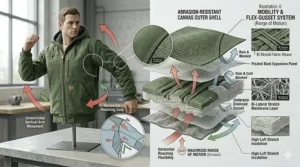
Here’s where Carhartt gets interesting. The Super Dux line ditches the classic duck canvas and goes with an 8.1-oz 97% nylon / 3% spandex blend — and that 3% changes everything. The spandex component means the fabric actually moves with you. Reach overhead, twist, crouch: the jacket follows instead of fighting.
Wind Fighter® technology is woven into the shell structure (not just a coating), which is meaningfully better at blocking gusting wind than a simple DWR treatment on fabric that otherwise lets air pass freely. Pair that with Rain Defender® DWR and 100g 3M™ Thinsulate™ insulation in body, hood, and arms, and you’ve got a jacket that’s legitimately capable of handling cold, wind, and light precipitation simultaneously.
What most buyers overlook about this model is the adjustable drop-tail hem. In cold-weather work, your lower back is a major heat loss point — especially when bending or lifting. The cinchable hem lets you seal that gap. Small detail, real-world difference.
The Super Dux is the pick for mobile tradespeople. Electricians, plumbers, HVAC technicians — anyone who transitions between crawl spaces, ladders, and outdoor environments throughout the day will appreciate the flex. It’s also a strong choice if you run warm and want insulation without feeling trapped.
Customers love the mobility, with many noting it’s the first work jacket they’ve worn that doesn’t restrict their range of motion on a ladder.
✅ Rugged Flex® stretch fabric — best mobility in this roundup
✅ Wind Fighter® + Rain Defender® dual protection
✅ Adjustable drop-tail hem seals lower back
❌ Less warm than heavier duck options below 10°F
❌ Nylon shell less abrasion-resistant than canvas in rough conditions
Priced in the $120–$150 range.
4. Carhartt Men’s Yukon Extremes Loose Fit Insulated Active Jac (Model 104458)
When you need serious protection and you’re not interested in compromises, this is the answer. The Yukon Extremes line sits at Level 4 in Carhartt’s warmth rating system — Extreme Warmth — and the jacket earns that classification.
The shell is 500-denier Cordura® nylon — the same material used in military gear and expedition packs. It’s tear-resistant, abrasion-resistant, and when treated with Rain Defender® and Wind Fighter® technology, it forms a legitimate barrier against the elements. Inside: 150g 3M™ Thinsulate™ featherless insulation throughout the hood, body, and arms. Compare that to the Super Dux’s 100g fill, and you understand why this jacket is rated for conditions where the Dux would start to lose ground.
The reflective 3M™ Scotchlite™ Carbon Black taping on the center back yoke and front pockets is a thoughtful addition for anyone working in low-light conditions — construction sites at dawn or dusk, roadside utility work, pre-sunrise farm tasks.
Per OSHA’s cold stress guidelines (osha.gov/cold-stress), workers exposed to temperatures below 40°F for extended periods face real risks of frostbite and hypothermia. The Yukon Extremes is one of the few work jackets in this price category that takes that risk seriously. One HVAC reviewer working rooftop installations in Dallas winters called it “a monster against the wind” — needing only one base layer underneath in sub-freezing conditions.
✅ 150g Thinsulate™ — warmest pick in this review
✅ 500-Denier Cordura® shell — exceptional durability
✅ Reflective taping for low-light visibility
❌ Stiff shell — noticeable sound when moving
❌ Not the pick if you run hot or work indoors frequently
In the $150–$190 range — the most you’ll spend here, and worth every dollar if you need it.
5. RefrigiWear Iron-Tuff Jackoat Insulated Work Jacket
Most jackets in this review are built for cold. The RefrigiWear Iron-Tuff Jackoat is built for brutal. With a comfort rating down to -50°F (-45.5°C), this jacket exists in a different category entirely — one occupied by food processing workers, freezer warehouse staff, cold storage logistics teams, and anyone whose job description includes the phrase “walk-in.”
The shell is a tough nylon oxford. Inside: 11.25-ounce RefrigiFill™ polyester insulation — RefrigiWear’s proprietary blend, perfected over 65+ years of building extreme-cold workwear. The insulation is engineered to trap warm air in even the most severe convective cooling environments. A soft fleece collar, bound seams that physically seal out drafts, elastic back band, and knit cuffs work together as a system — not just individual features.
The Jackoat’s extended length deserves mention. It covers the lower torso more completely than most hip-length work jackets, which is exactly what you need in environments where cold radiates from the floor. Per the CDC’s NIOSH cold stress guidelines (cdc.gov/niosh/topics/coldstress), prolonged exposure to freezing temperatures without proper insulation is a serious occupational hazard — and the Jackoat is specifically engineered to address that risk.
If you don’t work in sub-zero environments, this is overkill. But if you do, nothing else on this list comes close.
Buyers working in meat processing plants and cold distribution centers consistently rate this as the only jacket that keeps them genuinely comfortable through a full shift.
✅ -50°F comfort rating — extreme cold specialist
✅ Extended length for full torso coverage
✅ Proven over 65+ years of cold-storage use
❌ Too warm for mild conditions — you’ll overheat quickly
❌ Bulkier than standard work jackets
In the $100–$140 range — remarkable value for what it delivers.
6. Berne Men’s Heritage Duck Hooded Active Work Jacket
Berne has been dressing hard workers since 1915. The Heritage Duck Hooded Active Work Jacket carries that legacy in a package that won’t gut your wallet — and it does it without cutting corners that actually matter.
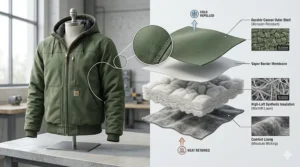
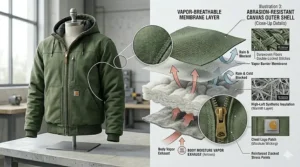
The shell is traditional duck canvas — tough, abrasion-resistant, and proven on jobsites across every industry. A water-repellent finish handles morning dew and light precipitation. The three-piece insulated hood with drawstring is a feature you’ll genuinely appreciate on windy days — a single-piece hood just flops around; a three-piece hood conforms and seals. Knit storm cuffs and a knit waistband close the gaps at wrists and hem.
Pleated elbows and an action back are the details that separate this jacket from cheaper duck alternatives. They don’t just talk about mobility — they engineer it in. Combine that with triple-needle stitched main seams and a heavy-duty brass front zipper, and this is a jacket built to survive real work.
This is the best pick for budget-conscious buyers who need reliable cold weather job protection without compromising on durability. It’s also a strong choice for workers who need a versatile jacket across a range of temperatures — the insulation level sits comfortably in the “cool to cold” range rather than the extreme end.
The Heritage Duck sells at a rate that reflects real-world satisfaction — 900+ units bought monthly on Amazon speaks for itself.
✅ Outstanding value for a duck canvas jacket
✅ Three-piece insulated hood — better cold sealing than single-piece
✅ Action back + pleated elbows for mobility
❌ Less warmth than Carhartt or RefrigiWear at extreme temps
❌ Limited color options
Priced in the $70–$100 range — the best budget pick in this roundup.
7. Timberland PRO Men’s Baluster Work Jacket
The Baluster is what Timberland PRO built for workers who need insulation that’s smart about where it puts the warmth. The body and back panels use 100-gram insulation; the arms step down to 80-gram. That differential isn’t arbitrary — your arms move constantly and generate heat; your core doesn’t, and needs more thermal protection.
The result is a jacket that stays warm where warmth matters while avoiding the sausage-casing feel of a uniformly over-insulated shell. The Baluster also excels on the storage front: two zip chest pockets, two lower front pockets, and an inside chest pocket with hook-and-loop closure. For a project manager or crew lead carrying a phone, tablet, inspection sheets, and a tape measure, this level of pocket organization is genuinely useful.
The nylon shell holds its shape well and resists surface abrasion in typical construction environments. While it won’t withstand the kind of punishment a Cordura® shell does, it’s more than adequate for worksites where you’re supervising or doing moderate physical tasks.
What most buyers overlook about this model is how clean it looks when you step into a site trailer or an owner meeting. The Baluster doesn’t scream “work jacket” the way heavier canvas options do — a subtle advantage for tradespeople who interface with clients regularly.
Buyers consistently praise the fit and the warmth distribution, noting it feels balanced rather than bulky.
✅ Smart warmth zoning — heavier in core, lighter in arms
✅ Excellent pocket organization for field use
✅ Professional appearance suitable for client-facing roles
❌ Less durable than canvas in high-abrasion applications
❌ Not built for extreme cold below 10°F
In the $110–$140 range — a strong mid-range choice
✨ Don’t Miss These Exclusive Deals!
🔍 Take your cold weather protection to the next level with these carefully selected work jackets. Click any highlighted product name to check current pricing and availability on Amazon. These are the tools that’ll keep you warm, safe, and productive through the coldest months on the job!
Problem → Solution: Why Your Current Work Jacket Is Failing You
Before you buy, it helps to diagnose exactly where your current cold weather job protection is breaking down. Here are the five most common problems — and what to look for in a solution.
Problem 1: You’re cold within 30 minutes of being outside. The spec sheet says “insulated.” Your body disagrees. This usually means the jacket’s insulation is either too low-fill or not being sealed properly at cuffs, hem, and collar. Solution: Look for rib-knit storm cuffs, an adjustable hem, and a cinchable collar — not just a main-body insulation rating.
Problem 2: You sweat, then freeze. Active workers who generate heat during tasks often overheat in heavy insulation, sweat through a mid-layer, then feel frigid the moment they stop. The fix isn’t less insulation — it’s moisture-friendly insulation like 3M™ Thinsulate™, which retains warmth when damp, unlike down-filled options.
Problem 3: The wind cuts right through. A water-resistant jacket that doesn’t block wind is only half-useful in winter conditions. According to research on thermal comfort published by the National Institute for Occupational Safety and Health, wind dramatically accelerates heat loss from the body. Look for Wind Fighter® technology or tightly woven shell fabrics — the Yukon Extremes’ 500-denier Cordura® and the Super Dux’s Wind Fighter® weave both address this directly.
Problem 4: You can’t reach or bend properly. A work jacket that restricts your range of motion isn’t just annoying — it’s a safety risk on an active site. Pleated elbows, action backs, and stretch-blend shells (like the Super Dux’s nylon-spandex construction) are what separate real work jackets from repurposed outdoor gear.
Problem 5: Your jacket wore out in one season. Budget jackets often use single-stitched seams and lighter-weight shells that fray, tear, and separate under real worksite conditions. Triple-stitched seams and reinforced stress points — standard on Carhartt and Berne — are non-negotiable if you want a jacket to outlast your job contract.
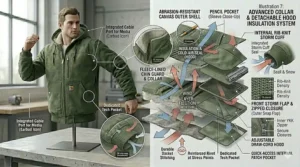
Real-World Scenario: Which Jacket Fits Your Work Life?
Specs are specs. Let’s match actual worker profiles to the right pick.
Profile 1: The Outdoor Construction Worker, Sub-20°F mornings Marcus works concrete forming in Minnesota. He’s outside from 6 a.m. until mid-afternoon, moderate activity, with stretches of standing and waiting. He needs serious warmth but can’t afford to be soaked in sweat by 10 a.m. Best pick: Carhartt Yukon Extremes (104458). The 150g Thinsulate™ handles the cold; Wind Fighter® and Rain Defender® cover precipitation; the Cordura® shell handles the job site abuse. The price is justified by how long it’ll last.
Profile 2: The Cold Storage Warehouse Worker James runs a forklift in a distribution freezer. His environment sits between 0°F and 10°F for his entire 8-hour shift. Standard work jackets fail here. There’s only one real answer: RefrigiWear Iron-Tuff Jackoat. The -50°F comfort rating gives James real thermal margin, and the extended jacket length covers the lower torso that most jackets ignore. After one shift in this jacket, you don’t go back.
Profile 3: The Mobile Tradesperson, Variable Conditions Danny is an electrician who works indoors and outdoors throughout the day — crawl spaces, attics, rooftops. He needs mobility more than maximum warmth, and he generates enough body heat when working that a heavy insulated jacket becomes uncomfortable. Best pick: Carhartt Super Dux (105533). The Rugged Flex® stretch fabric moves with him; the insulation is adequate for outdoor exposure without cooking him in enclosed spaces.
Profile 4: The Budget-Conscious General Worker Tony does property maintenance — some outdoor time, some indoor time, temps ranging from 20°F to 45°F through his workday. He doesn’t need extreme warmth and doesn’t want to spend $150+. Best pick: Berne Heritage Duck Hooded Active Work Jacket. Durable canvas, solid insulation for his temperature range, and priced right.
How to Choose an Insulated Work Jacket for Men: 6 Criteria That Actually Matter
1. Match insulation to temperature range — not just “warmth.” 80g fill = comfortable in the 20–40°F range for moderate activity. 100g works down to around 10–20°F. 150g and above handles below 10°F or extended static exposure. The RefrigiWear’s proprietary fills operate in a category entirely their own. Don’t over-buy or under-buy.
2. Shell material determines longevity. Duck canvas (12 oz.) wins for abrasion resistance and long-term durability on rough sites. Nylon shells (like 500-denier Cordura®) offer better water and wind performance with slightly less abrasion protection. Poly shells are lighter but shorter-lived in demanding conditions.
3. Wind resistance isn’t the same as water resistance. These are two separate properties. A DWR coating helps with rain. A wind-blocking shell weave or Wind Fighter® construction addresses cold penetration from wind. You need both for winter outdoor work cold weather job protection — not just one.
4. Mobility features: look past the fit description. “Relaxed fit” doesn’t mean the jacket moves with you. Look for specific design features: pleated elbows, bi-swing backs, gussets, or stretch-blend fabrics. These translate to real mobility gains that a general cut description doesn’t capture.
5. Seam construction predicts lifespan. Single-stitched seams separate under stress. Triple-stitched main seams last. On heavy-use work jackets, this distinction determines whether you’re buying one jacket or three over the same period.
6. Closure systems determine heat retention. Rib-knit cuffs and waistbands outperform Velcro in cold weather — they seal more completely and don’t degrade. Adjustable hoods with cinch cords keep your head warm in wind. Storm flaps over zippers prevent cold air from cutting through the zipper channel.
For more on workplace thermal hazards, OSHA’s official Cold Stress guidance page provides detailed recommendations on appropriate protective clothing for various temperature and wind chill combinations.
Common Mistakes When Buying a Work Jacket for Cold Weather
Mistake 1: Choosing by price tag alone. The cheapest thermal work jacket in the category rarely survives a full winter of hard use. A $65 jacket that lasts one season costs more per year than a $140 jacket that lasts five. Do the math before you reach for the budget shelf.
Mistake 2: Ignoring insulation type. Standard polyester fill and 3M™ Thinsulate™ are not the same thing. Thinsulate uses finer fibers to trap more air per gram of material, meaning you get the same warmth at half the bulk. According to 3M’s insulation technology research, this matters particularly for active work where jacket mobility is critical. Don’t treat insulation as a single-variable spec.
Mistake 3: Buying for looks over function. A work jacket that photographs well and performs poorly will frustrate you every morning. Pay attention to cuff design, hem adjustability, and hood construction — the unglamorous details that determine whether the jacket actually seals out cold.
Mistake 4: Ignoring layering compatibility. Some jackets are cut too slim to accommodate a quality base layer and mid-layer underneath. If your jacket doesn’t fit over a fleece, you’ll be under-dressed on the coldest days. Loose or relaxed fit labels are your friend here — check the actual cut before buying.
Mistake 5: Assuming “waterproof” and “water-resistant” are synonymous. DWR-treated duck work jackets resist light moisture. Full waterproof construction (sealed seams, waterproof membranes) is a different product category. If you’re regularly working in rain, that distinction is critical. For thermal protection in dry-but-cold conditions, DWR is usually sufficient.
Features That Actually Matter (And Those That Don’t)
Features that genuinely improve your day:
- Rib-knit storm cuffs that seal at the wrist ✅
- Three-piece insulated hoods (conform and seal) vs. single-piece hoods (flap and gap) ✅
- Adjustable hem drawcords (seal lower back in wind) ✅
- Wind-blocking shell construction, not just DWR ✅
- Triple-stitched seams at stress points ✅
- Reflective taping for low-light site visibility ✅
Features that sound good but rarely change anything on a worksite:
- “Packability” for a primary work jacket — you’re not backpacking; you’re going to work
- Excessive brand embroidery on functional surfaces
- “Breathable” ratings without actual material specs — requires scrutiny
- Removable hoods on jackets that aren’t layering systems (you’ll never remove it in winter)
According to the Wikipedia overview of thermal insulation principles, effective cold-weather protection relies on trapping still air between insulating layers — which is why cuff and hem sealing is as important as fill weight. The jacket that’s “warmest” on a spec sheet is sometimes cooler in practice because it doesn’t seal properly at the edges.
Long-Term Cost & Maintenance: The Real Investment Math
People underestimate how much workwear costs over time when they buy cheap.
The actual math: A $70 jacket that lasts 1–2 winters = $35–$70 per season. A $150 jacket that lasts 5–7 winters = $21–$30 per season. The premium option is often the budget option in disguise.
What makes a work jacket last:
- Shell material: 12-oz duck canvas > light polyester shell, every time
- Seam construction: triple-stitched > double-stitched > single-stitched
- Zipper quality: brass zippers (Berne, Carhartt, RefrigiWear) outlast plastic alternatives by years
- Hardware: reinforced stress points at pocket corners and cuff transitions
Maintenance tips that actually extend jacket life: Machine wash cold, gentle cycle, mild detergent — applicable to most duck and nylon shells. Never use bleach on DWR-treated fabrics; it destroys the water-repellent coating. Tumble dry low. To reactivate a DWR coating that’s lost effectiveness, a low-heat tumble cycle (or a quick hit with an iron on low through a cloth) re-bonds the treatment to the fabric. This is worth doing every season.
Avoid storing insulated jackets compressed. Compression permanently degrades insulation loft over time — especially for fill-based products. Hang them loosely or store flat in a breathable bag.
A properly maintained Carhartt duck jacket can realistically last a decade in moderate hard-use conditions. That changes the value equation significantly.
✨ Don’t Miss These Exclusive Deals!
🔍 Ready to upgrade your cold-weather protection? Click any product name above to check current pricing and availability on Amazon. Don’t let another brutal morning catch you underdressed!
FAQ: Insulated Work Jacket Men — Your Questions Answered
❓ What is the warmest insulated work jacket for men on Amazon?
❓ Is a duck work jacket waterproof or just water-resistant?
❓ How much insulation do I need in a work jacket for cold weather?
❓ Can I wear an insulated work jacket as a mid-layer?
❓ How long should a quality insulated work jacket for men last?
Conclusion: The Right Jacket Changes How You Work
Cold is one of those variables you either manage or it manages you. The right insulated work jacket men choose isn’t just about staying comfortable — it’s about maintaining the focus and physical capacity to do your job properly when temperatures make everything harder.
If you take one thing from this guide, let it be this: match the jacket to the actual conditions of your workday, not the conditions of your worst-case scenario. The Yukon Extremes is a better jacket than the Super Dux for the right worker. Buying the most powerful tool for the job only helps when the job actually requires it.
For the majority of outdoor construction, general contracting, and farm/ranch work in US winters, the Carhartt J130 or the 106673 will cover you comprehensively. Step up to the Yukon Extremes or RefrigiWear if your conditions genuinely demand it. And if you’re watching your budget without wanting to sacrifice durability, the Berne Heritage Duck is a genuine steal.
Whatever you choose — look at the cuffs, the seams, the shell weight, and the insulation type. Those four details tell you more about a work jacket’s real-world performance than any marketing headline will.
✨ Don’t Miss These Exclusive Deals!
🔍 Click any product link above to check the current Amazon price and availability. Prices and stock can change — don’t wait until the cold hits to find out your size is gone!
Recommended for You
- 7 Best Construction Work Jackets in 2026
- Best Reflective Safety Jacket for Night Work in 2026 (Top 7 Picks)
- 7 Best 360 Degree Reflective Jackets in 2026: Stay Seen, Stay Safe
Disclaimer: This article contains affiliate links. As an Amazon Associate, I earn from qualifying purchases. If you purchase products through these links, we may earn a small commission at no additional cost to you.
✨ Found this helpful? Share it with your friends! 💬🤗
