
In This Article
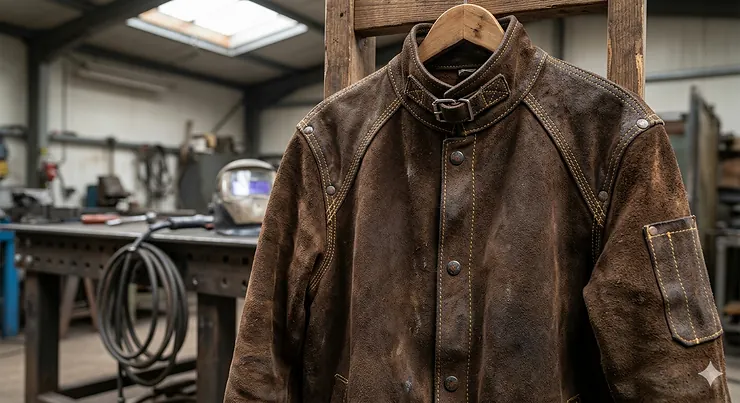
Walk into any welding supply shop on a Saturday morning and you’ll hear the same argument playing out at the counter. One guy swears by leather — thick, stiff, indestructible. The next swears it’ll cook you alive by lunch and reaches for cotton instead. Both of them are right, which is exactly the problem.
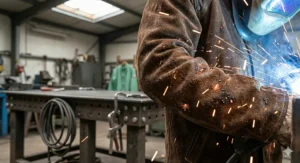
The leather welding jacket vs FR cotton debate isn’t really a debate at all once you separate it from brand loyalty. It’s a question about heat, sparks, and how your body handles eight hours under a hood. Leather shrugs off molten spatter and lasts for years; flame-resistant cotton breathes, moves, and won’t leave you drenched in July. Neither one is “better” in a vacuum — they’re built for different fights.
This guide breaks down both materials in plain terms, walks through seven real jackets currently sold on Amazon spanning budget to premium, and gives you a framework for matching the coat to the way you actually weld. No marketing fluff, no inflated claims — just what the materials do and who should be wearing which one.
Quick Comparison: Leather vs FR Cotton vs Hybrid
| Material Type | Protection Level | Breathability | Weight | Best For |
|---|---|---|---|---|
| Full Leather (cowhide/boarhide) | Highest — stops spatter, slag, prolonged sparks | Low | Heavy (3–4 lbs+) | High-amp stick/MIG, overhead, out-of-position work |
| FR Cotton (9 oz treated) | Moderate — self-extinguishes, light spark resistance | High | Light (1–1.5 lbs) | TIG, low-amp work, hot environments, hobbyists |
| Hybrid (leather sleeves + cotton body) | High on arms, moderate on torso | Medium | Medium (2–2.5 lbs) | MIG/stick welders who move a lot and want balance |
Look at the table and the pattern is obvious: leather wins on raw protection, cotton wins on comfort, and hybrids exist because most welders don’t actually want to choose. If you’re doing short TIG runs in a stuffy garage, a 9 oz FR cotton jacket will save you from a heat-exhaustion headache that no amount of leather toughness makes up for. If you’re laying down stick beads overhead with slag raining down, that same cotton jacket turns into confetti within a season.
✨ Already know your welding style? Jump straight to the seven jackets below — each one is matched to a specific use case so you’re not guessing.
💬 Just one click — help others make better buying decisions too!😊
The 7 Best Welding Jackets Worth Buying Right Now
We pulled this list from currently listed Amazon products across three categories — straight FR cotton, straight leather, and hybrid builds — so you can compare apples to apples instead of getting steered toward whatever’s cheapest.
1.Lincoln Electric Traditional FR Cloth Welding Jacket (K2985)
Lincoln Electric Traditional FR Cloth Welding Jacket is the jacket most people picture when they imagine a basic welding coat, and for good reason. It’s built from 9 oz. flame-retardant cotton rated for a 25–300 amp range, which in practice means it’s happiest at the lower end of that window — TIG work, light MIG, the kind of welding where sparks are more of a nuisance than a threat. The inside pocket and snap cuffs are nothing fancy, but they do the job, and the fact that it’s machine washable while still retaining flame-retardant properties for around 100 home washes means you’re not babying it like a leather coat.
What most buyers overlook here is that “machine washable” doesn’t mean “indestructible.” Owners who weld twice a week report small char holes appearing in the chest and sleeve area after a couple of years — not a defect, just what 9 oz. cotton does when sparks land on it repeatedly. For occasional use, that timeline stretches out considerably.
This Lincoln K2985 suits hobbyists, students in welding programs, and anyone doing light-duty fabrication who values breathability over bulletproof protection.
✅ Lightweight and breathable for long sessions
✅ Machine washable without losing FR rating
✅ Budget-friendly entry point into FR gear
❌ Not rated for heavy stick or high-spatter work
❌ Cotton thins out faster under daily heavy use
Price range: around $60–$80 | Verdict: The default FR cotton choice, and a smart one if your welding stays light-duty.
2. Black Stallion FN9-30C FR Cotton Welding Jacket
Black Stallion FN9-30C comes from Revco, a brand that’s been making welding gear long enough to know where cotton jackets actually fail — at the snaps and the collar gap. So they reinforced both. The leather-backed snap closures resist the early wear that kills cheaper cotton jackets, and the raised welder’s collar closes the gap between helmet and jacket where sparks love to sneak in.
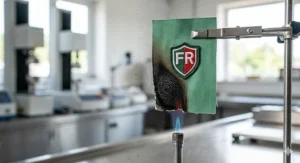
The 9 oz. flame-resistant cotton itself behaves exactly like you’d expect: it self-extinguishes rather than continuing to burn, and the listing is refreshingly honest that this is light-duty gear, not a stick-welding workhorse. The scribe pocket is a small touch that matters more than it sounds — soapstone and welding pencils have a way of disappearing into a regular pocket.
This jacket fits the welder doing intermittent shop work who wants a step up in stress-point durability without paying leather prices.
✅ Leather-reinforced snaps outlast standard cotton snaps
✅ Dedicated scribe pocket for marking tools
✅ Multiple color options for shop visibility
❌ Still light-duty — not built for heavy spatter
❌ No sleeve or chest reinforcement beyond the cotton itself
Price range: around $45–$65 | Verdict: A smarter budget pick than generic cotton jackets, mainly because of where the reinforcement is placed.
3. QeeLink Split Cowhide Leather Welding Jacket
QeeLink Split Cowhide Leather Welding Jacket is proof that full leather protection doesn’t have to come with a full leather price tag. It’s stitched with heat-resistant Kevlar thread rather than standard thread, which matters more than it sounds — Kevlar doesn’t melt the way cotton or polyester thread can under direct heat, so seams hold even when the surrounding leather is taking a beating. Corrosion-resistant rivets at the stress points are another detail budget jackets usually skip.
Four pockets, including two soapstone pockets on the sleeves, plus adjustable neck, cuffs, and waist make this more functional than its price suggests. The tradeoff is split cowhide rather than full-grain or premium boarhide — it’s tougher than cotton by a wide margin, but it won’t have the same buttery break-in feel as the pricier leathers further down this list.
Best suited to someone buying their first full leather jacket who wants real protection without committing to a premium brand.
✅ Real leather protection at a fraction of premium pricing
✅ Kevlar-sewn seams resist heat-related failure
✅ Adjustable fit across neck, cuffs, and waist
❌ Split leather feels stiffer than premium grades initially
❌ Sizing reports vary more than name-brand options
Price range: around $75–$105 | Verdict: The most sensible entry point if you’ve decided leather is worth the investment.
4. Lincoln Electric Shadow Split Leather Sleeved Welding Jacket (K2986)
Lincoln Electric Shadow Split Leather Sleeved Welding Jacket solves a problem leather and cotton jackets each create on their own. Your sleeves take the worst abuse in MIG and stick welding — that’s where you’re closest to spatter and where abrasion from handling metal wears fabric thin. So Lincoln put split cowhide there, and kept the torso in breathable ASTM D6413-compliant 9 oz. FR cotton. The result is a jacket that protects where it counts and breathes where it doesn’t matter as much.
The spatter guard button liner is a clever bit of engineering most jackets skip entirely — a three-layer fabric-and-Velcro design behind the snap column that stops sparks from finding their way through the front closure gap. One thing to flag: multiple owners note this jacket runs small, so sizing up is the safer bet.
This hybrid is built for welders doing MIG and stick work who move through awkward positions all day and don’t want a full leather coat weighing them down.
✅ Leather sleeves where abrasion and spatter hit hardest
✅ Breathable FR cotton torso reduces heat buildup
✅ Spatter guard lining adds front-closure protection
❌ Runs small — most buyers need to size up
❌ Leather sleeves require spot cleaning, not full machine wash
Price range: around $90–$125 | Verdict: The clearest argument for hybrid construction on this whole list.
5. Black Stallion Hybrid Cotton & Cowhide Welding Jacket (FRB9-30C/BS)
Black Stallion Hybrid Cotton & Cowhide Welding Jacket takes the same leather-sleeves-plus-cotton-body formula and adds Revco’s signature build details: a stand-up welder’s collar and dual scribe pockets instead of just one. The 9 oz. FR cotton body keeps weight down compared to a full leather coat, while cowhide sleeves handle the brunt of spark exposure during stick and MIG work.
What separates this from a budget hybrid is consistency. Revco/Black Stallion has been making FR cotton and leather welding gear for decades, and it shows in details like reinforced stitching at pocket edges and a collar that actually stays up instead of flopping.
Shop welders who split their time between TIG and stick welding — and don’t want to own two separate jackets — are the obvious audience here.
✅ Dual scribe pockets for marking tools
✅ Established brand reliability in build quality
✅ Balanced weight between leather and cotton zones
❌ Costs more than straight cotton alternatives
❌ Fewer color options than the brand’s all-cotton line
Price range: around $115–$150 | Verdict: A premium hybrid for welders who want Revco’s reputation backing the build.
6. Lincoln Electric Heavy Duty Leather Welding Jacket (K2989)
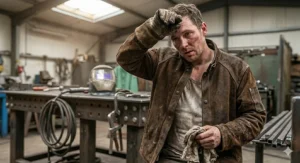
Lincoln Electric Heavy Duty Leather Welding Jacket is the jacket you reach for when there’s no margin for “mostly protected.” Side-split cowhide leather covers the entire jacket, front and back, built specifically with high-amperage and out-of-position welding in mind — the stuff where slag falls from above and sparks land somewhere other than directly in front of you.
The tradeoff for that coverage is exactly what you’d expect: weight and heat retention. This isn’t a jacket for a hot shop in August unless you’ve got serious ventilation. But for production welders doing overhead and out-of-position work daily, that’s a fair exchange for not getting burned through a thinner jacket.
Best for daily-use professionals doing high-amp stick or MIG welding where spatter direction is unpredictable.
✅ Full leather coverage front and back
✅ Built specifically for high-amp and overhead welding
✅ Trusted name-brand construction
❌ Heavier and hotter than hybrid or cotton options
❌ Can’t be machine washed — needs leather-specific care
Price range: around $130–$165 | Verdict: If your work demands full leather, this is the no-compromise pick.
7. Caiman Gold Boarhide Welding Coat (3030-6)
Caiman Gold Boarhide Welding Coat is the jacket for welders who want full leather protection but refuse to feel like they’re wearing a sauna to get it. Boarhide — pigskin leather — runs 10–15% lighter than cowhide while offering comparable or better cut and heat resistance, thanks to its naturally tighter fiber structure. Caiman backs that up with a vented back and underarms, satin-lined shoulders for easier arm movement, and a corduroy-lined collar that doesn’t chafe the way raw leather collars can.
Every seam is sewn with 100% Kevlar thread in a folded, double-stitched pattern, and reinforced stress points are riveted rather than just stitched. This is the detail-oriented leather jacket — every feature exists because someone identified a specific failure point in cheaper coats and engineered around it.
This one’s for the welder who’s already committed to full leather and is willing to pay for the version that doesn’t punish them for it.
✅ 10–15% lighter than standard cowhide leather
✅ Vented back and underarms reduce heat buildup
✅ Satin-lined shoulders improve mobility and comfort
❌ Highest price point on this list
❌ Pigskin grain texture isn’t to everyone’s taste
Price range: around $160–$200 | Verdict: The premium pick for welders who weld all day and want leather that doesn’t feel like a punishment.
Top 7 Spec & Price Comparison
| Jacket | Material | Price Range | Best For |
|---|---|---|---|
| Lincoln K2985 | 9 oz FR Cotton | $60–$80 | Light TIG/MIG, hobbyists |
| Black Stallion FN9-30C | 9 oz FR Cotton | $45–$65 | Budget intermittent use |
| QeeLink Split Cowhide | Leather | $75–$105 | First leather jacket, budget |
| Lincoln K2986 Shadow | Hybrid | $90–$125 | MIG/stick, mixed positions |
| Black Stallion FRB9-30C/BS | Hybrid | $115–$150 | TIG + stick combo work |
| Lincoln K2989 | Full Leather | $130–$165 | High-amp, overhead, daily pros |
| Caiman 3030-6 Boarhide | Premium Leather | $160–$200 | All-day pro welding, max comfort |
Line these seven up and the pricing tells its own story — you’re paying almost entirely for material coverage, not gimmicks. The two cotton jackets cluster under $80, hybrids land in the $90–$150 middle ground, and full leather starts climbing once you’re past $130. Notice that the jump from QeeLink’s budget leather to Caiman’s premium boarhide isn’t really about whether you’re protected; it’s about whether you’re comfortable while you’re protected.
✨ Found the jacket that fits your work? Check current availability and pricing before you decide — stock and pricing shift often on safety gear like this.
Real-World Scenarios: Which Welder Are You?
The weekend hobbyist. You’re doing light TIG work in a home garage a few hours a week, mostly on small projects. Heat exhaustion is a bigger risk to you than getting hit by molten slag. The Lincoln K2985 or Black Stallion FN9-30C covers you without making summer welding miserable.
The student or apprentice. You’re in a welding program doing a mix of processes, your budget is tight, and your jacket needs to survive being shoved in a bag between classes. The QeeLink Split Cowhide Leather Jacket gives you real protection to learn stick and MIG without the premium price of name-brand full leather.
The mobile fabricator. You’re climbing into awkward positions on job sites, doing MIG and stick work where your arms take the abuse but you still need to move freely. Either hybrid — the Lincoln K2986 or Black Stallion FRB9-30C/BS — solves this better than full leather or full cotton alone.
The production welder. You’re at a bench eight-plus hours a day doing high-amp stick or MIG, often out of position, and a thin jacket isn’t an option. The Lincoln K2989 or, if budget allows, the Caiman 3030-6 Boarhide, are built for exactly this grind.
Common Mistakes When Buying a Welding Jacket
The most expensive mistake is buying based on amperage rating alone and ignoring how you actually weld. A jacket rated for 300 amps doesn’t help if you’re doing overhead work and sparks are landing on your shoulders instead of your chest — coverage pattern matters as much as material thickness.
The second mistake is skipping sizing notes. Several leather and hybrid jackets — the Lincoln K2986 included — run noticeably small, and a tight welding jacket restricts the exact arm movement you need for clean bead control. Buy looser than you think you need to.
The third is underestimating leather welding jacket durability claims from no-name brands. Split cowhide and full-grain cowhide are not interchangeable terms, and “heavy duty” on a listing doesn’t always mean Kevlar-stitched seams or reinforced rivets — check the actual construction details, not just the headline.
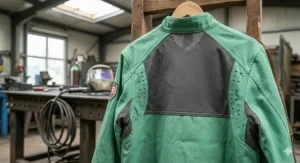
How to Choose Between Leather and FR Cotton
- Identify your dominant welding process. TIG and light MIG generate less spatter, favoring cotton; stick and high-amp MIG favor leather.
- Assess your environment’s heat. A poorly ventilated shop in summer makes leather’s lower breathability a real liability, not just a discomfort.
- Map your typical body position. Out-of-position and overhead work sends sparks somewhere other than straight ahead — full coverage leather earns its keep here.
- Calculate your actual welding hours. Occasional hobbyists rarely need the durability premium that justifies leather’s price and weight.
- Decide if a hybrid splits the difference. If your arms take more abuse than your torso, leather sleeves with a cotton body solves more problems than it creates.
- Check the protection level analysis on the listing. Reputable brands state plainly whether a jacket is “light-duty” or rated for higher amperage — trust that over marketing language.
- Budget for replacement, not just purchase. Cotton wears out faster but costs less per replacement; leather costs more upfront but stretches that cost over years.
Leather vs FR Cotton: The Material Showdown
This is the heart of the material comparison welding shoppers actually need. Leather, specifically cowhide or boarhide, resists penetration from molten spatter almost entirely — sparks bounce or burn out on the surface rather than soaking through, which is why it’s still standard in shipyards and heavy fabrication. FR cotton works on a different principle: it’s not impenetrable, it’s self-extinguishing. A spark can land, char a small spot, and the fire stops there instead of spreading — useful for lighter work, insufficient for sustained heavy spatter exposure.
The honest tradeoff is comfort versus coverage. Leather traps heat against the body, and in a hot shop that becomes its own hazard through fatigue and dehydration. Cotton breathes, but it offers a fraction of the abrasion resistance, meaning it wears through faster under identical conditions. Neither material is objectively superior — they’re solving different problems, and the right choice depends entirely on what your welding actually exposes you to.
Hybrid Jackets: Best of Both Worlds?
Hybrid construction exists because most welders’ bodies don’t experience uniform risk. Your forearms and chest take direct exposure during MIG and stick welding; your back and underarms mostly don’t. Putting leather where the real risk concentrates and cotton everywhere else isn’t a compromise — for a lot of welders, it’s actually the more rational design than committing fully to either material.
The catch is care complexity. A hybrid jacket can’t be thrown in the wash the way a pure cotton jacket can, since the leather portions need spot cleaning or leather-specific treatment. If low-maintenance simplicity matters more to you than optimized protection zones, that’s worth weighing against the performance benefits.
What to Expect: Real-World Performance
On paper, specs look similar across brands. In practice, the differences show up within the first few welding sessions. Full leather jackets feel stiff for the first several wears before the leather breaks in and starts moving with your arms instead of against them — boarhide breaks in faster than cowhide due to its finer fiber structure. FR cotton jackets feel comfortable immediately but show their first small burn marks within weeks of regular use, which is normal wear, not a failure.
Heat buildup is the most underestimated factor. A full leather jacket in a non-ventilated shop during summer can genuinely impact welding quality, because fatigue and overheating affect hand steadiness over a long shift. This is the practical reason vented designs like the Caiman boarhide command a premium — the venting isn’t cosmetic.
Features That Actually Matter (And Ones That Don’t)
What matters: Kevlar-stitched seams, leather-reinforced snaps, a proper stand-up welder’s collar, and pocket placement that doesn’t interfere with arm movement. These directly affect how long the jacket survives and how safe the gaps in coverage actually are.
What doesn’t matter as much: Color, beyond visibility preferences in a shared shop, and marketing terms like “premium” or “professional-grade” without backing specs. A jacket described as a premium leather welding jacket should specify leather type, stitching material, and reinforcement points — if it doesn’t, treat the word “premium” as decoration, not a spec.
Welding Jackets for Beginners vs Pros
Beginners are usually better served prioritizing comfort and forgiving fit over maximum protection, since early welding sessions tend to be shorter and lower-amperage — the Lincoln K2985 or QeeLink leather jacket cover this stage well without overspending on capability you’re not using yet. Professionals welding daily at higher amperage should treat jacket durability as a cost-per-use calculation rather than a sticker price, where the Lincoln K2989 or Caiman Boarhide pay for themselves over a multi-year service life that a $50 cotton jacket simply can’t match under the same conditions.
Long-Term Cost & Maintenance
A $60 FR cotton jacket that needs replacing every 18–24 months under regular use costs roughly the same over five years as a $150 hybrid jacket that lasts the full stretch — the math isn’t as lopsided as the upfront price suggests. Leather’s advantage shows up most clearly for heavy daily users, where a $160–$200 jacket amortized over 5+ years often beats replacing cheaper cotton jackets three or four times in that span.
Maintenance differs sharply by material. FR cotton jackets handle regular machine washing, which keeps them from accumulating flammable oils or grease — important, since OSHA’s welding standard expects protective clothing to stay free of combustible buildup. Leather and hybrid jackets need spot cleaning and occasional conditioning to prevent cracking, with full machine washing generally avoided entirely.
Safety, Standards & OSHA Compliance
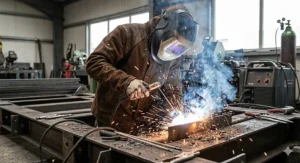
OSHA’s welding, cutting, and brazing standard requires that protective clothing match the size, nature, and location of the welding work being performed — it deliberately avoids mandating one specific material, leaving the protection level analysis up to the employer’s hazard assessment. Where flash fire or short-duration thermal exposure is a real risk, OSHA’s enforcement guidance expects flame-resistant clothing to be provided and worn.
For garments specifically marketed as flame-resistant, NFPA 2112 sets the design, testing, and certification benchmark most reputable FR cotton jackets are built to meet. Leather, notably, isn’t NFPA 2112 rated in the same way — it’s treated as inherently flame-resistant through material properties rather than chemical treatment, which is part of why the two materials get evaluated on different criteria entirely.
Frequently Asked Questions
❓ Is a leather welding jacket better than FR cotton for beginners?
❓ Can FR cotton welding jackets handle stick welding?
❓ How long does a leather welding jacket usually last?
❓ Do hybrid welding jackets meet NFPA 2112 standards?
❓ What's the difference between cowhide and boarhide welding jackets?
Conclusion
There’s no universal winner in the leather welding jacket vs FR cotton question, and anyone telling you otherwise is selling something. Leather earns its reputation through raw protection and durability — it costs more upfront and traps more heat, but for high-amp, out-of-position, or daily professional welding, that tradeoff makes sense. FR cotton earns its place through breathability and price, ideal for lighter work, hot environments, and welders who aren’t putting in eight-hour shifts under the hood. Hybrids exist for the very reasonable reason that most welders don’t fit neatly into either category.
Match the jacket to your actual welding — process, amperage, environment, and hours per week — rather than to whichever material has the louder fan base at the supply counter. Of the seven jackets above, the Lincoln K2986 Shadow hybrid is the single best starting point for most welders who do mixed MIG and stick work, while the Caiman Boarhide remains the standout if you’re welding full-time and comfort matters as much as protection.
✨ Ready to gear up? Compare current pricing and availability on the jackets above before stock or seasonal pricing shifts.
Recommended for You
- Best Split Leather Welding Jacket: 7 Top Picks for 2026
- 7 Best Work Jackets with Tool Pockets in 2026
- 7 Best Insulated Work Jacket Men in 2026 — Tested & Ranked
Disclaimer: This article contains affiliate links. As an Amazon Associate, I earn from qualifying purchases. If you purchase products through these links, we may earn a small commission at no additional cost to you.
Found this helpful? Share it with a fellow welder who’s still arguing about leather vs cotton at the supply counter.
